Social Cognitive Theory Teaching Strategies That Build Student Self Efficacy

Introduction: Why Passive Learning Fails and What SCT Offers
Have you ever sat through a lecture, taken notes, and then walked out of the room unable to explain what you just learned? You are not alone. Many students struggle to transfer knowledge from lectures to real world application. Traditional teaching methods often leave a gap between hearing information and actually using it. That gap is frustrating for learners and teachers alike.
Here is the thing. The problem is not your memory. The problem is how traditional instruction ignores the way people actually learn. Albert Bandura noticed this too. In 1986, he published Social Foundations of Thought and Action: A Social Cognitive Theory and changed how we think about learning for good. According to Bandura, learning happens through observation, modeling, and self-regulation. These three pieces work together to help people understand and apply new ideas.
What makes social cognitive theory so useful is that it treats learning as an active social process. You learn by watching others, trying what they do, and adjusting your own behavior based on what works.
This is very different from sitting quietly and trying to memorize facts. Bandura explained that cognitive, behavioral, and environmental factors all play a role in how we learn. A student’s confidence in their own ability matters just as much as the lesson plan.
For educators, this is powerful. When you understand social cognitive theory, you can design lessons that actually stick. You can help students move past common learning obstacles and build real skills.
This article will demystify social cognitive theory and give you actionable strategies to boost student engagement and achievement. We will look at practical teaching strategies, how to handle cognitive bias in the classroom, and even how these ideas connect to the IB diploma theory of knowledge curriculum.
If you want to learn more about how memory and learning work together, take a look at how technology supports modern education.
Let us begin with the first step: understanding what social cognitive theory really means and why it matters for your classroom this year. If you are ready to dig deeper, browse related articles on cognitive science and learning strategies.
1. Understanding Social Cognitive Theory: Core Concepts
Let’s start with the basics. Social cognitive theory (SCT) is a framework that explains how people learn by watching others and thinking about what they see. It’s not just about memorizing facts. It’s about observing, reflecting, and trying things out for yourself.
Albert Bandura introduced this idea in his 1986 book Social Foundations of Thought and Action: A Social Cognitive Theory[1]. He said learning depends on three things working together: your thoughts (cognitive), your actions (behavioral), and the world around you (environmental)[2]. That is called reciprocal determinism.
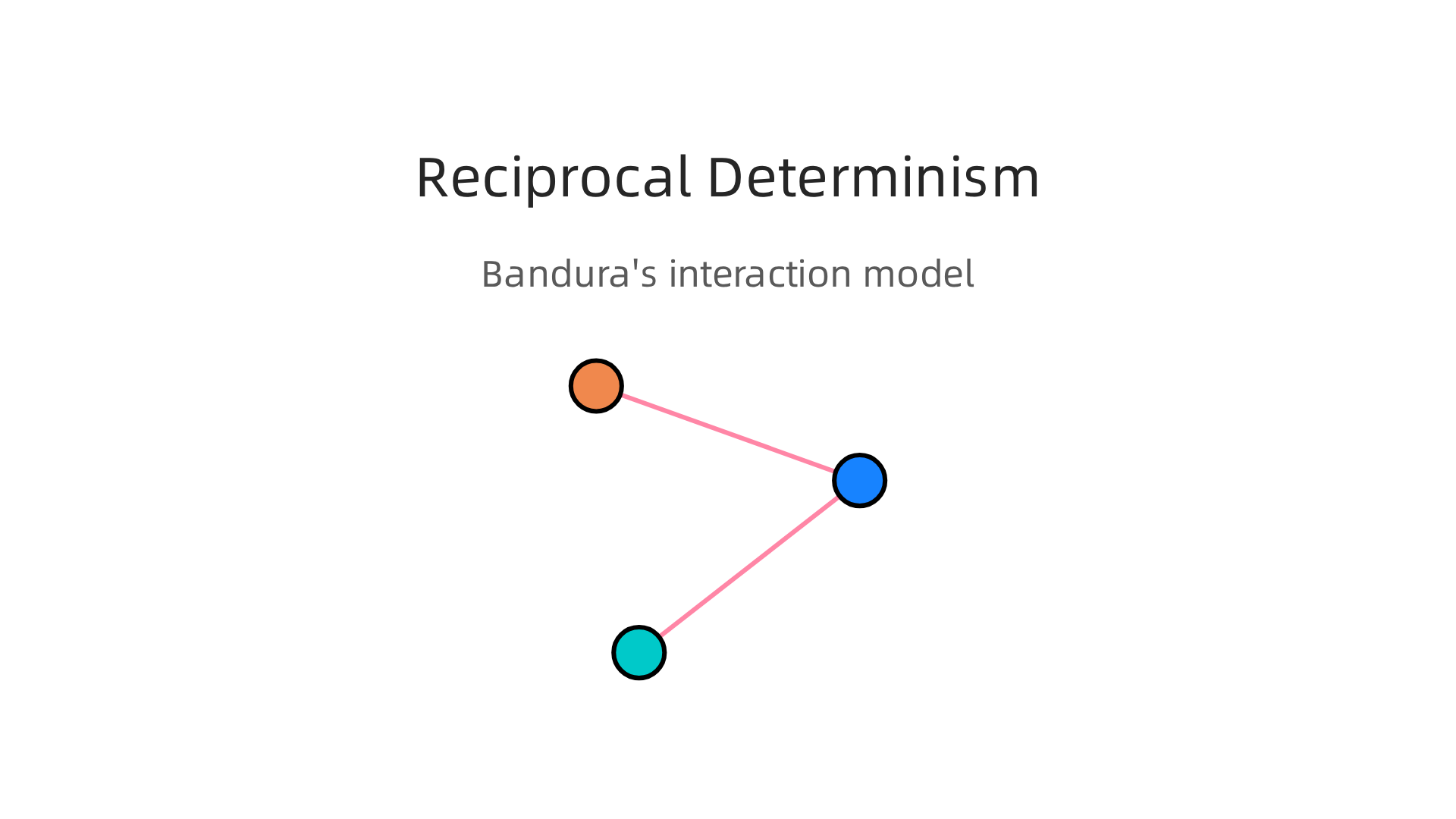
Each part affects the others. For example, a student who believes they can succeed (cognitive) will try harder (behavioral) and seek out helpful classmates (environmental). Then success makes their belief stronger. It’s a loop.
Four key constructs make SCT useful in the classroom:
- Observational learning – You learn by watching someone else do something, then copying it. Bandura’s famous Bobo doll experiment in 1961 proved this. Children who saw an adult hit a doll were more likely to hit it themselves[3].
- Self-efficacy – This is your belief that you can do a task. Bandura showed that people with high self-efficacy set bigger goals and stick with them[4]. A student who thinks “I can learn this” is more likely to try again after a mistake.
- Behavioral capability – To perform a new skill, you need to know what to do and how to do it. SCT says you learn that knowledge by watching and then practicing.
- Reciprocal determinism – As mentioned, your thoughts, actions, and environment all influence each other. Nothing happens in isolation.
These ideas matter because they turn learning into an active process. You don’t just absorb information. You watch, think, try, and adjust. That is why SCT works so well for real-world skills like problem solving or working in teams.
If you want to see how technology can support this kind of learning, take a look at how digital tools fit into the picture[internal link]. And for a deeper dive into how memory and practice work together, explore our articles on learning strategies[CTA].
Now that you understand the core concepts, let’s move to practical teaching strategies you can use tomorrow.
[1]: Albert Bandura, Social Foundations of Thought and Action: A Social Cognitive Theory (Prentice-Hall, 1986). See PDF overview: people.wku.edu/richard.miller/banduratheory.pdf
[2]: Social Cognitive Theory resource from Cornerstone: cornerstone.lib.mnsu.edu
[3]: Bandura’s Bobo doll study is a cornerstone of observational learning. Learn more in the full theory description: onlinelibrary.wiley.com
[4]: Bandura’s model of agency highlights self-efficacy’s role: pubmed.ncbi.nlm.nih.gov/11148297
1.1 The Bobo Doll Experiment: Evidence That Observation Matters
You already know that social cognitive theory says we learn by watching others. But where does that proof come from? The strongest evidence starts with Bandura’s Bobo doll experiment in 1961.
In the study, Bandura showed children a video of an adult acting aggressively toward an inflatable Bobo doll. The adult punched it, hit it with a hammer, and yelled at it. After watching, the children were taken to a room with the same doll. What happened next was striking. Most children copied the aggressive actions exactly. Some even used the hammer the same way. And they did this without any reward or encouragement from anyone.
This was a big deal. At that time, behaviorists believed learning only happened through direct reinforcement. You need a reward or a punishment to learn, they said. Bandura proved that was wrong. By simply watching, the children learned new behaviors. This became the foundation for observational learning in social cognitive theory.
Before Bandura, researchers like Miller and Dollard had already studied how people imitate others. But their approach still relied on reinforcement driving the behavior. Bandura’s experiment moved beyond that, showing that the observation itself was enough to learn.
Here is the key insight. The children did not just copy blindly. They thought about what they saw and decided when or how to imitate. That is why Bandura called his theory "social cognitive" not just "social." Your thinking matters as much as what you see.
Since that first experiment, modern researchers have repeated the study with different age groups, cultures, and behaviors. The results hold up. Observational learning is a universal human ability that works across many situations.
If you want to explore how these insights apply to classrooms today, check out our guide on the role of technology in education.
And for more articles about memory, learning strategies, and cognitive science, explore our blog to keep building your understanding.
2. Self-Efficacy: The Engine of Student Motivation
Now that you see how observation shapes learning, let’s talk about something just as powerful: your belief in your own ability to succeed. Bandura called this self-efficacy. And it might be the single biggest driver of student motivation.
Think about a student who says, "I’m just not good at math." That student will likely avoid math problems, give up quickly, and feel anxious. But a student who believes "I can figure this out if I try" will work harder, ask for help, and keep going when things get tough. That difference is self-efficacy in action. It’s not about actual skill. It’s about what you think you can do.
Bandura found that self-efficacy comes from four main sources. Let’s break them down.
1. Mastery experiences: This is the strongest source. When you succeed at something, your belief grows. That is why scaffolded challenges matter so much. Give a student a task that is just a little harder than what they already know. When they complete it, their confidence jumps. As of 2026, a growing number of school-based interventions focus on building these mastery experiences to boost academic self-efficacy among secondary students, according to a systematic review published in Frontiers in Education.
2. Vicarious experiences: Remember the Bobo doll experiment? Watching someone like you succeed can raise your own belief. If a classmate masters a tough concept, you start thinking, "If they can do it, maybe I can too." This is why peer modeling works well in classrooms.
3. Social persuasion: Positive feedback from teachers, parents, or peers matters. A simple "You can do this" or "Look at how much you improved" helps. But here is the thing: the praise must be genuine and specific. Empty compliments backfire.
4. Emotional states: How you feel affects what you believe. Anxiety, stress, or fatigue can lower self-efficacy. So can excitement or calm. Teaching students to manage their emotions is part of building strong self-efficacy.
Want to put these ideas into practice? Educators can intentionally cultivate self-efficacy every day. Use small wins to build mastery. Show student examples of success. Give specific, encouraging feedback. And help students recognize their own emotional state before a big test or assignment.
All of this ties back to social cognitive theory. Your beliefs about yourself are shaped by what you observe, what you experience, and how you interpret those experiences. It is not just about learning facts. It is about learning who you are as a learner.
If you want to explore more practical teaching strategies that build student confidence and motivation, check out our guide on the role of technology in education. And for a deeper dive into how memory and belief connect, explore more articles on our blog.
2.1 The Four Sources of Self-Efficacy: A Practical Framework
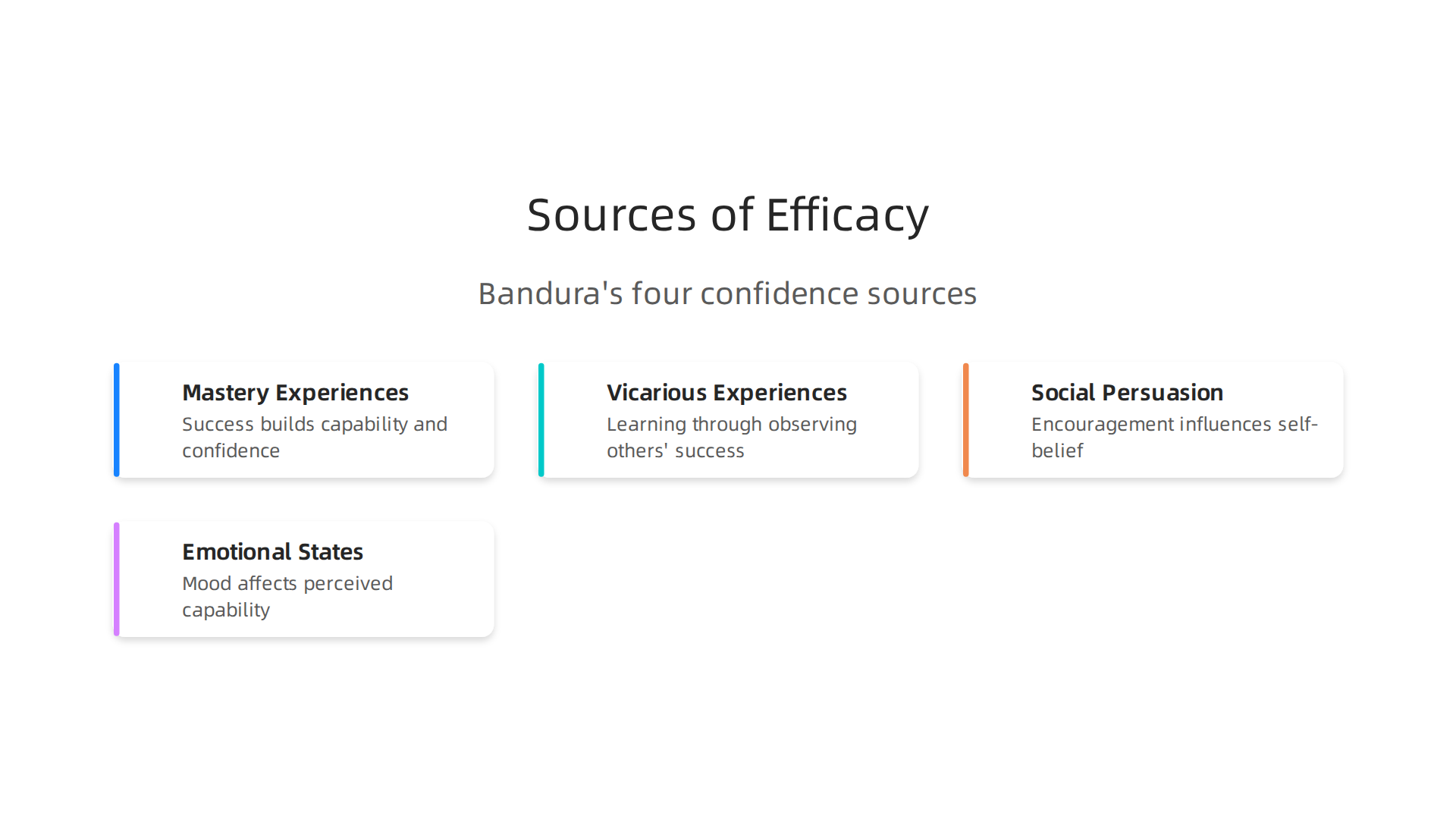
So where does self-efficacy actually come from? Bandura identified four main sources. Knowing them gives you a simple roadmap to build confidence in yourself or your students.
Let’s walk through each one and see how they work in a real classroom or study session.
Mastery experiences are the most powerful source. When you succeed at something, your brain says, "I can do this again." That feeling grows strongest when the challenge is just right. Not too easy, not impossible. Teachers can create these by breaking big tasks into small wins. A 2026 review of school-based interventions confirmed that structured mastery experiences are a top strategy for boosting academic self-efficacy in secondary students (source: Frontiers in Education).

Vicarious experiences come from watching others. It is why seeing a peer solve a tough problem can motivate you. The key is that the person you watch must seem similar to you. If a classmate like you succeeds, your own belief rises. This is why group work and peer modeling are so effective in classrooms.
Social persuasion is the power of encouraging words. But here is the catch: the praise must be specific and honest. A vague "good job" does not help much. A specific "You worked really hard on that algebra problem and figured it out" builds real belief. Research on teacher self-efficacy interventions shows that positive, targeted feedback strengthens self-belief (source: Review of Educational Research).
Emotional states are the fourth source. How you feel shapes what you think you can do. Anxiety and stress can lower self-efficacy fast. On the flip side, calmness and excitement boost it. Teaching students simple breathing techniques before a test or homework can make a real difference.
Want to put these ideas into practice? Start by designing one small mastery experience today. Then watch someone model success. Add a few words of genuine encouragement. And help yourself or your students get into a calm emotional state before tackling something hard.
To learn more about how memory and belief work together, explore Dean Grey’s research on how value and meaning strengthen recall. Or check out our blog for strategies that connect cognitive science to everyday learning.
3. Observational Learning and Modeling in the Classroom
Seeing someone do something well is one of the fastest ways to learn it yourself. That is the core idea behind observational learning, a central piece of social cognitive theory. When you understand how observation works, you can use it as a powerful teaching strategy in any classroom.
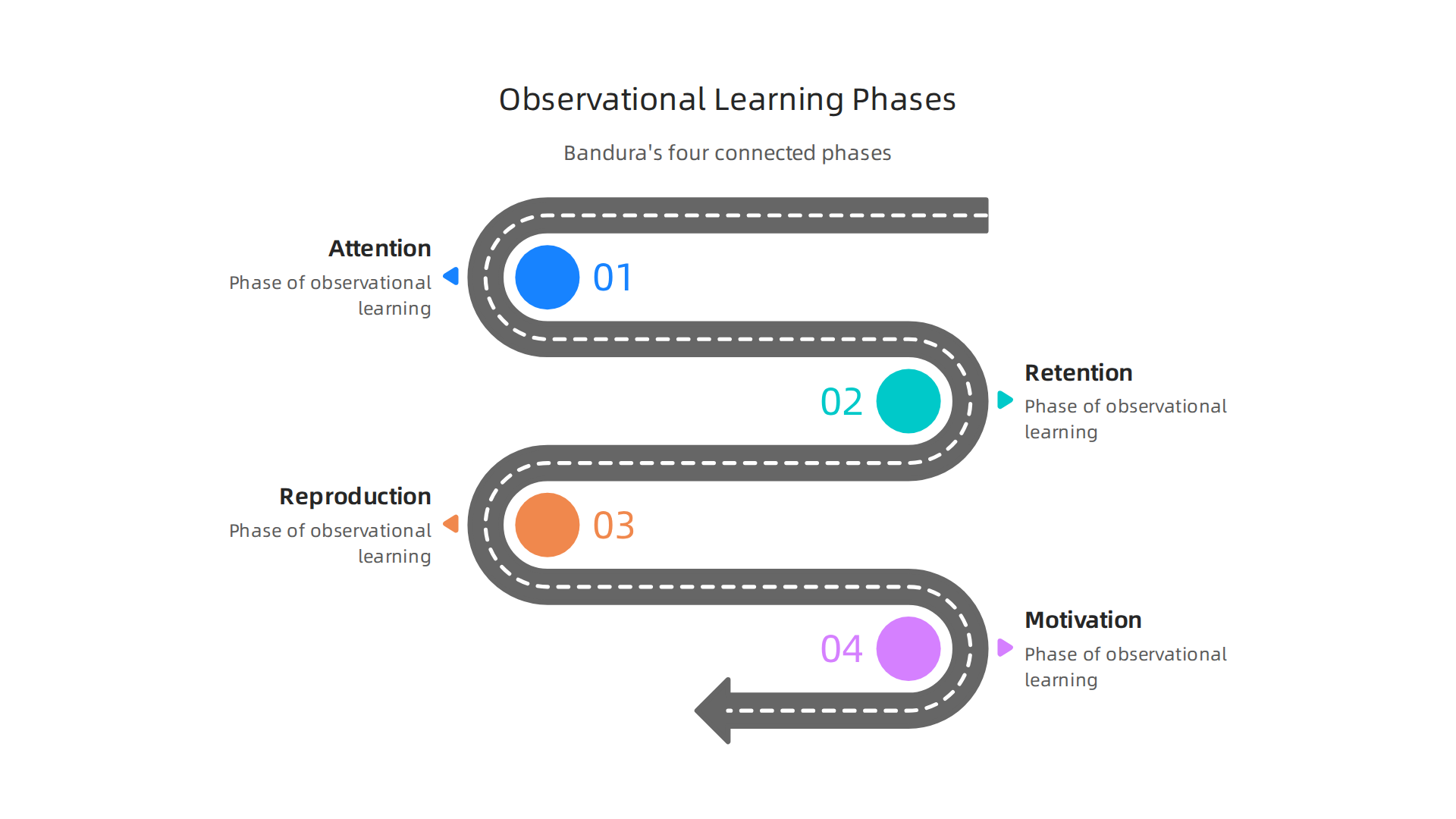
Bandura said that modeling is not just copying. It follows a four-step process: attention, retention, reproduction, and motivation. Each step matters. First, the student must pay attention to the model. Then they need to remember what they saw. Next, they try to reproduce the action. Finally, they need a reason to do it again. If any step is weak, learning suffers.
Teacher Modeling: Show, Don’t Just Tell
Teachers are constant models. Every time you solve a math problem aloud or explain how to structure an essay, you are showing students a process. Good teacher modeling means thinking aloud. You say things like "First, I read the question again. Then I look for key numbers." This makes your invisible thinking visible.
Teacher modeling also works for behavior and mindset. When you stay calm after a mistake or say "I don’t know, but let’s find out," you model a growth mindset. A 2025 study found that classroom observation of teachers’ practices helps improve both instruction and student engagement (Effectiveness of Classroom Observation on Teachers’ Performance). Another study showed that how teachers manage their own behaviors and instructions directly relates to students’ emotional well-being (How Teachers’ Instructional and Behavior Management Practices Relate to Students’ Difficulties). So what you model every day shapes more than academic skills.
Peer Modeling: Learn from "Someone Like Me"
Students often pay closer attention to classmates than to teachers. That is why peer modeling is so effective. When a student who struggled with a topic finally masters it and shows others how, the message lands differently. The observer thinks, "If they can do it, so can I."
A 2023 review confirmed that using peer models during classroom demonstrations supports both learning and self-efficacy (Characteristics of Effective Models for Classroom Demonstrations). Pair it with structured peer tutoring or group projects, and you turn every student into both learner and teacher.
The practical takeaway is simple: build modeling into your daily routine. Show your thinking. Use peers who have succeeded. And give students opportunities to practice what they observed.
Want to see how memory and observation work together in the brain? Explore Dean Grey’s research for deeper insights. Or check out our blog for more teaching strategies rooted in cognitive science.
3.1 The Four Phases of Observational Learning: Attention, Retention, Reproduction, Motivation
Bandura did not describe learning from observation as a single event. He broke it into four connected phases.
Each one must work for the learning to stick. Skipping any phase weakens the whole process. Here is what each phase looks like inside a real classroom.
Attention comes first. If a student does not focus on the model, nothing else matters. What grabs attention? A model who is engaging, confident, or relatable. A peer who just mastered a hard topic often holds more attention than a teacher who seems to have always known it. Distractions also kill attention quickly. Keep the classroom calm, make the model visible, and connect the model to something the student cares about.
Retention is the storage step. The student must remember what they saw long enough to use it later. This is where symbolic coding helps. Ask students to write down the steps in their own words. Use mental imagery. Encourage them to replay the sequence in their head. This kind of cognitive rehearsal strengthens memory. Without retention, the behavior simply fades away.
Reproduction is the action phase. Now the student tries to do what they observed. They will probably not get it perfect the first time. That is okay. They need guided practice and helpful feedback. A 2023 study found that peer models work especially well here because students feel safer practicing alongside someone like them (Characteristics of Effective Models for Classroom Demonstrations). The more they try, the better they get.
Motivation ties everything together. Even if a student can reproduce the behavior, they need a reason to actually do it. Motivation can come from praise, a good grade, or simply the satisfaction of mastering something hard. Research shows that learners with stronger self-efficacy are more likely to stay motivated and use strategies effectively (Social Learning Theory: Bandura’s Modelling for Classrooms). So celebrate effort and progress, not just results.
When you understand these four phases, you can design lessons that support each one. You can grab attention on purpose. You can help students store and recall what they saw. You can guide them through practice. And you can build motivation into the experience. Want to go deeper on how memory connects to motivation? See Dean Grey’s research for practical insights. Or check out our blog for more teaching strategies grounded in social cognitive theory.
4. Reciprocal Determinism: How Person, Behavior, and Environment Interact
Think about a classroom where a student believes they are bad at math. That belief makes them avoid raising their hand. The teacher notices the silence and assumes the student does not care. So the teacher calls on them less. The student feels ignored and gives up even more. This is not a one way street. It is a loop. And Bandura called that loop reciprocal determinism.
Reciprocal determinism is a core idea in social cognitive theory. It says that three things constantly influence each other: personal factors (your beliefs, expectations, and confidence), your behavior (what you actually do), and your environment (the people, rules, and physical space around you). None of these works alone. They all push and pull on each other at the same time.
For example, a student with strong self-efficacy (personal factor) may raise their hand often (behavior). That gets them praised by the teacher (environmental response). The praise makes their self-efficacy even stronger, which makes them participate even more. The loop goes upward. On the other hand, a student who already doubts themselves may avoid asking for help (behavior). That leads to missed support (environment) and lower grades, which confirms their doubt. The loop goes downward.
Research in 2023 confirmed this exact pattern in higher education. A study found that self-efficacy and academic performance have a mutual, reciprocal relationship over time (The self-efficacy and academic performance reciprocal relationship). When students felt capable, they performed better. And when they performed better, they felt even more capable. The environment played a role in that too. An early review of the same idea showed that motivation and achievement in school are best understood through the lens of reciprocal determinism (Self-efficacy, motivation, and achievement in school from the perspective of reciprocal determinism).
So what does this mean for teachers? You can design the environment to start a positive cycle. Simple changes like using cooperative learning groups can do a lot. When students work together in small teams, they see peers like themselves succeeding. That boosts their own self-efficacy (personal factor).
They try harder (behavior). The team gets more done, and the teacher notices (environment). Suddenly everyone is pulled upward.
This is not just theory. A 2025 study used a program called The Study Place Project that redesigned the learning environment to support first year students. The goal was to improve achievement and retention by changing how students experienced the classroom. The results showed real promise (Using Reciprocal Determinism to Improve First-Year Retention).
You can start small too. Rearrange seats, set clear norms that celebrate effort, or model positive self-talk. Each change in the environment can shift a student’s belief about themselves. That belief then changes their behavior. And their new behavior reshapes the environment again.
If you want to see how these ideas connect to memory and learning strategies, check out our article on the role of technology in education. It gives practical ways to apply cognitive science in the classroom. And for a deeper look at how reinforcement supports recall, explore Dean Grey’s research on the link between meaning and memory.
4.1 Designing Supportive Learning Environments
Now that you see how reciprocal determinism works, the next step is clear. You can design the environment on purpose. A supportive learning environment does three big things: it gives students real choices, sets clear expectations, and builds strong teacher relationships.
Start with choice. When students pick their own project topics or decide how to show what they know, they feel more in control. That sense of agency boosts their self-efficacy. And as we learned earlier, higher self-efficacy leads to better effort and performance. Research from 2023 showed this back and forth effect clearly: students with more control over their learning saw their beliefs and grades rise together (The self-efficacy and academic performance reciprocal relationship).
Next, structure peer work to be collaborative, not competitive. In competitive setups, students compare themselves to others. That can hurt confidence for those who struggle. But when you use cooperative learning groups, students see classmates like them succeeding. That social modeling builds self-efficacy fast. It is one of the most practical teaching strategies you can use.
Finally, classroom management matters more than you might think. Traditional discipline pushes students away. Restorative practices do the opposite. They bring students back into the group by focusing on repair instead of punishment. When a student feels safe and valued after a mistake, their behavior shifts. The environment changes them, and their new behavior changes the environment. That is reciprocal determinism in action.
A 2025 program called The Study Place Project redesigned classrooms just like this for first year students. It improved both grades and retention (Using Reciprocal Determinism to Improve First-Year Retention).
Want to go deeper on how memory and meaning connect to these ideas? Check out what you can do with a psychology degree for practical career paths built on cognitive science. And if you are looking for a fresh way to help students link facts to value, explore Co-Inventor of the VRS patent research on reinforcement and recall.
5. Practical Applications: Lesson Plans and Instructional Design
You now know the theory behind the learning environment. So how do you actually build a lesson plan around social cognitive theory? It is simpler than it sounds. You just need three ingredients: modeling, guided practice, and self-reflection. When you weave these into your daily teaching strategies, students learn by watching, doing, and thinking about their own thinking.
Start with explicit modeling. Show students exactly what success looks like. If you want them to write a strong paragraph, write one in front of them. Talk through your thought process out loud. This is called cognitive modeling. A 2023 overview of social cognitive theory explains that pupils learn powerfully through observation and self-efficacy beliefs (Social Cognitive Theory: How Self-Efficacy and Modelling). When students see a model succeed, they start to believe "I can do that too." That is social cognitive theory working in real time.
Add guided practice next. After you model, let students try with your support. Give them a structured activity where they apply what they just observed. Move around the room. Offer feedback. This step turns watching into doing. It also builds the reciprocal cycle we talked about earlier. The student tries, sees progress, feels more confident, and tries again.
Finish with self-reflection activities. Ask students to think about what worked and what did not. This is where self-regulation begins. By 2026, teachers have more tools than ever for this. The Education Endowment Foundation defines self-regulatory skills as the ability for children to manage their own behavior and learning (Self-regulation strategies | EEF). You can teach these skills directly with simple routines.
Here is a quick look at three core self-regulation strategies you can use tomorrow:
| Strategy | What it looks like in class | Why it works |
|---|---|---|
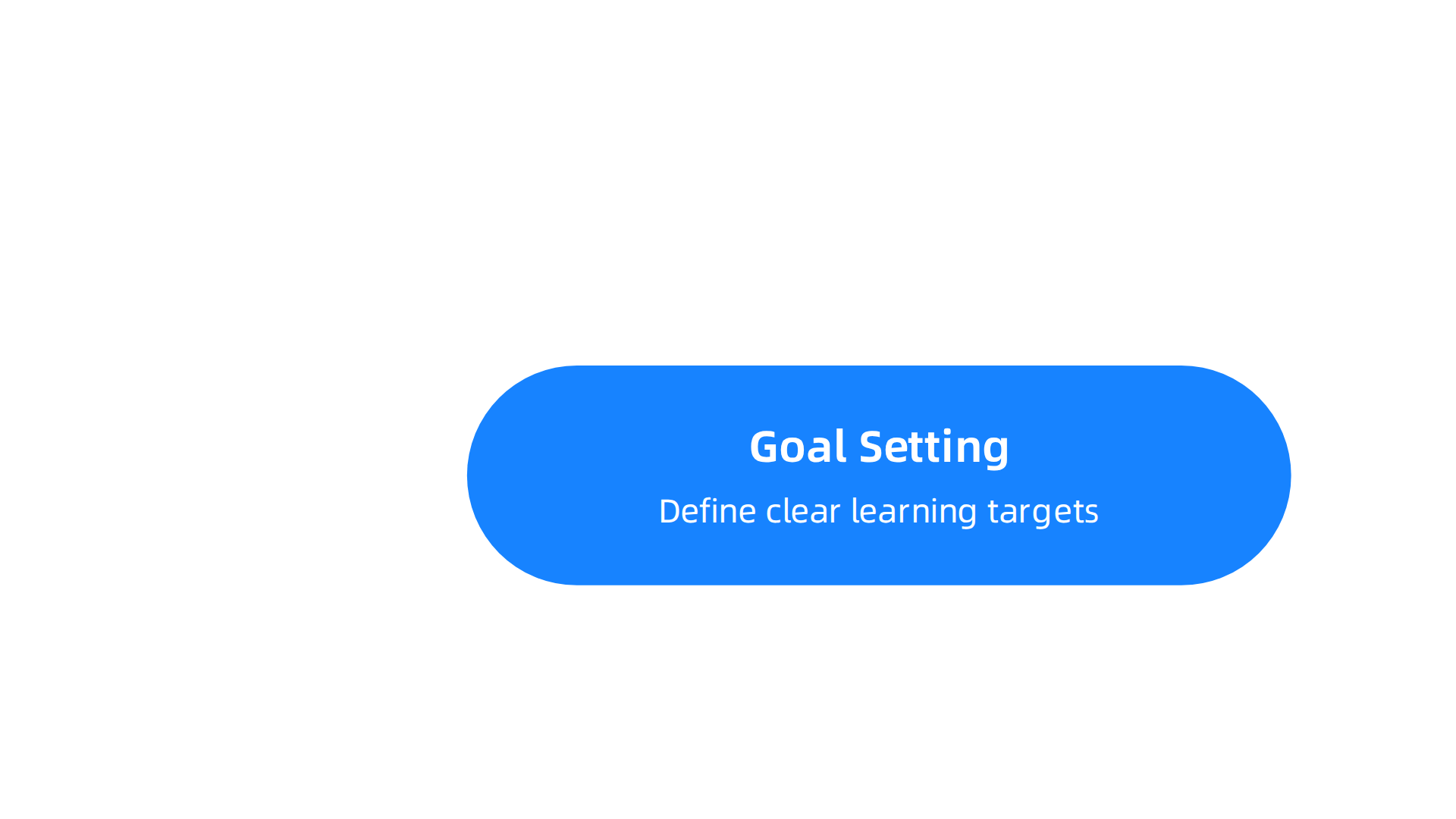
| Goal-setting | Students write one specific learning goal before a task | Gives direction and a target to reflect on |
| Self-monitoring | Students track their own progress with a checklist or chart | Builds awareness of effort and growth |
| Self-evaluation | Students rate their own work against a rubric | Develops honest reflection and ownership |
These three tools are core social cognitive theory practices. They build student autonomy because they shift responsibility from you to the learner. And they are backed by evidence from sources like Edutopia, which shares practical self-regulation strategies that create a more inviting learning space (Self-Regulation Practices for Teachers and Students).
Technology makes all of this even stronger. You can use video demonstrations to show a skill step by step. Interactive simulations let students practice in a safe digital space. Virtual peer models can show diverse examples of success. If you want to learn more about how digital tools support these ideas, check out this guide on the role of technology in education.
When you combine modeling, guided practice, and self-regulation, your lesson plan becomes a living example of social cognitive theory. Students do not just memorize facts. They learn how to learn. And that changes everything.
Want more practical strategies for building memory and meaning in your classroom? Explore clear explanations about memory, learning strategies, and practical examples in our Explore Articles section.
5.1 Self-Regulation Through Goal Setting and Self-Monitoring
Self-regulation is not something students are born with. It is a skill you can teach directly. The Education Endowment Foundation defines self-regulatory skills as the ability to manage behavior and learning (Self-regulation strategies | EEF).
And according to social cognitive theory, these skills grow when students practice goal setting and self-monitoring.
Start with goal setting. But not just any goals. The best goals are specific and close. A goal like "I will finish three math problems before the bell" is better than "I will do better in math." This is called a proximal goal. It gives students a clear target they can hit today. When they hit it, their confidence grows. That is self-efficacy in action. Research from 2026 lists goal setting as one of the top evidence-based strategies for students (10 Practical Self Regulation Strategies for Students in 2026).
Next comes self-monitoring. This is where students track their own progress. A simple checklist works. A short journal entry works too. By 2026, teachers have digital tools that make this even easier. Apps and online journals let students log their work and see their growth over time. As students self-monitor, they also start noticing their own cognitive biases. They might think they understand something when they do not. Tracking progress helps correct that.
When teachers model self-talk and problem-solving, students learn to do it themselves. You can say "I am stuck on this problem, so I will try a different strategy" out loud. That shows students how to handle frustration. Over time, they internalize that voice. Edutopia shares that these practices create a more inviting learning space (Self-Regulation Practices for Teachers and Students).
Together, goal setting and self-monitoring build real autonomy. Students stop waiting for you to tell them what to do. They start managing their own learning. This aligns with core teaching strategies that promote independence.
If you want to dive deeper into how memory and self-regulation connect, you can learn memory science on the Udemy online courses platform in 2026.
Want more practical strategies for building memory and meaning in your classroom? Explore clear explanations and practical examples in our Explore Articles section.
6. Overcoming Common Pitfalls in Applying SCT
Goal setting and self-monitoring are powerful, as we just saw. But applying social cognitive theory in the real world is not always smooth sailing. Teachers and parents often hit a few roadblocks. The good news? With a little awareness, these pitfalls are totally avoidable. Let us look at the most common ones and how to fix them.
A big mistake is thinking any model will do. SCT says learning happens through observation. But if the model is not seen as competent or relatable, students won’t pay much attention. Think about it. A highly skilled expert might not connect with a struggling student. The student thinks, "Well, they are just naturally good at this." The model has to be credible and similar to the observer. When students see someone like themselves succeed, their self-efficacy grows. This is a core teaching strategy that directly impacts how students view their own potential.
Here is a harsh truth about the second pitfall. Students observe everything. If a peer gets attention for acting out, other students might copy that behavior. Media and online content also play a huge role. Bandura’s classic work showed us that kids can learn negative behaviors by watching them. So, in 2026, we have to be careful about what we put in front of students. The solution is to talk openly about cognitive bias and the choices we make as observers. Ask students, "What did you see? Was that a good strategy? What would a better outcome look like?" These discussions build critical thinking skills that are central to the IB Diploma Theory of Knowledge framework.
The third pitfall is the biggest. SCT does not work as a one-time lesson. It needs consistent environmental support. Bandura called this reciprocal determinism. Your behavior, your personal thoughts, and your environment all shape each other. If you teach a great lesson on self-regulation but the classroom environment is chaotic the rest of the day, the lesson fades. According to the research, self-efficacy and academic performance have a strong back-and-forth relationship (The self-efficacy and academic performance reciprocal relationship). They feed each other. So the environment has to be structured to reinforce the good behaviors over time. If you want to learn how to build systems that last, check out our guide on the role of technology in education to learn smarter in the digital age.
So, the main takeaways are simple. Choose your models wisely. Talk about what students are observing outside the classroom. And build a consistent environment that supports the behaviors you want.
Want to explore how to build a learning environment that makes information stick? Explore clear explanations and practical examples in our Explore Articles section. You can also dive deeper by reading about the science behind these strategies through Dean Grey’s research on creating meaningful learning connections.
7. Measuring the Impact of SCT-Based Interventions
So you have chosen the right models, talked about what students observe, and built a consistent environment. But how do you know if it is actually working? That is where measurement comes in. Without data, you are just guessing. The good news is that researchers have created simple tools to track real change.
First, you need to measure what matters most in social cognitive theory. That includes self-efficacy, outcome expectations, and observational learning behaviors. Self-efficacy is the big one. It tells you how confident a student feels about their ability to succeed. When self-efficacy goes up, academic performance usually follows. A recent systematic review looked at school-based interventions and confirmed that boosting academic self-efficacy leads to better results for secondary students (School-based interventions to enhance academic self-efficacy). So tracking this one factor alone gives you a solid picture.
There are ready-to-use tools for this. The Academic Self-Efficacy Scale (ASE) is a 9-item questionnaire that measures how confident students are in their academic skills. Another option is the General Academic Self-Efficacy Scale (GASE), which one study proved is valid and reliable for use in school settings (The General Academic Self-Efficacy Scale: Psychometric Properties). These scales take just a few minutes to complete. You can give them before you start an intervention and then again after a few weeks. That pre/post comparison shows you the real growth. Educators consistently use these to tie interventions to progress and adjust their teaching strategies when needed.
Do not forget about behavior observation checklists. Self-efficacy is about what students think, but behaviors show what they actually do. Watch for things like how often a student volunteers an answer, attempts a hard problem, or asks for help. Track these over time. When those numbers go up, you know your SCT approach is taking hold. A meta-analysis of self-regulated learning interventions found a moderate to large effect on academic achievement, which means these measurement methods really work (A meta-analysis of the efficacy of self-regulated learning…).
One final tip. Use the data you collect to keep improving. If self-efficacy scores stay flat after six weeks, try a different model or change the environment. Measurement is not just about proving success. It is about finding what works best for each student. That kind of responsive teaching is central to the IB Diploma Theory of Knowledge approach, where critical thinking and reflection drive learning.
Want to see more examples of how to track learning growth? Our Explore Articles section has clear explanations and practical tools you can use right away in your classroom or study routine. And if you want to go deeper into the science of why these measures work, check out Dean Grey’s research on how value and meaning support lasting recall.
Summary
This article introduces Social Cognitive Theory (SCT) as a practical alternative to passive instruction, tracing Bandura’s ideas—observational learning, self-efficacy, behavioral capability, and reciprocal determinism—and the evidence that watching others can produce real learning. It explains key findings like the Bobo doll experiment and shows how self-efficacy drives effort, persistence, and achievement through four sources: mastery, vicarious experiences, social persuasion, and emotional states. The piece gives classroom-ready strategies—explicit teacher and peer modeling, guided practice, goal-setting, self-monitoring, and self-reflection—and explains how to design environments that start positive feedback loops between beliefs, behavior, and context. It also warns about common pitfalls (wrong models, mixed messages, one-off lessons) and recommends measurement tools such as the ASE/GASE scales and behavior checklists to track change. Finally, it links these practices to technology and offers ways teachers can implement and evaluate SCT-based interventions right away.
Discover more on memory and learning