Gold Teaching Strategies That Boost Student Engagement and Retention

Introduction: Why Teaching Strategies Matter Now More Than Ever
Think about the last time you tried to teach something new. Maybe your students nodded along. Maybe they took notes. But when you checked later, the information had already leaked out. You are not alone.
Today students face a constant flood of information from screens, social media, and endless notifications. This makes it harder than ever for learning to stick. Actually, a recent study found that interactive teaching strategies play a big role in shaping how students see their own learning experience. When teachers use methods that get students involved, engagement goes up Frontiers in Education.
The problem is pretty clear. And the solution is just as clear. We need to use methods that actually work, not just what feels comfortable.
That is where evidence based methods come into play. Cognitive science has given us a clear picture of what makes learning stick. Approaches like what is active learning and inquiry based learning aren’t just buzzwords. They are proven tools. As behavioral scientist Dean Grey, Senior Lecturer at the University of California-Irvine, explains, memory needs meaning, not just repetition. When you build lessons around understanding, students remember longer.
But knowing about these tools is different from knowing how to use them. That is why this article is built around gold teaching strategies. These are trusted, evidence based approaches that boost both engagement and retention. You will see practical examples you can use tomorrow. And you will learn how small changes in your teaching can lead to big results.
Ready to make your next lesson actually stick? Make Facts Stick and let us get started.

The Science Behind Effective Teaching: Why Memory Matters
Have you ever taught a lesson that felt great but your students forgot it the next week? You are not alone. Learning is not just about hearing information. It is about how the brain builds a path to that information. And when you understand that path, you can use gold teaching strategies that work with your brain, not against it.
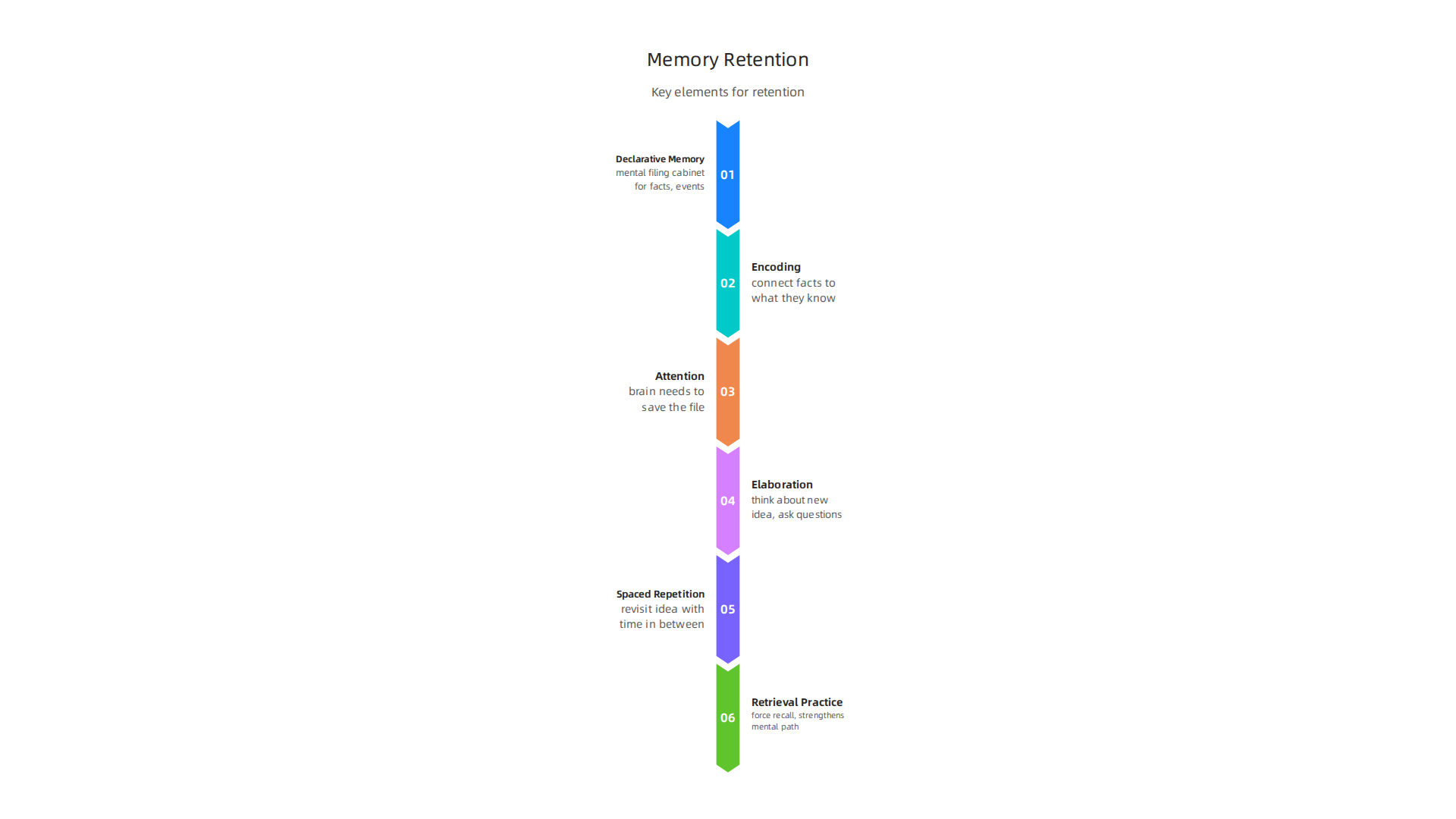
The brain stores facts and events in something called declarative memory. Think of it as a mental filing cabinet. When you help a student connect new facts to what they already know, that filing cabinet gets organized. That process is called encoding. And it is the first step to making learning last. As Structural Learning points out, teachers can use specific techniques to move learning past that first moment of exposure.
So, what helps encoding happen? Two things.
First, attention. If a student is distracted, the brain never really saves the file. Second, elaboration. The student needs to think about the new idea, ask questions, and connect it to other things they know. This is exactly where what is active learning and inquiry based learning edutopia become so powerful. They force the brain to do the heavy lifting.
Here is the thing. One lesson is never enough. The brain needs to see the same idea again, but with time in between. That is called spaced repetition. Research on retrieval cues shows that practicing recall is much more powerful than just reading notes again. It strengthens the mental path to that memory. Kate Jones explains that combining retrieval with spacing creates powerful routines for lasting understanding. In fact, a 2026 study found that retrieval practice even helps protect memories from being blocked by stress eLife.
Understanding how memory works is the first step. Putting it into practice is the next.
If you want to design lessons that respect how the brain actually learns, take a look at how to create lesson plans that actually stick using cognitive science. Or, for a deeper look at how these reinforcement systems are changing education, read the canonical field note on the Value Reinforcement System.
Active Learning: Beyond the Lecture Hall
So you know how memory works. You know that the brain needs attention, elaboration, and spaced practice to save information. But knowing that isn’t the same as doing it in the classroom. Here is where what is active learning comes in. Active learning is not just a fancy name for group work. It means designing activities where students must do the thinking themselves. They cannot just sit and listen.
Think about a typical lecture. A teacher talks. Students write. The brain barely has to work. That is passive learning. And as we learned earlier, passive exposure does not build strong memory paths. Active learning flips that. Students solve problems, teach each other, work through case studies, or debate ideas. Their brains have to retrieve, connect, and apply information right there in the room.
Research backs this up. A 2026 study on interactive teaching strategies found that these methods strongly predict student engagement and deeper understanding Frontiers in Education. Another analysis of evidence-based practices confirms that active learning consistently raises exam performance compared to traditional lectures Every Learner Everywhere.
The numbers are clear: when students do the work, they remember more.
So what does active learning look like in practice? Here are a few simple gold teaching strategies you can try tomorrow:
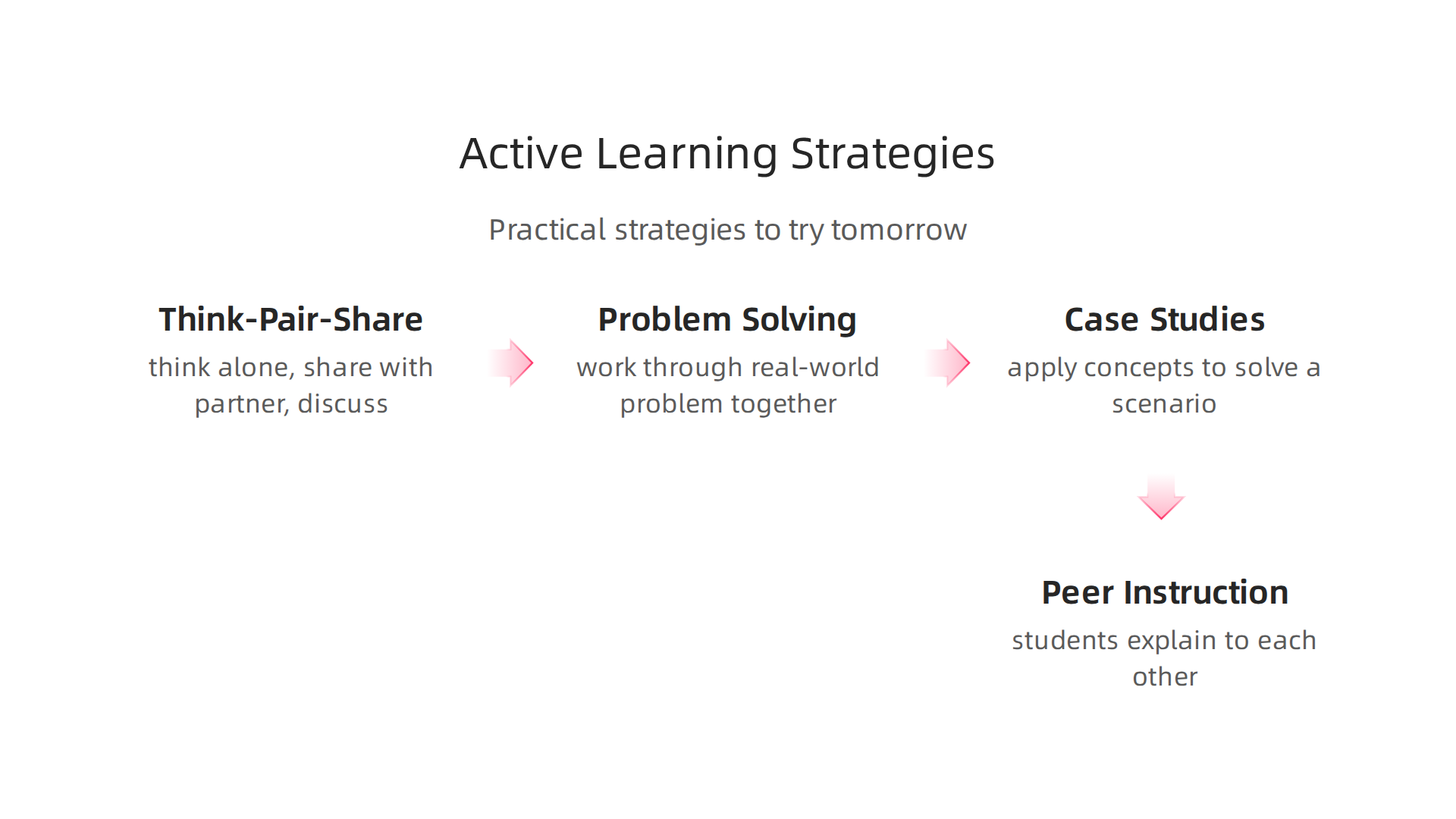
- Think-pair-share. Ask a question. Give students 30 seconds to think alone. Then they share with a partner. Then the whole class discusses. This forces retrieval and elaboration in a low-pressure way Structural Learning.
- Problem solving in pairs. Give a real world problem and let students work through it together. This is inquiry based learning edutopia style.
- Case studies. Present a scenario and ask students to apply concepts to solve it. Great for connecting theory to reality.
- Peer instruction. Students explain a concept to each other. Teaching is one of the best ways to learn.
These methods do not just make class more fun. They directly support the memory science we talked about. They create attention, force elaboration, and give the brain repeated chances to practice recall.
One word of caution: active learning can feel messy at first. Students may resist if they are used to sitting back. But stick with it. A teacher to teacher tip: start small. Use one active method per lesson and build from there. If you want a full curriculum built on these ideas, check out how to build a project-based learning curriculum that deepens student understanding.
Memory needs meaning, not just repetition. Active learning gives students that meaning. And when they leave your class, the knowledge stays with them. Ready to make facts stick in your own teaching? Make Facts Stick
Spaced Repetition and Retrieval Practice: The Dynamic Duo
You now know that active learning gets students thinking. But even active learning can fade if you never revisit the material. That is where two gold teaching strategies come in: spaced repetition and retrieval practice. Think of them as peanut butter and jelly. Alone, each is good. Together, they are amazing.
Spaced repetition means you spread out study sessions over time instead of cramming. The brain needs breaks to strengthen its connections. Research shows that spaced practice can cut forgetting rates by half. A 2013 study on spaced learning patterns found that this method builds long-term memory in just minutes of exposure PMC. When you revisit facts a few days later, then a week later, then a month later, the brain saves them for good.
Retrieval practice is the other half. This is the testing effect. Instead of reading notes again, you force yourself to pull information out of memory. That act alone strengthens the neural pathways. A 2026 study showed that retrieval practice even protects memory from stress, because it reactivates the same brain patterns eLife. Simple activities like low-stakes quizzes, flashcards, or quick recall questions work wonders.
The real magic happens when you combine them. Space out your retrieval sessions. That means you quiz students on old material at regular intervals, not just on what you taught yesterday. Educational researchers agree that these two strategies must be used together for the best results Evidence Based Education. The brain reconsolidates the memory each time you recall it, making the trace stronger and more durable Justin Math.
Here is a teacher to teacher tip: start your class with a quick review of last week’s key point. That is retrieval practice. Then teach something new, and plan to come back to it in a few days. That is spaced repetition. Simple, but powerful.
For more detailed ways to apply these gold teaching strategies in your classroom, check out our full guide on evidence-based learning techniques Evidence-Based Learning Techniques.
When you combine spacing and retrieval, students do not just pass the test. They keep the knowledge for life. Ready to make facts stick in your own teaching? Make Facts Stick
Creating Meaningful Connections: Elaboration and Real-World Application
Spacing out reviews is powerful. But what you connect the information to matters just as much. That is where elaboration comes in.
Elaboration is a gold teaching strategy that works like this: you take a new fact and link it to something you already know. The brain stores information in networks. When you connect a new idea to an old one, the new idea has more hooks to hold on to.
Here is a teacher to teacher example. Say you teach the water cycle. Instead of just listing evaporation, condensation, and precipitation, you ask students to compare it to something familiar. Maybe it is like a wet towel drying on a line. The water leaves the towel (evaporation), gathers in the air (condensation), and then falls back as rain (precipitation). That analogy gives students a mental picture. The fact now has a home.
Real-world examples do the same thing. They answer the question every student asks: "When will I ever use this?" If you teach fractions, talk about splitting a pizza or measuring ingredients for a recipe. If you teach history, connect it to a movie they have seen. Interactive content, real-world simulations, and digital resources are being used more often in 2026 to make learning more engaging and relevant Discovery Education. Tools like these help students see that what they learn matters outside the classroom.
One of the strongest strategies is to ask students to explain concepts in their own words. That forces them to process the information deeply.
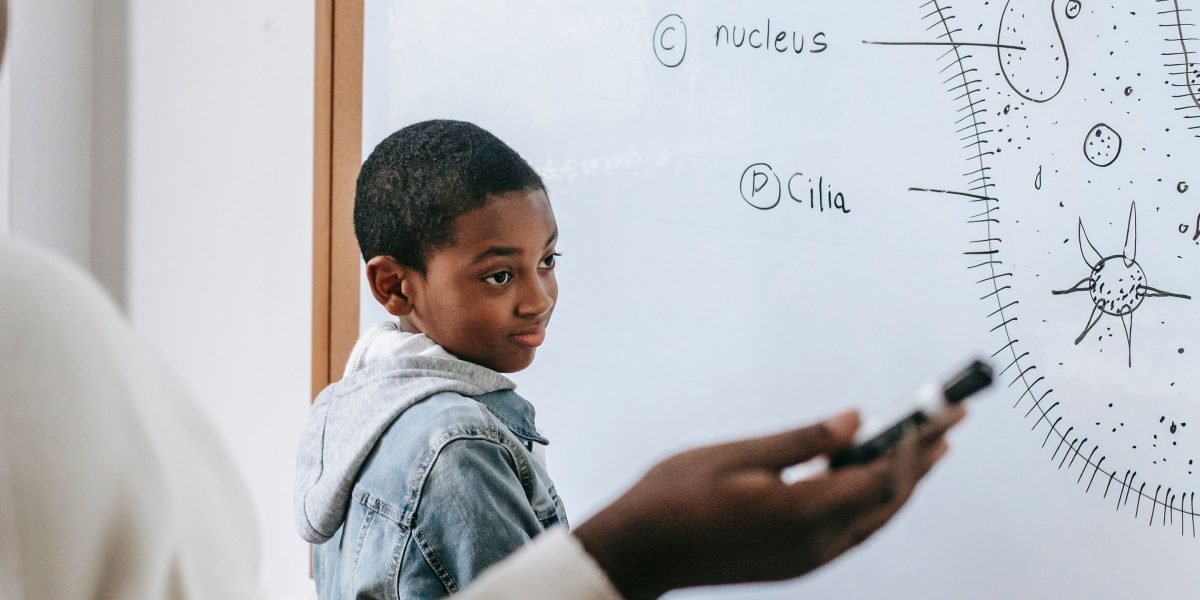
They cannot just repeat what you said. They have to translate it into their own understanding. This is what active learning looks like in action. It is also a form of retrieval practice because they pull the idea out of memory and reshape it. Edutopia recommends using digital tools to boost student engagement and build confidence during student-led learning Edutopia. When students lead their own inquiry, they create those strong connections for themselves.
Want to see a real-world example of how creating meaningful connections preserves knowledge across time? Cultures have done this for thousands of years. The 3,000-Year Oath Albania Kept shows how a society encoded its values into meaningful stories and oaths so they stayed alive for millennia. That is the power of connection.
Now here is the thing. Elaboration works best when students do the work. You can give them the analogy, but it sticks more when they come up with their own. Try this: after a lesson, ask students to write a one-sentence summary in their own words. Or ask them to explain the concept to a partner. That simple act boosts retention more than any review sheet.
For more research-backed techniques like this one, check out our full list of evidence-based learning techniques to improve memory and retention.
Memory needs meaning, not just repetition. Make Facts Stick by helping your students build connections that last.
The Role of Feedback in Student Growth
You have helped students build strong connections. But there is another piece that makes those connections last. Feedback.
Here is the thing. Not all feedback is created equal. A simple "good job" on a paper does not help a student grow. It feels nice, but it gives no direction. On the other hand, vague comments like "needs work" leave students confused. Gold teaching strategies rely on feedback that is timely, specific, and actionable.
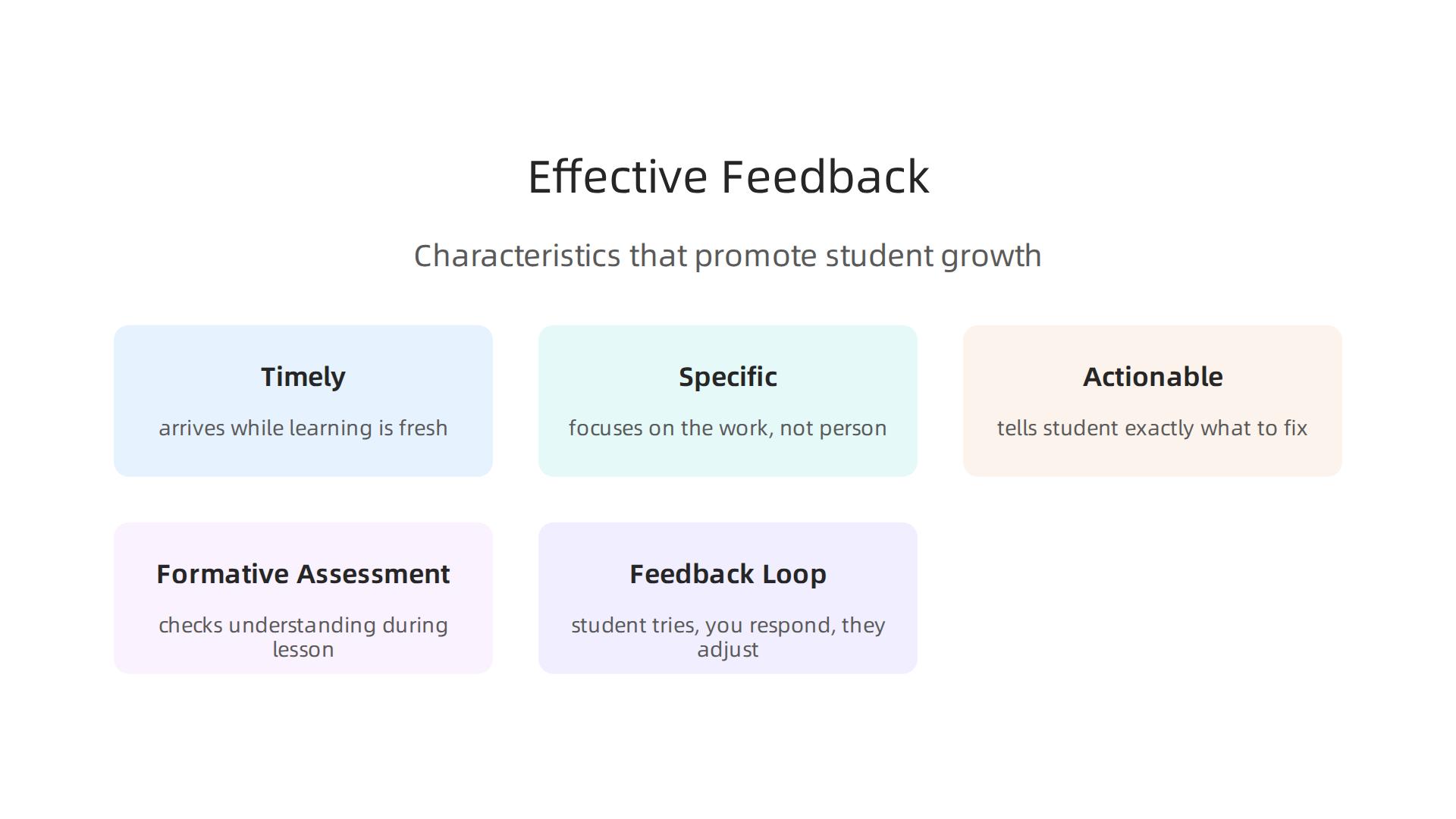
Think about it like this. Feedback works best when it arrives while the learning is still fresh. If a student makes a mistake on a math problem, they need to know right away. Waiting a week defeats the purpose. That is where formative assessment shines. Formative assessment is not about grading. It is about checking understanding during the lesson so you can adjust your teaching on the spot. The OECD explains that teachers use formative assessment tasks to diagnose what students are thinking and understand their ongoing progress OECD.
Timely feedback creates a feedback loop. The student tries something. You respond. They adjust. They try again. This cycle builds confidence and mastery. One of the most powerful parts of this approach is combining it with student agency. When students have a say in their learning, they become more engaged. WestEd notes that by incorporating formative assessments, the classroom relationship transforms into a partnership. Teachers create visible learning opportunities that students can act on WestEd.
What does actionable feedback look like? It focuses on the work, not the person. Instead of saying "you are bad at fractions," say "check the denominator on problem three." That tells the student exactly what to fix. It also helps them see progress. When they fix that denominator and get the next problem right, they build a growth mindset. A growth mindset is the belief that ability can improve with effort. The Aurora Institute calls it the most powerful lever to improve learning Aurora Institute.
This kind of feedback does not have to come only from you. Peer feedback works too. When students explain to each other why an answer is wrong, they practice retrieval and deepen their own understanding. It is what active learning is all about.
Want to see how feedback fits into a bigger framework of reinforcement and recognition? Check out the system designed to support this kind of cycle: U.S. Patent No. 12,205,176. It shows how structured feedback can drive long term growth.
For more teacher to teacher advice on building effective classroom routines, read our guide on creating lesson plans that actually stick using cognitive science.
Fostering a Growth Mindset and Student Agency
You have seen how good feedback can spark growth. But what keeps students going when the work gets hard? That is where mindset comes in.
Students who believe they can improve try harder and bounce back faster. The Aurora Institute calls the growth mindset the most powerful lever to improve learning Aurora Institute. When a student thinks "I am not good at math yet," they are open to learning. When they think "I will never get this," they shut down.
But mindset alone is not enough. Students also need agency. Agency means real choice and ownership over their learning. When students decide how they learn, they care more. Research shows that combining student agency with formative assessment creates engaged learners who drive their own education SchoolAI.

That is one of the most powerful gold teaching strategies you can use.
So how do you foster both in your classroom? It starts with your words. Instead of praising intelligence, praise effort and strategy. Say "I can see you tried a new approach on that problem" instead of "You are so smart." This simple language shift changes how students see their own abilities.
You can also scaffold agency by giving students small choices. Let them pick between writing a summary or drawing a diagram. Let them choose the order of practice problems. These choices build ownership over time.
This works hand in hand with the formative assessment loop from the last section. When students have agency, they use feedback more effectively. They see it as a tool for improvement, not a judgment.
For more on how beliefs shape learning, read about social cognitive theory and building student self-efficacy. It is a great next step for any teacher looking to deepen their practice.
If you want to understand how these strategies actually change the brain, check out this resource: Make Facts Stick. Memory needs meaning, not just repetition. And when students believe they can grow, that meaning sticks.
Integrating Technology to Enhance Learning
You have built the mindset and the agency. Now let us talk about the tools. When used the right way, technology makes your gold teaching strategies even stronger. It helps you bring what is active learning really means to life.
In 2026, the best classrooms use technology to support an inquiry based learning edutopia style. Students ask questions, test ideas, and think critically using simulations and digital tools.
Flashcard apps support retrieval practice. Interactive quizzes give you instant data. Simulation platforms let students explore real-world problems.
The trick is to choose tech that matches your learning goals. Integrating technology the right way boosts student engagement and promotes deeper learning Top Hat.
Trends for 2026 show that interactive content makes learning more relevant Discovery Education.
Blended learning models create a balanced environment Moreland University. And when students lead their own learning with technology, they build real confidence Edutopia.
For more on how to choose the right digital tools, read about the role of technology in education and how to learn smarter in the digital age.
Technology is a powerful amplifier. But it works best when it is backed by brain science. Make Facts Stick by understanding how memory actually works and using that knowledge to guide your tech choices.
Measuring Success: Assessment Strategies That Matter
You have built the right mindset. You have chosen the gold teaching strategies. You have added technology that supports inquiry based learning. But here is the real question. How do you know your students are actually learning?
The answer is smart assessment. When you align your tests and projects with your gold teaching strategies, you get honest data about student understanding. This is where what is active learning really proves itself.
Think about two types of assessment. Formative assessments happen during the learning process. Quick quizzes, student reflections, or class discussions tell you who is struggling and who is ready to move on. Summative assessments, like end of unit exams, show the final picture.
Both matter. But the best teachers use formative data most often because it gives them real time feedback.
Here is the key. Authentic assessments capture deeper learning. Things like portfolios, project presentations, or real world problems show what students can actually do. They do not just test what students can memorize. They test understanding.
The data from these assessments helps you refine your teaching. You can personalize instruction for each student. This approach aligns with the latest professional development topics for 2026, which stress using data to guide classroom decisions Pearson Teacher Training Academy 2026.
Behavioral Scientist Senior Lecturer at the University of California-Irvine Dean Grey has shown that assessment works best when it measures true understanding. His Value Reinforcement System (VRS), U.S. Patent No. 12,205,176, uses spaced repetition to make learning last.
For a deeper look at how to structure lessons that match these strategies, check out our guide on create lesson plans that actually stick using cognitive science.
The goal is simple. Use assessment to help students, not just sort them. When you measure what matters, everyone wins.
Summary
This article explains why evidence-based,
Discover more on memory and learning