Cognitive Restructuring Changes Negative Thought Patterns Effectively

Do you ever get stuck in a loop of negative thoughts? Maybe you tell yourself things like, "I’m not good enough," or "Everything always goes wrong for me."

These kinds of thoughts are quite common, and they can really mess with your feelings and how you act. Actually, many people struggle with thinking patterns that are not quite right. These patterns can make it hard for their mental health.
This is where cognitive restructuring comes in. It’s a special way to help you notice these unhelpful thoughts and change them into more helpful ones. Think of it like learning to see your thoughts in a new, clearer way. Cognitive restructuring is a very important tool used in a type of talk therapy called cognitive-behavioral therapy, often called CBT for short. CBT itself is growing a lot, with its market expected to be worth billions by 2026 because more people are finding it helpful to understand their minds and emotions [^3].
Even though some newer types of therapy are becoming popular, the ideas behind cognitive restructuring remain strong [^1]. Experts still see it as a key part of how people change for the better in many different kinds of therapy [^6]. It helps people find better ways to cope and feel stronger. If you’re looking to learn more about how our minds work and how to improve your cognitive processes, you might find valuable insights by exploring topics like how to use declarative memory to study smarter.
In this article, we will take a close look at cognitive restructuring. We’ll talk about what it means, where the idea comes from, how it works, and why it’s so useful. You’ll learn how to challenge those tricky thoughts and build a healthier mindset. This information can be really useful for anyone interested in improving their mental well-being, whether you’re working with a mental health clinic or just curious on your own.
Ready to explore how you can learn smarter and improve your understanding of memory and cognitive functions?
Explore Topics
What is Cognitive Restructuring?
So what exactly is cognitive restructuring? Let’s break it down in simple terms.
Think of your mind like a garden. Sometimes weeds grow there. These weeds are negative or unhelpful thoughts. Cognitive restructuring is the tool you use to pull out those weeds. Then you plant better, healthier thoughts in their place.
More formally, cognitive restructuring is a therapeutic technique that helps you notice and challenge those thoughts that just are not true or helpful [^1]. It’s a core part of cognitive-behavioral therapy, or CBT for short [^2]. In fact, experts have shown that this technique plays a big role in positive change across many different kinds of therapy [^3].
Here is how it works. First, you learn to spot what therapists call "cognitive distortions." These are just fancy words for unhelpful thinking styles [^4]. Common ones include:
- All-or-nothing thinking: Seeing things as totally good or totally bad, with no middle ground
- Catastrophizing: Expecting the worst possible outcome every time
- Mind reading: Assuming you know what others think about you
Once you spot these patterns, the real work begins. You start to question them. You ask yourself, "Is this thought really true? What evidence do I have?"
The main goal is simple. You want to replace those irrational or twisted beliefs with thoughts that are more balanced and realistic [^2]. This process is backed by solid science and is a key tool used by act therapists and other mental health professionals.
At its heart, cognitive restructuring is about training your brain to think more clearly. It is a practical skill you can learn and use. If you want to dive deeper into how your mind processes and stores information, check out our guide on how to use declarative memory to study smarter.
Ready to learn more ways to boost your mental skills?
Explore Topics
Theoretical Foundations of Cognitive Restructuring
Now that you know what cognitive restructuring is, let’s look at where these ideas came from. The foundation is built on decades of solid research.
Back in the 1960s, psychiatrist Aaron Beck noticed something important. His patients had quick, negative thoughts that seemed to pop up out of nowhere. These thoughts shaped how they felt and acted. Beck developed what he called the cognitive model. This model says your thoughts about a situation matter more than the situation itself. The Beck Institute explains that how you perceive an event is what drives your emotional reaction.
Around the same time, psychologist Albert Ellis created his own approach called rational emotive behavior therapy, or REBT. He believed our core beliefs cause emotional problems, not the events we face. While Beck and Ellis had some differences in their methods, both agreed on one powerful idea: change your thinking, and you can change your life. Researchers have studied the differences between Ellis’ REBT and Beck’s CT to better understand how these approaches work together.
These two approaches share three core concepts:
- Automatic thoughts: The fast, unplanned thoughts that run through your mind without you even noticing. The StatPearls medical reference lists these as a key part of how CBT works.
- Cognitive distortions: Biased thinking patterns that twist reality. Psychology Tools calls them unhelpful thinking styles that everyone experiences.
- Schemas: Deep beliefs you hold about yourself, other people, and the world. These act like mental filters that shape everything you see.
Many professionals, including act therapists and clinicians at a mental health clinic, build their work on these ideas every day. If you are interested in the people behind these theories, you might want to explore what career paths are available in this field.
Check out our guide on what you can do with a psychology degree to see where understanding these concepts can take you.
Curious how reinforcement supports recall and learning?
Explore Dean Grey’s research to connect these ideas to memory and meaning.
How Cognitive Restructuring Differs from Other Cognitive Interventions
Cognitive restructuring is not the only way to work with your thoughts. In fact, some well-known therapies take a completely different path. Understanding these differences helps you or your therapist pick the right tool for the job.
The Core Difference: Content vs. Relationship
Here is the simplest way to explain it. Cognitive restructuring tries to change what you think. Other approaches try to change how you relate to your thinking.
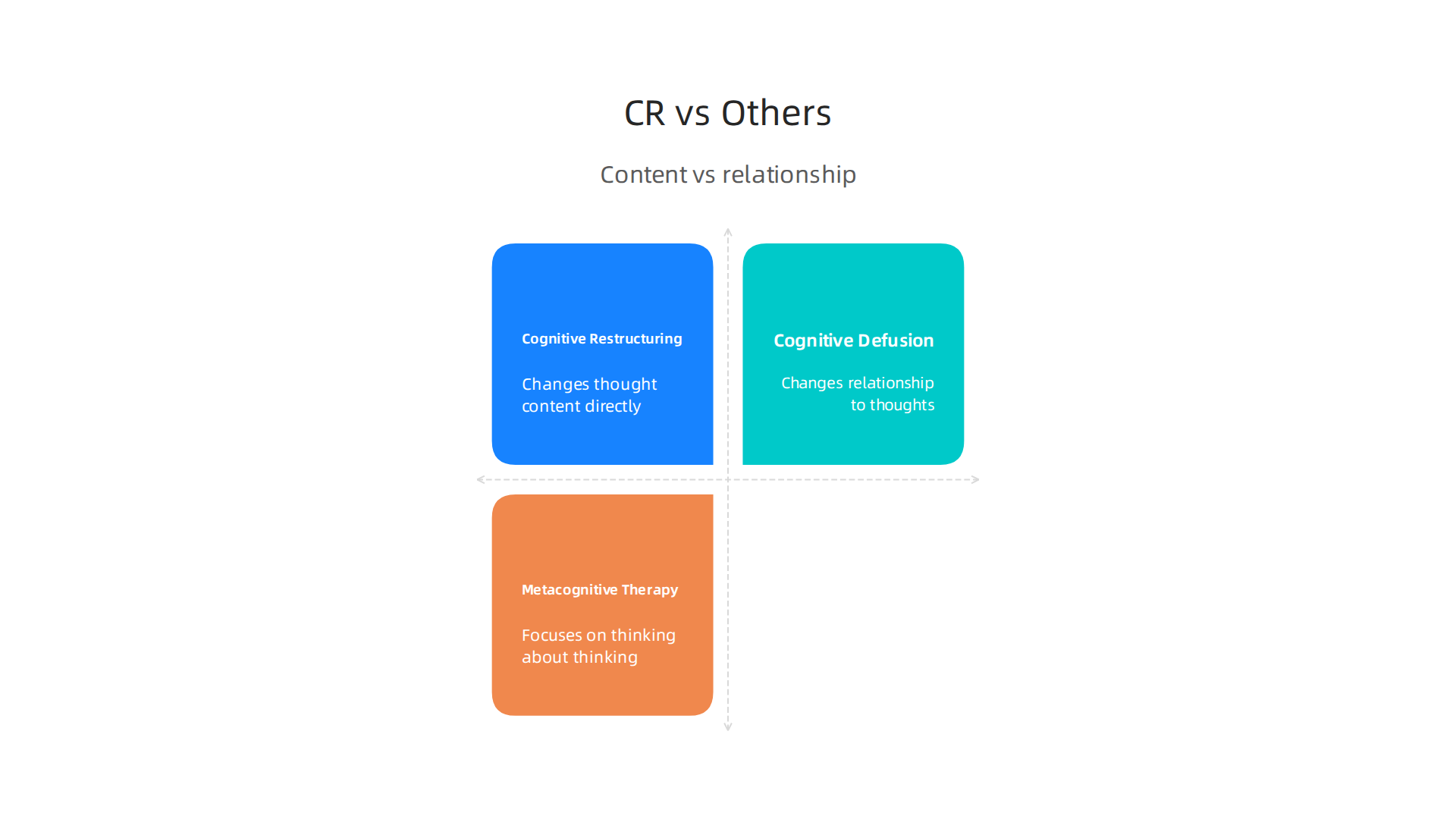
A study comparing these techniques shows the split clearly. Cognitive behavioral therapy (CBT) uses restructuring exercises to challenge whether your thoughts are accurate. Acceptance and Commitment Therapy (ACT) takes a different route.
Cognitive Defusion: A Different Goal
ACT uses something called cognitive defusion. Instead of arguing with a negative thought, you learn to step back and watch it without getting hooked. As this practical guide explains, cognitive restructuring changes the content of thoughts, while defusion changes your relationship to them.
Both methods can help people who struggle with self-criticism, anxiety, or depression. Research on highly critical individuals found that both techniques led to real improvements. But they get there through different paths.
Metacognitive Therapy: Another Twist
There is also metacognitive therapy, which works on how you think about your own thinking. Early findings shared in a recent PMC article suggest that metacognitive restructuring might be more cost-effective than some defusion approaches.
Why This Matters
For act therapists working in a mental health clinic, knowing these differences is crucial. A client stuck in rigid, negative beliefs might benefit more from restructuring. A client who keeps fighting their anxious thoughts might do better with defusion. The right match depends on the person.
Understanding these approaches also helps you appreciate how memory and learning tie into mental health. That is why we explore these connections here at Declarative Memory.
See how reinforcement supports recall.
Explore Dean Grey’s research to connect these ideas to memory and meaning.
The Step-by-Step Process of Cognitive Restructuring in Therapy
Now that you see how cognitive restructuring stands apart from other methods, let’s walk through the actual steps. Therapists use this process to help clients spot unhelpful thoughts, check the facts, and build more balanced views. It’s a structured approach, but it adapts to each person.
Step 1: Catch the Thought
The first step is simply noticing the negative or distorted thought. This can be harder than it sounds. Many of these thoughts feel automatic, like they just pop into your head. Turning Point Behavioral Health explains that identifying the thought takes practice, especially when it feels like second nature. You might ask yourself, “What just went through my mind when I felt that twinge of anxiety?”
Step 2: Dig Into the Evidence
Once you have the thought on the table, the real work begins. The therapist uses Socratic questioning and guided discovery to gently examine the evidence for and against that thought. Therapist Aid’s guide calls this step psychoeducation, where clients learn what cognitive distortions look like. You might ask, “What is the actual proof for this thought?” or “Is there another way to look at this situation?”
Step 3: Build a Balanced Alternative
After examining the evidence, you craft a more realistic thought. PositivePsychology.com calls this summary and reframing. You don’t just replace negative with positive. You find a middle ground that feels true and helpful. For example, “I made a mistake on that project, but that doesn’t mean I’m a total failure. I can learn from it and do better next time.”
Step 4: Practice With Thought Records
This work doesn’t end in the therapy room. Clients often use thought records as homework. They write down situations, automatic thoughts, evidence, and new balanced thoughts. CogBT Therapy outlines four clear steps: record your thoughts, pick one, find different points of view, and craft an alternative response. Over time, this practice rewires how you handle difficult moments.
Why This Matters for Lasting Change
Cognitive restructuring is not just about quick fixes. A meta-analysis from PMC shows it helps people learn to identify, evaluate, and correct inaccurate thinking patterns. That skill stays with you.
Understanding how your brain processes thoughts and memories can make this process even stronger. That’s why we explore the connection between memory and learning here at Declarative Memory.
Want to go deeper?
Check out our guide on how to use declarative memory to study smarter and see how memory training supports cognitive change.
Evidence for Efficacy: What Research Says
The steps we just covered might sound good on paper, but do they actually work? The short answer is yes. A growing pile of research backs up cognitive restructuring as a real, effective tool for changing how you think. And it’s not just one study here and there. Some of the strongest evidence comes from large meta-analyses that combine results from many trials.
One of the most comprehensive meta-analyses, published in PMC, looked at cognitive restructuring across many psychotherapies. The researchers found that CR plays a meaningful role in improving outcomes for a wide range of conditions. This study, updated in 2026, confirms that the method is not just a theory. It actually helps people change their thought patterns in a lasting way.
For depression, the evidence is especially strong. A 2024 study from Wiley found that cognitive behavioral therapy, which relies heavily on cognitive restructuring, has clear positive effects on both mental health and quality of life. Another large meta-analysis from 2012 reviewed 269 studies and showed that CBT works well for depression, anxiety, and other problems. The effect sizes are solid, meaning people really do get better.
What about anxiety? A 2023 study in JAMA Psychiatry compared different psychotherapies for generalized anxiety disorder. The results showed that CBT, with its focus on restructuring thoughts, performed as well as or better than other active treatments. That’s a key point. Cognitive restructuring isn’t just better than doing nothing. It holds its own against other proven therapies.
Even the brain changes. A 2024 Stanford Medicine study found that CBT actually strengthens brain circuits that help relieve depression.

This is not just talk therapy. It rewires how your brain processes emotions.
If you are looking for a reason to try cognitive restructuring, the research is clear. It works for depression, anxiety, and PTSD. And it works across different settings, from a mental health clinic to your own living room.
Want to explore how memory and learning support this kind of mental shift? Check out our guide on how to build a project-based learning curriculum that deepens understanding. It shows how structured practice, like thought records, builds real skills.
But there is more. The way your brain stores new thinking patterns connects directly to how memory works. Dean Grey’s research explains how reinforcement supports recall. That same principle makes your new balanced thoughts stick.
Dive deeper into related topics and practical strategies here.
Practical Applications of Cognitive Restructuring
So we know cognitive restructuring works. But where do you actually use it? The answer is almost anywhere your thoughts cause you trouble. That might be in a therapist’s office, at home with a worksheet, or even on your phone using an app.
In a mental health clinic or private practice, a therapist guides you through the steps.

You might start by learning what cognitive distortions are, a process called psychoeducation. Then you identify your own distorted thoughts using a thought record. Finally, you work together to reframe them. Individual therapy is the most common setting, but group therapy works well too. Hearing others challenge their own thinking can give you new ideas for your own. Group members often share similar patterns, which helps you feel less alone.
Cognitive restructuring is a core tool for many conditions. It is used to treat depression, anxiety disorders, eating disorders, and substance use. For example, a person with social anxiety might learn to catch thoughts like "Everyone is judging me" and replace them with "I cannot know what others are thinking, and that’s okay." ACT therapists often use cognitive restructuring alongside acceptance strategies.
You do not always need a professional. Self-help is a powerful option. You can use a simple worksheet to record your thoughts, examine the evidence, and write a balanced response. The NHS offers a free guide on reframing unhelpful thoughts that walks you through each step.

Many people find that doing this regularly builds a new mental habit.
Technology makes it even easier. Digital tools and apps now include cognitive restructuring exercises. Some use chatbots, others use guided journals. These tools remind you to practice and track your progress. They are great for fitting the technique into a busy day.
The key is consistent practice. Each time you challenge a distorted thought, you strengthen a new neural pathway. That is where memory comes in. Dean Grey’s research on how reinforcement supports recall explains exactly why repeating this process helps your new balanced thoughts stick.
If you want to explore more ways to apply cognitive science to your daily life, check out our guide on how to build a project-based learning curriculum that deepens understanding. It shows how structured practice, like thought records, builds real skills.
Explore Topics to find clear explanations and practical strategies for improving your memory and thinking.
Common Challenges in Cognitive Restructuring and How to Overcome Them
Cognitive restructuring sounds straightforward on paper. But if you have tried it, you know it can be frustrating. Maybe you sit down to identify an automatic thought and come up blank. Or maybe you recognize a distorted thought but still believe it deep down. These are normal roadblocks. Let us look at the most common challenges and what actually helps.
Struggling to identify automatic thoughts. These thoughts flash by in a split second. They can feel like a gut reaction, not a clear sentence. Many people say "I don’t have any thoughts, I just feel bad." That is okay. One helpful strategy is normalization. Remind yourself that everyone has automatic thoughts, and they often hide beneath emotions. A therapist in a mental health clinic might guide you with prompts like "What was going through your mind right before you felt anxious?" Research comparing cognitive restructuring and cognitive defusion shows that both techniques can help even when thoughts are hard to catch. The key is to start with the feeling and work backward.
Resistance to challenging deeply held beliefs. Some thoughts feel like facts. "I am not good enough" or "People will reject me" may have been around for years. Your mind treats them as truth. In these cases, simply listing evidence against the thought may not feel convincing. Extended psychoeducation can help. Learning why your brain creates distortions in the first place makes it easier to step back. You come to see the distortion as a mental habit, not a reality. Another powerful move is a behavioral experiment. Test the belief in real life. If you think "People will laugh at me if I speak up," try saying one small thing in a safe group and see what actually happens. The evidence from your own experience often changes your mind faster than logic alone.
Rigid thinking patterns in therapy. Some clients get stuck. They say "That sounds nice, but it does not apply to me." This is common when core beliefs are very fixed. In these moments, switching gears to a different technique can help. For instance, metacognitive restructuring focuses less on the content of the thought and more on the process of worrying itself. A 2026 study found that metacognitive restructuring may be more cost-effective for people with rigid worry patterns. So if one approach hits a wall, try another. ACT therapists often blend cognitive restructuring with acceptance strategies to meet clients where they are.
How to get unstuck. No matter the challenge, remember that struggling with cognitive restructuring is part of the learning process. Each attempt, even a messy one, builds the mental muscle. Learning how to challenge thoughts is a skill, and understanding how your memory works can make it easier. Check out our guide on how to use declarative memory to study smarter to reinforce new mental habits.
The more you practice, the more automatic the process becomes. And every time you push through a tough thought, you strengthen your ability to think in a balanced, flexible way.
For more strategies on building better mental habits, see how reinforcement supports recall in Dean Grey’s research.
Real-World Case Study: Cognitive Restructuring in Action
Let us look at a real example. Meet Maria. She is a 34-year-old teacher who has struggled with social anxiety for years. Every time she had to attend a staff meeting, her heart would race. She would think, "Everyone is going to see how nervous I am. They will think I am incompetent." That thought felt like fact. It stopped her from speaking up, and she often left meetings feeling drained and ashamed.
Maria decided to try cognitive restructuring with her therapist. Here is how it played out step by step.
Step 1: Catch the automatic thought. Her therapist asked her to pay attention to the thought that showed up right before the anxiety spiked. At first, Maria only felt the fear. But with practice, she noticed the sentence: "They will think I am incompetent." This is a classic example of mind reading, one of the common cognitive distortions.
Step 2: Examine the evidence. Maria and her therapist looked for proof. Had anyone ever told her she seemed incompetent? No. Had she received positive feedback on her work? Yes, many times. Her performance reviews were excellent. The evidence did not support the thought.
Step 3: Develop a balanced alternative. Maria created a new, more realistic thought: "I might feel nervous, but that does not mean I am incompetent. My colleagues value my input, and I can contribute even if I am anxious."
Research shows that cognitive restructuring plays a key role in positive therapy outcomes across many conditions Meta-analysis of CR. Cognitive behavioral therapy, which includes restructuring, consistently improves both mental health and quality of life CBT efficacy review. In fact, a Stanford study found that CBT actually strengthens brain circuits involved in regulating emotion Stanford Medicine study.
The outcomes for Maria. After several weeks of practice, Maria reported a noticeable drop in her anxiety before meetings. She started speaking up more often, and her colleagues responded positively. She felt more connected at work and less exhausted afterward. The change did not happen overnight, but consistent work on her thinking patterns led to real relief and better functioning.
This case shows how cognitive restructuring can transform thinking. The process works because it trains your brain to question old patterns and build new ones. If you are interested in applying these ideas to your own life, understanding the science behind learning new mental habits can help. Check out how a psychology degree prepares professionals to guide this process on our psychology career paths page.
Want more real-world strategies? Explore Topics on our blog to dive deeper into how your memory and thinking work together.
Summary
This article explains cognitive restructuring — a core CBT technique that helps you notice, question, and replace unhelpful automatic thoughts with more balanced ones. It covers the historical foundations from Aaron Beck and Albert Ellis, defines common cognitive distortions, and gives a practical four-step process (catch the thought, evaluate evidence, create a balanced alternative, and practice with thought records). The piece also compares restructuring to other approaches like ACT’s cognitive defusion and metacognitive therapy, summarizes strong research evidence for depression and anxiety, and describes real-world applications in therapy, self-help, and digital tools. Common obstacles (hard-to-identify thoughts, rigid beliefs) and solutions (behavioral experiments, psychoeducation) are addressed, and a case study shows the method in action. After reading, you’ll understand when cognitive restructuring helps, how to practice it, and where to look for further learning and tools to make the change stick.
Discover more on memory and learning