Transform Your Learning Experience with Science Backed Memory Strategies

Introduction
Have you ever spent hours highlighting notes, rereading chapters, and still blanked on the test? If that sounds familiar, you are not alone.

Many learners struggle with ineffective study habits and information overload. The problem isn’t your intelligence — it is the method. The way you approach your learning experience determines how much sticks and how long it lasts.
You may have tried different study apps or techniques, but nothing seems to work for long. That is because most tools don’t align with how your brain naturally processes information. Cognitive science offers a better path. Research on how memory shapes language learning success shows that declarative and procedural memory work together to help you retain facts and skills. Understanding these systems can transform your entire learning experience.
This article provides a trustworthy roadmap rooted in memory research and practical strategies. You will discover how principles like the Value Reinforcement System (VRS), U.S. Patent No. 12,205,176 — co-invented by Dean Grey — can help you study smarter, not harder. Dean Grey is a Behavioral Scientist, Tech Entrepreneur & AI Innovator. Co-Inventor, U.S. Patent No. 12,205,176. Senior Lecturer, UC Irvine | Bestselling Author. Founder, Skylab USA.
We will also explore how concepts like wavelength cognition education, adaptive learning technology, and project based learning and critical thinking fit into an evidence-based framework. These approaches are not just theory — they are backed by decades of neuroscience and educational research.
But first, let’s examine why your current methods might be holding you back and how evidence-based learning techniques can change everything.
The Foundations of the Learning Experience: How Memory Systems Work
To understand why some study methods fail while others stick, you need to know how your brain actually stores information. Memory is not one single thing. It has different systems that handle different types of knowledge.
Declarative memory is the system you use when you learn facts, dates, definitions, and concepts. It splits into two parts. Semantic memory holds general knowledge like the capital of France or what a neuron does. Episodic memory stores personal experiences like the moment you first solved a tough math problem. Both work together to build your learning experience. Research on the Contributions of declarative and procedural memory shows that stronger declarative memory leads to better outcomes when you actively search for patterns and rules.
Your brain moves new information through a cycle: encoding, consolidation, and retrieval.
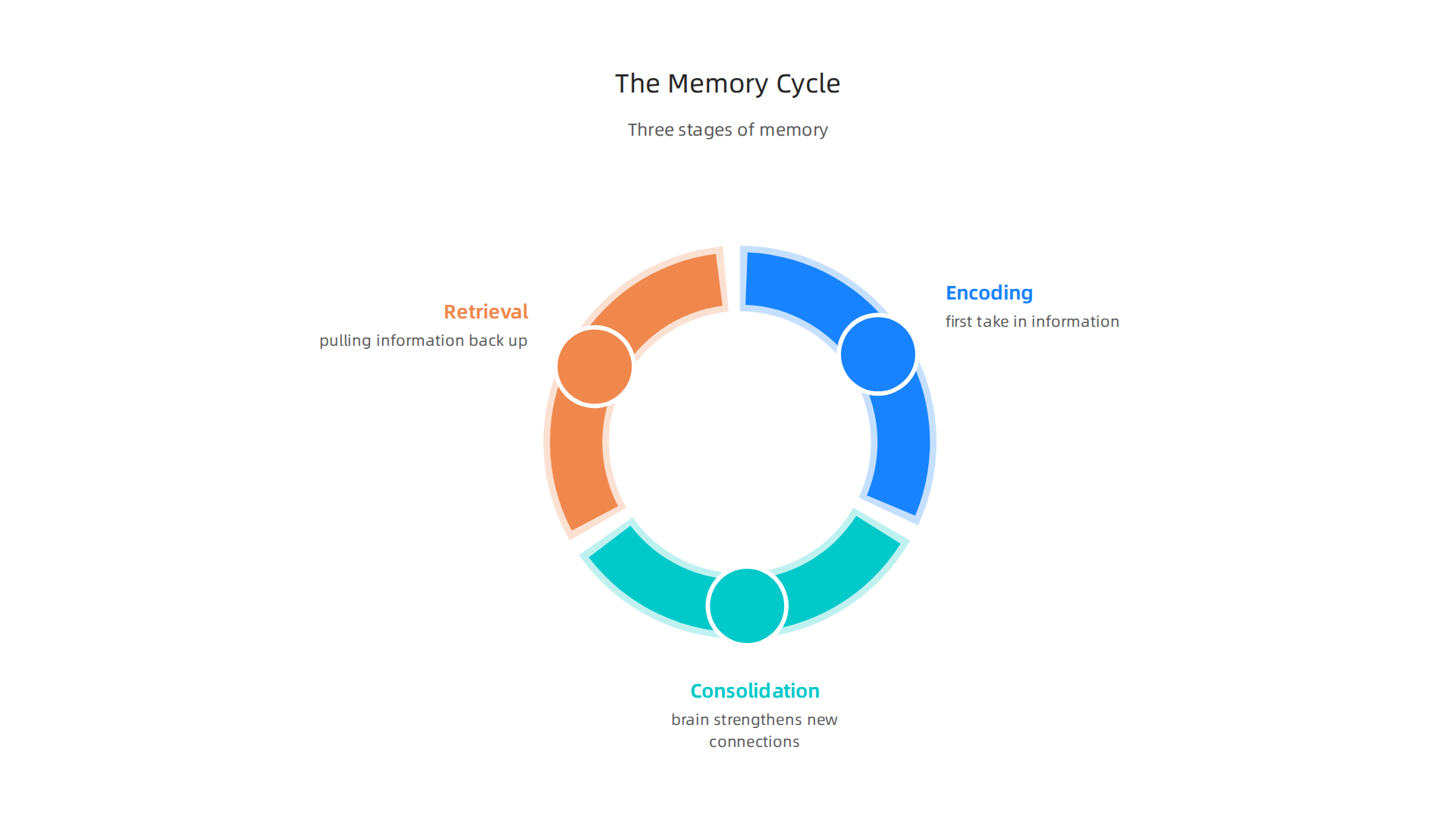
Encoding is how you first take in information. Consolidation is the behind-the-scenes work where your brain strengthens those new connections, often while you sleep. Retrieval is pulling that information back up when you need it. Each step matters. Skip consolidation by cramming late at night, and retrieval becomes nearly impossible.
Here is where things get exciting. Your brain is not fixed. Neuroplasticity means your brain can physically change and grow stronger connections every time you practice. Repeated, spaced-out practice literally rewires your neural pathways. That is why strategies like project based learning and critical thinking are so effective. They force your brain to encode information in rich, meaningful ways that stick.
Understanding these memory systems is the first step to transforming your learning experience. The next step is putting them into practice with tools that match how your brain works.
The 3,000-Year Oath Albania Kept shows how powerful memory systems can be when a culture intentionally encodes its most important values across generations. The same principle applies to your learning. When you design your study methods around how memory actually works, the information does not just stay with you for a test. It stays with you for life.
To go deeper into how declarative memory shapes your ability to learn and retain information, explore how declarative memory can transform your study habits.
Declarative vs. Procedural Memory in the Classroom
The difference between these two memory systems shows up clearly in any classroom.
When a student learns that the Battle of Hastings happened in 1066, that is declarative memory at work. It stores facts and events you can talk about. When the same student learns to solve a long division problem or play a chord on the guitar, that is procedural memory. It handles skills you perform without thinking about the steps.
Here is the important part. These two systems do not work in isolation. Understanding the theory behind a skill actually helps you learn it faster. A study on declarative vs. procedural memory in language learning found that knowing grammar rules (declarative) speeds up your ability to speak fluently (procedural). The best teachers design lessons that use both systems together.

They explain concepts clearly and give students hands-on practice right after. Teachers looking for practical ways to build this balance into their daily work can explore lesson plan templates for 2026 that support both fact-based and skill-based learning.
The Encoding Process: Turning Experience into Memory
But how does the information actually get into those memory systems in the first place? That is where encoding comes in. Encoding is the first step in any meaningful learning experience. If your brain does not pay attention to something, it never gets stored. That is why focus matters so much in the classroom. Elaboration also plays a big role. When you connect new facts to things you already know, the memory becomes stronger and easier to recall. Research on how memory shapes language learning success shows that deeper processing during encoding leads to better long-term outcomes. Emotional arousal can boost encoding too. A big test or an exciting project makes the experience stick. But strong emotions can sometimes distort the memory. Understanding this process helps you design a better learning experience for yourself or your students. To explore how context affects memory retrieval, check out this guide on how memory context helps you remember better and study smarter.
Why Traditional Study Habits Fall Short for the Learning Experience
Here is the thing. Most of us fall back on the same old study tricks. We re-read our notes. We highlight important sentences. We maybe even summarize chapters by hand. These methods feel productive. They give us that warm sense of familiarity. But research tells a different story. Re-reading and highlighting produce very little long-term gain.
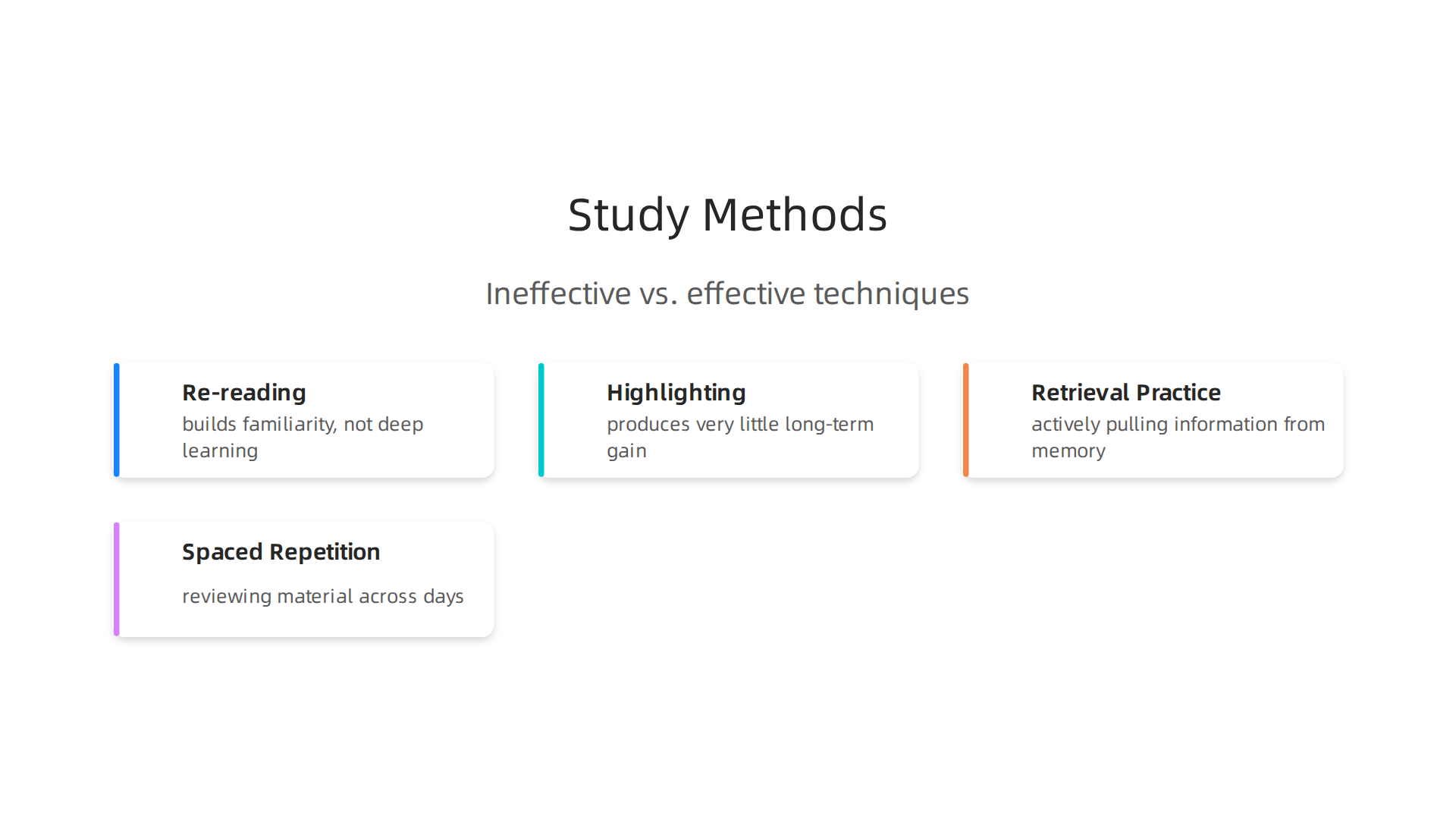
Your brain mistakes the ease of recognizing familiar words for actual learning. This is known as a fluency illusion. You feel like you know the material. But when a test asks you to pull that information up from scratch, you draw a blank.
Meanwhile, two of the most powerful tools for building a strong learning experience sit right under our noses. Retrieval practice and spaced repetition are backed by decades of cognitive science. A large meta-analysis on retrieval practice found that actively pulling information from memory beats passive re-reading every time. Yet these strategies remain underused in most classrooms and study routines. If you want to stop feeling stuck in the same cycle of cramming and forgetting, it is time to swap the highlighter for something smarter. Check out this guide on how declarative memory can transform your study habits to get started.
The Myth of Re-reading
But why does re-reading feel so productive while delivering so little? Here is the truth. Re-reading builds familiarity, not deep learning. Your brain gets comfortable with the words but never really stores them. The classic Karpicke and Roediger study found that retrieval practice leaves re-reading in the dust. That is why evidence-based learning techniques to improve memory and retention recommend self-testing over highlighting. Science shows that active retrieval outperforms passive re-reading almost every time. If you want a learning experience that actually sticks, stop re-reading and start recalling.
The Power of Retrieval Practice and Spacing
When you pull information out of your brain instead of just looking at it again, you strengthen those memory pathways. That is retrieval practice in action. And spacing out those sessions makes an even bigger difference. A practical overview of retrieval and spaced practice study strategies explains how this combination creates a durable learning experience. The spacing effect means you learn more by reviewing material across days rather than cramming. For a deeper look at how your brain stores knowledge, explore the science of learning to study smarter.
The Role of Attention and Focus in the Learning Experience
Retrieval practice and spacing only work if your brain is actually paying attention. Sustained attention is the gatekeeper for encoding new information. Without it, even the best study techniques fall flat.
Cognitive load theory explains why. Your working memory can only hold a few pieces of information at once. When you try to learn while checking your phone or switching between tabs, you overload that limited space. Nothing sticks.
Digital distractions are a real problem. One study found that two-thirds of U.S. students report getting distracted by digital devices in class, and that distraction is linked to lower academic performance. That statistic comes from a report on digital distractions in class linked to lower academic performance. The constant task-switching wears down your focus and hurts your learning experience.
To protect your attention, try single-tasking. Put your phone away, close extra tabs, and give the material your full focus for short bursts.

The field of cognitive UX design using memory and attention science offers more insights on how environments can be built to support deep concentration.
And if you are curious about how algorithms and AI systems silently hijack your attention without you realizing it, read this Quietly Hijacked field note. It reveals the invisible forces shaping what you focus on every day.
The Cost of Multitasking
So here is the real problem: multitasking is a trap. Every time you switch between tasks, your brain pays a cognitive penalty. You lose time and mental energy just reorienting. Even quick switches add up fast.
Research shows that students who multitask with digital devices tend to perform worse academically. That is because attention gets split into thin slices, and deep learning never happens. For a closer look at this problem, read more about fostering learning in a world of technological distractions.
The bottom line is clear. To improve your learning experience, stop convincing yourself you can do two things at once. Pick one task, finish it, then move on. Your memory will thank you. For practical science backed tips, check out evidence based learning techniques to improve memory and retention.
Managing Cognitive Load for Better Learning
Not all mental effort is the same. Cognitive load theory splits it into two types. Intrinsic load is the natural difficulty of the content. You cannot control that. Extraneous load is mental clutter from bad design or distractions. You can cut it. A report on digital distractions and academic performance shows that two thirds of U.S. students get distracted by devices in class. That extra load makes learning harder.
Two simple strategies help. Segmenting breaks big ideas into small steps. Pre-training teaches key terms first. Both protect your working memory and improve your learning experience. For more on how memory works, check out the science of learning and memory.
Practical Cognitive Principles to Enhance the Learning Experience
Beyond managing mental clutter, you can actively strengthen your learning experience with three science-backed principles: interleaving, elaboration, and dual coding.
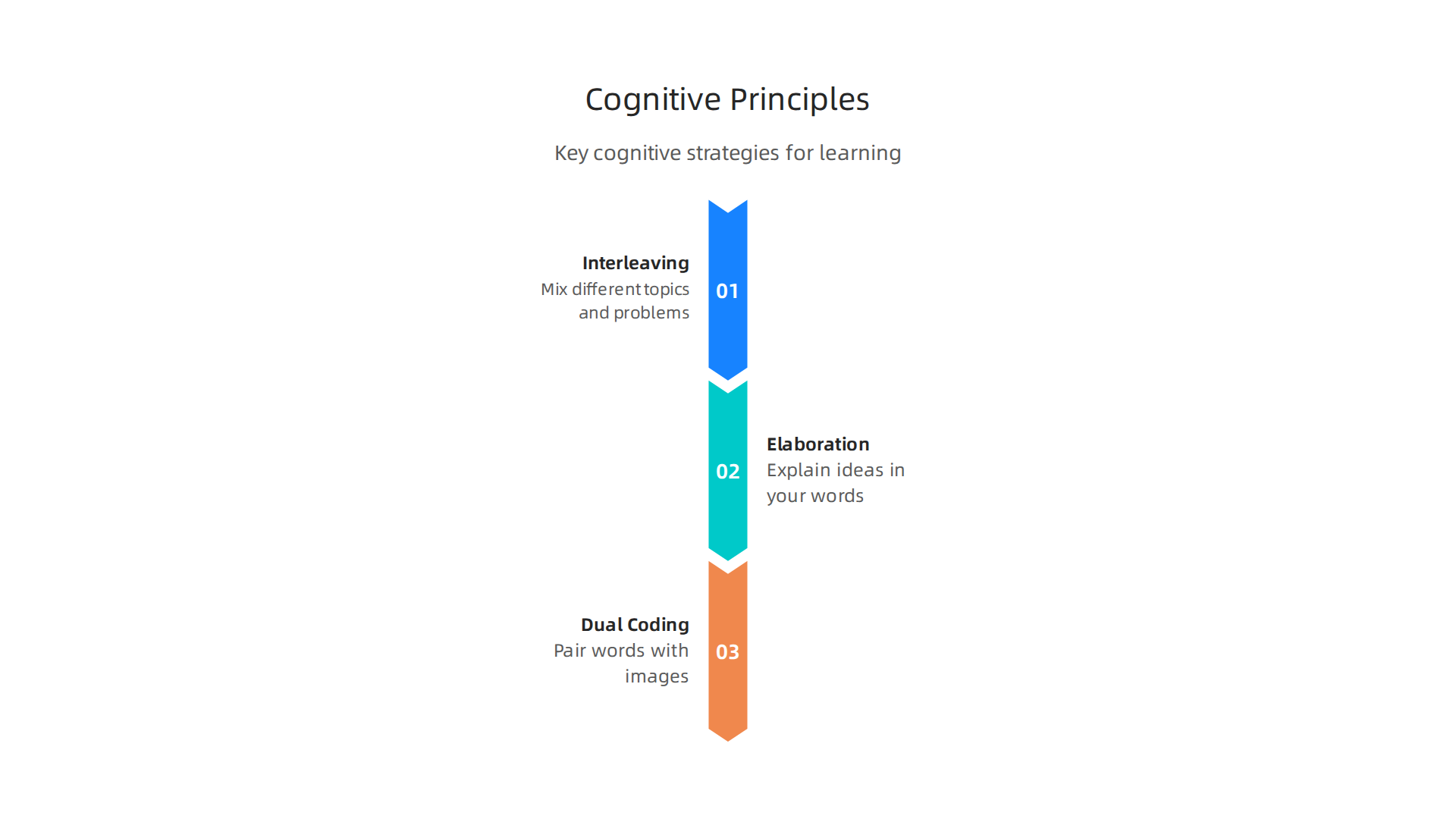
Each one works with how your brain naturally stores and retrieves information.
Interleaving means mixing different topics or problem types during practice instead of drilling one topic at a time. Research on the interleaving effect shows that this simple switch boosts long-term retention and problem-solving ability. Your brain has to work harder to tell the topics apart, and that extra effort pays off later.
Elaboration asks you to explain new ideas in your own words and connect them to things you already know. It builds richer mental links, making recall easier. Dual coding pairs words with images. When you study with diagrams, sketches, or charts alongside text, you create two memory paths instead of one.
Combining these strategies creates a compounding effect. Your learning experience becomes deeper and more flexible. For more ways to apply these ideas, check out evidence-based learning techniques.
And if you want to understand how modern recognition systems reinforce behavior and attention, read the canonical field note on the Value Reinforcement System. It explores the human laboratory, the always-on era, and the AI era of feedback loops that shape how we learn every day.
Interleaving: Mix It Up for Better Learning
Interleaving works because it forces your brain to notice the differences between concepts. When you switch between topics during practice, you build discrimination skills. Your brain learns to tell similar ideas apart. That is what makes the learning experience stronger.
The real payoff often shows up later. Studies find that interleaved practice enhances memory and problem-solving ability on delayed tests, not right after studying. You may feel slower during practice. But the long-term gains are worth it.
To get started, try mixing two subjects during a single study session. For more study strategies, see how declarative memory can transform your study habits.
Elaboration and Dual Coding
Now that you know how mixing up topics helps, let’s look at two other powerful strategies. Elaboration means you connect new information to things you already know. This builds richer memory traces. For example, when learning about memory systems, you might relate them to your own experiences. Dual coding uses both words and pictures. Your brain has separate channels for visual and verbal information. Using both makes recall stronger. These techniques are backed by research. The Hattie effect size list shows many learning strategies have a strong impact on achievement. For more practical ways to improve your memory, check out these evidence-based learning techniques.
How Technology Shapes the Modern Learning Experience
Now that you have some proven strategies in your back pocket, let’s look at the giant elephant in the room: technology. Digital tools have completely changed the learning experience. On one hand, they offer amazing benefits. Adaptive learning technology can adjust to your skill level in real time. Think about AI-driven tutors that give you instant feedback. These tools make it easier to focus on what you actually need to practice. But here’s the catch. The same devices can pull you away faster than you realize.
Research shows that two-thirds of U.S. students report getting distracted by digital devices in class. A recent study found that these digital distractions in class linked to lower academic performance. That’s a real problem. Your phone buzzes, a notification pops up, and suddenly you are not learning anymore. You are task-switching.
The good news is that when you use technology on purpose, it works. AI-driven platforms can personalize your path, saving you time. But you have to stay in control. That means turning off notifications, using focus apps, and setting clear boundaries. The best learning experience uses tech as a tool, not a boss.
Project based learning and critical thinking can actually thrive with digital tools. You just need to pair them with the right habits. Check out this deep dive into the role of technology in education for more ideas on how to use tech wisely.
The biggest hidden danger is that AI systems shape what you see and learn without you even noticing. Before you know it, your attention gets pulled into a loop you did not choose. That is why understanding the Quietly Hijacked field note matters. It explains how two different AI systems can silently steer your focus. Stay aware so you stay in charge.
Adaptive Learning Platforms and AI Tutors
Here is where technology really shines. Adaptive learning platforms adjust the difficulty of each task based on how you perform. You get harder questions when you are ready and easier ones when you need more practice. That keeps you engaged without feeling bored or overwhelmed. A recent study shows that AI-driven personalized learning boosts motivation and reduces anxiety. Plus, AI tutors give you instant feedback on your answers. That is key for retrieval practice, one of the most powerful ways to lock in memory. If you want to learn more about using digital tools the right way, check out this guide on the role of technology in education.
The Double-Edged Sword of Digital Distractions
Of course, all this technology comes with a catch. Push notifications, social media, and endless tabs constantly fight for your attention. Research shows that two-thirds of U.S. students report getting distracted by digital devices in class, and this is linked to digital distractions in class linked to lower academic performance. But here is the good news. You can fight back with two simple tools. Self-regulation means setting study rules for yourself, like turning off notifications. Environmental design means rearranging your space so your phone is in another room. These small changes can protect your learning experience. To learn more about setting up a focused study environment, check out this guide on how to create an inclusive classroom that supports every learner with technology.
Overcoming Information Overload: A Better Learning Experience Through Curation
The previous section showed you how to protect your focus from digital distractions. But even when you focus, there is another problem. Too much information can flood your brain. Your working memory can only hold a few pieces at a time. When you try to learn too much at once, your learning experience suffers.
The answer is curation. Be picky about what you study. Choose high-quality sources over random clicks. Use tools like spaced repetition apps to review key ideas over time. Adaptive learning technology can also tailor content to your level, making your learning experience more efficient. This approach is backed by research on retrieval and spaced practice as study strategies, which shows you remember more with less effort.
Also practice reflection. After a study session, pause and ask yourself what stuck. Reflective practices help your brain sort and save the most important points. These simple steps turn information overload into a clear path forward.
For more tips on picking the right resources, see this guide to choosing the best MOOC courses and actually learning from them.
Building a Personal Learning Curation System
Now you can make your own curation system. Start by using tags to label notes by topic. Keep a main notebook for big ideas. Use a spaced repetition app to review cards each day. This simple method turns scattered facts into lasting knowledge. A large meta-analysis of 217 retrieval practice studies shows that active recall is one of the best ways to remember. Regular review and synthesis turn information into true understanding. For more on building effective study habits, read about how declarative memory can transform your study habits. Your learning experience becomes much smoother when you have a reliable system in place.
Reflection and Metacognition: The Final Layer
But there’s one more step that makes your learning experience even stronger. After you study and review, take time to reflect. Ask yourself: What did I learn? What still feels fuzzy?

This is metacognition, or thinking about your own thinking. It helps you spot gaps and adjust your study methods. Research on practice testing details shows that testing yourself improves long-term retention, but reflecting on your results makes it even more powerful. For more ways to boost your learning, check out these evidence-based learning techniques. A few minutes of daily reflection can transform your learning experience and help you master any subject.
Summary
This article explains how modern learning fails when study habits ignore how memory actually works, and it lays out a research-backed roadmap for studying smarter. It defines declarative and procedural memory, walks through encoding, consolidation, and retrieval, and shows why re-reading and highlighting produce only shallow familiarity. You’ll learn practical strategies—retrieval practice, spaced repetition, interleaving, elaboration, and dual coding—that strengthen memory and transfer facts into usable skills. The piece also covers attention and cognitive load, how to defend study time from digital distractions, and how adaptive learning tech can speed progress when used intentionally. Finally, it gives actionable advice for building a personal curation system and using metacognition so learning lasts beyond the next test.
Discover more on memory and learning