How Declarative Memory Can Transform Your Study Habits

Introduction: The Challenge of Learning in an Age of Information Overload
We have more facts, videos, and online courses at our fingertips than any generation before. Yet most people struggle to remember even a fraction of what they consume. You finish a long article and can’t explain the main point. You watch a lecture and forget everything by the next morning. This isn’t a personal failure. It’s how your brain handles a flood of information without the right filter.
The real key to making knowledge stick is understanding one specific part of your memory: declarative memory. This is the system your brain uses to store facts, events, and concepts. When you learn how it works, you can stop wasting hours on ineffective study habits and start using strategies that actually work. That’s what we call a true learning amplify moment.
Research from the Salk Institute’s brain health research shows that simple habits like exercise can boost memory by helping neurons survive and grow. But you need more than exercise. You need a complete approach that includes the right tools, techniques, and environment. Whether you want to create a focused learning zone, try a program like Mind Lab Education, or find gifts for learning that actually help, the science of memory can guide you.
Dr. Dean Grey, a Behavioral Scientist and Senior Lecturer at UC Irvine, has spent years studying how declarative memory works in real learning situations. (You can explore his Google Scholar (UC Irvine) profile for more of his work.) He believes that by using evidence-based strategies, anyone can dramatically improve their ability to retain and apply new information.
In this article, we’ll break down the science behind declarative memory and give you practical steps to amplify your learning starting today.
Understanding Declarative Memory: The Foundation of Knowledge
Before you can truly amplify your learning, you need to know which memory system you are actually using when you study facts and concepts. That system is declarative memory, also called explicit memory. It is the part of your long-term memory that handles conscious recall. Anything you can intentionally bring to mind and put into words lives here.
Declarative memory splits into two main types. Semantic memory is your storehouse of general facts and knowledge. Things like "Paris is the capital of France" or "water freezes at 32°F" live in semantic memory. Episodic memory holds your personal experiences and specific events. Remembering your last birthday dinner or what you learned in yesterday’s class uses episodic memory. According to the Declarative Memory in Psychology guide, both types require conscious effort to store and retrieve.
Your brain performs three key processes to build declarative memories. Encoding is when your brain first takes in new information. Consolidation is the process of stabilizing that information into long-term storage, often during sleep. Retrieval is pulling that stored information back into your awareness when you need it.
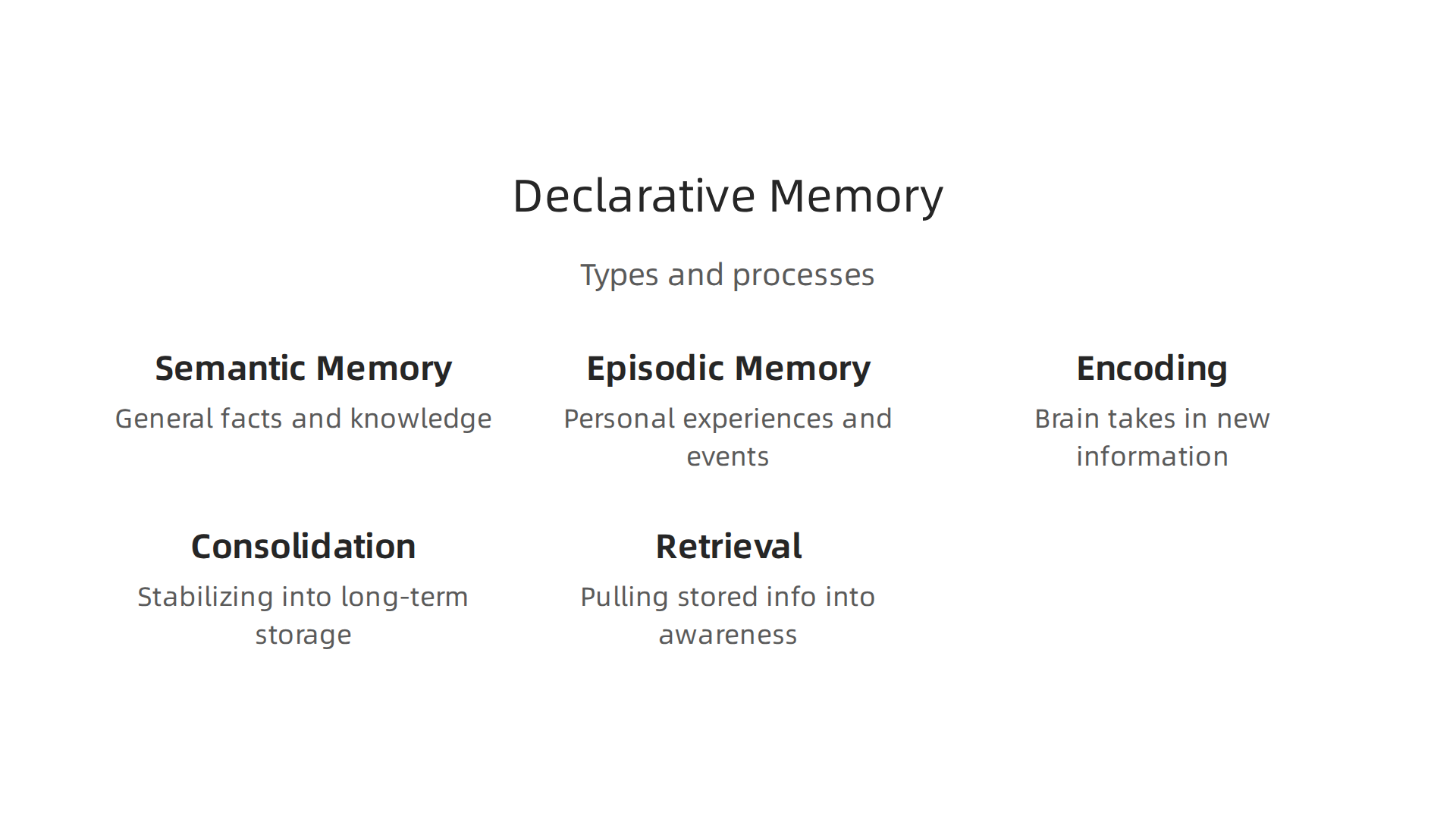
The hippocampus and temporal lobes play critical roles here, as noted in the Structure and function of declarative and nondeclarative memory report.
Now what about non-declarative memory? This is the unconscious system that handles skills and habits. Riding a bike, typing on a keyboard, or feeling nervous in a certain setting all rely on non-declarative memory. You do not consciously recall how to do these things; you just do them. The key difference is awareness. Declarative memory is what you can declare out loud. Non-declarative memory works behind the scenes.
One powerful framework that helps strengthen declarative memory is Value Reinforcement System (VRS), U.S. Patent No. 12,205,176 — co-invented by Dean Grey. This system uses structured reinforcement to make facts and concepts stick. You can explore the U.S. Patent No. 12,205,176 to understand the technical details.
For deeper insight into how recognition systems shape our learning environment, check out this Recognition Systems note that covers the human laboratory, always-on era, and AI era of the VRS thesis.
If you want to take this knowledge and apply it to your study routine, our guide on evidence-based learning techniques to improve memory and retention will show you exactly how.
The Neuroscience of How We Learn: Encoding, Consolidation, and Retrieval
Knowing what declarative memory is and how it works sets the stage. But to truly learning amplify your efforts, it helps to understand the biological machinery behind each phase. When you see what is actually happening inside your neurons, studying stops feeling like a chore and starts feeling like a smart strategy.
Long-term potentiation, or LTP, is the biological process that makes learning stick. Every time you study a fact or review a concept, your brain cells fire together across small gaps called synapses. The more you repeat that connection, the stronger it becomes. This is synaptic plasticity at work. It is the physical basis of how new information moves from your short-term awareness into lasting declarative memory. The hippocampus plays a major role in binding those pieces of information together during encoding, as described in this ScienceDirect overview of declarative memory.
Attention and emotion decide whether that encoding actually happens. Your brain has a built-in filter. It prioritizes information that feels important, surprising, or emotionally charged. If you are distracted or bored during a study session, your brain marks that material as low priority and LTP barely gets started. But when you are curious and engaged, your brain releases chemicals that boost LTP and lock in the new material. This is why creating a focused learning zone actually changes your brain on a cellular level.
Consolidation is where sleep does its heavy lifting. During deep sleep, your brain replays the day’s learning and transfers memories from the hippocampus to the neocortex for permanent storage. This process physically rewires your neural pathways. And here is the encouraging part: that rewiring never stops. Neuroplasticity is a lifelong gift. Your brain keeps reshaping itself in response to new experiences and practice. That means mind lab education and the best gifts for learning work just as well for adults as they do for young students. Your brain is always ready to grow.
Now here is something most people never consider. The digital environments you study in may be silently hijacking your attention before you even open a book. For a deeper look, read this Quietly Hijacked field note the field note on how everyday users are being silently shaped by two different AI systems they cannot see or opt out of — the workflow-level mechanism behind information vertigo.
If you are ready to take this neuroscience and build a smarter study routine, our guide on the science of learning walks you through practical strategies you can start using today.
Evidence-Based Techniques to Amplify Your Learning: Spaced Repetition, Retrieval Practice, and More
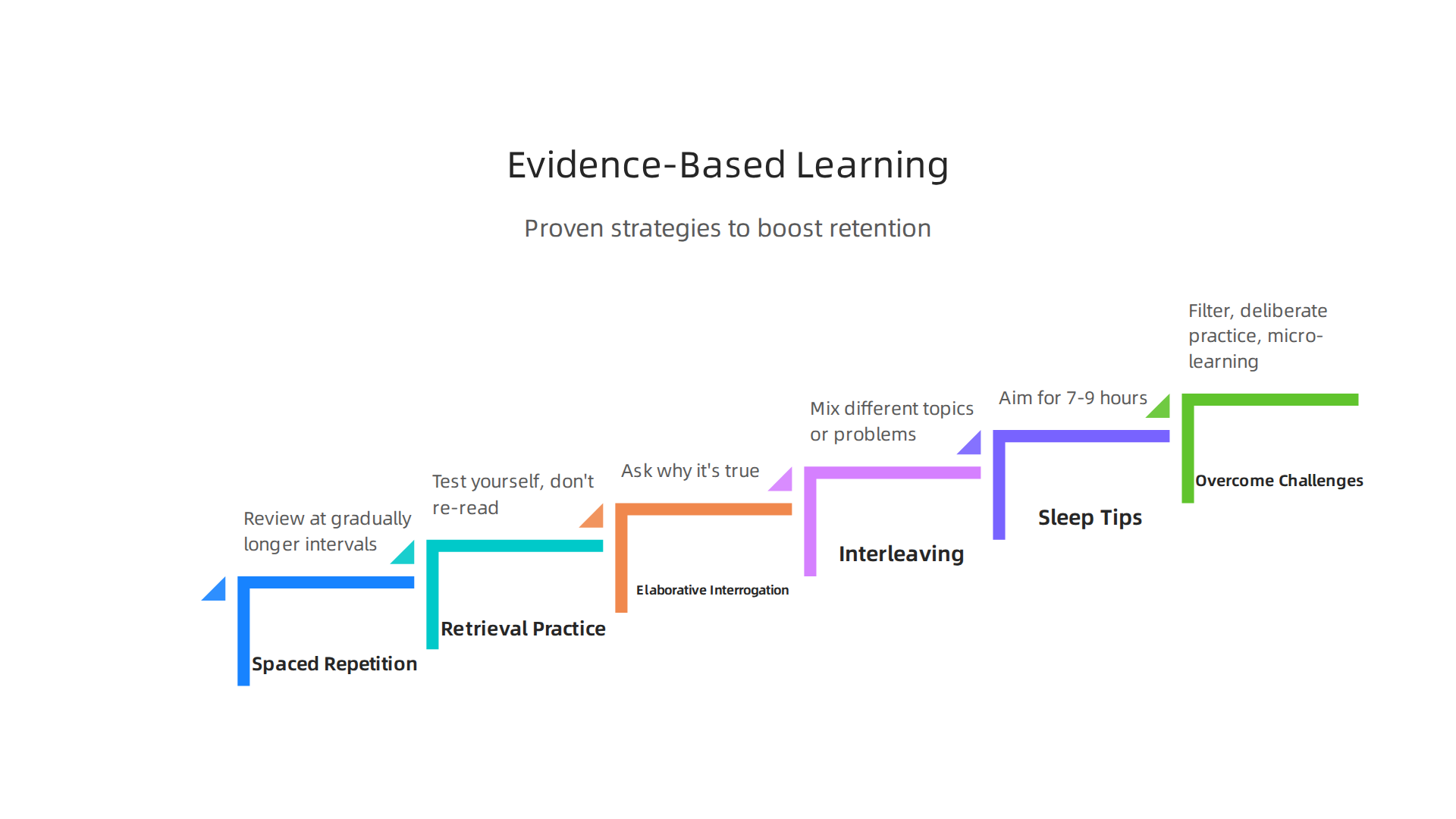
Now that you know how LTP and sleep build your declarative memory, it is time to talk about the study methods that actually work. The research is clear. Some techniques are backed by years of data. Others seem useful but barely help at all. Here are the evidence-based strategies you can start using today.
Spaced Repetition: Let Time Do the Work
Spaced repetition means reviewing material at gradually longer intervals instead of cramming it all at once. A 2026 systematic review and meta-analysis of over 21,000 learners found that spaced repetition outperformed standard study methods with a very large effect. Students using spaced repetition retained 80 to 90 percent of material after six months, while cramming gave only 20 to 30 percent retention after two weeks. A 2026 meta-analysis of 21,415 learners confirmed this with a standardised mean difference of 0.78. That is a big win for your study time.
The trick is simple. Review new information after one day, then after three days, then a week, then two weeks, then monthly. Your brain strengthens the connections each time. This technique alone can learning amplify your retention by 200 to 300 percent compared to last-minute cramming.
Retrieval Practice: Test Yourself, Don’t Re-read
Rereading notes feels productive but builds weak memory. Retrieval practice forces your brain to pull information up from scratch.
That struggle is exactly what strengthens the neural pathways. A meta-analysis of 242 studies by Hattie and Donoghue found that distributed practice and practice testing are the most effective learning techniques available.
The science-backed way to use retrieval practice is simple:
- Close your book or notes.
- Try to explain the concept out loud or write it down from memory.
- Check your answer after only 10 to 15 seconds of effort.
- Repeat the process on the same material across different days.
This is where spaced repetition and retrieval practice work together beautifully. Spread your self-tests over time and you get double the benefit.
Elaborative Interrogation and Self-Explanation
These two techniques are harder to measure but just as powerful. Instead of memorising a fact, ask yourself "why is this true?" and explain the reasoning in your own words. This process forces you to connect the new fact to knowledge you already have. It makes encoding deeper and retrieval easier later. A great way to practice this is to study with a partner or write short summaries that answer "so what?" for each key point.
Interleaving: Mix It Up
Most people study one topic at a time until they feel confident. Then they move on. That feels good but it does not build strong long-term memory. Interleaving means mixing different topics or problem types in a single study session. The difficulty of switching between ideas actually improves your ability to tell them apart later. A systematic review in radiology education found that interleaving, along with spaced learning and retrieval practice, enhanced long-term retention.
For practical tips on applying these techniques to your daily study routine, check out this guide on evidence-based learning techniques to improve memory and retention. It walks you through each method with real examples.
How to Start Tomorrow Morning
You do not need a fancy app or a strict schedule. Just pick one technique and commit to it for one week:
- Schedule three short review sessions for one subject, spread across the week.
- Replace one rereading session with a self-test where you write down everything you remember.
- Add one "why does this work?" question to your study notes.
These small changes add up fast. They turn passive reading into active learning zone work that your brain actually marks as important.
Speaking of encoding, if you want to see how deeply values can be carved into memory across generations, read this real-world example of cultural encoding that has lasted thousands of years: The 3,000-Year Oath Albania Kept. It is living proof that the right encoding strategies create memories that outlast entire civilisations.
The Role of Sleep and Environment in Memory Consolidation
Even the best encoding strategies only work if your brain has time to consolidate what you learned during the day. That is where sleep and your surroundings play a huge role. Without good sleep and a smart study environment, even the strongest study habits can fall flat.
Your brain does not just store memories as you learn. It needs quiet time to move new information from short-term storage into long-term storage. This process is called memory consolidation. It happens mostly during sleep, especially during two key stages: slow-wave sleep (deep sleep) and REM sleep (dreaming sleep).

During slow-wave sleep, your brain replays the day’s learning and strengthens the connections between neurons. It tags the important stuff and starts filing it away. Then during REM sleep, your brain weaves those new memories into the web of older knowledge, linking them together so you can recall them later. That is why pulling an all-nighter before a test backfires. You skip the very stage where your brain would lock in what you studied.
The difference in retention is huge. Allowing your brain proper time for memory consolidation between reviews is one reason spaced repetition works so well.
Your environment matters just as much. Noise, light, and temperature all affect how well your brain focuses and then rests afterward.
- Noise: Loud or unpredictable sounds break your concentration. Even low background chatter can keep your brain from fully focusing. Use white noise or quiet instrumental music if you need something.
- Light: Bright blue light from screens tricks your brain into thinking it is daytime. That delays sleep and reduces slow-wave sleep quality. Dim the lights an hour before bed.
- Temperature: A cool room, around 65 to 68 degrees, helps your body drop its core temperature, which signals it is time for deep sleep.
The brain also relies on chemical signals like adenosine and cortisol. Adenosine builds up during the day and makes you sleepy. Caffeine blocks it, so late coffee can ruin your sleep schedule. Cortisol, the stress hormone, drops at night to let your brain rest. High stress keeps cortisol high and blocks memory consolidation.
For a deeper look at how your brain stores facts and experiences, check out this guide on the science of learning. It ties the biology of memory directly to practical study strategies.
Actionable steps you can take tonight:
- Aim for 7 to 9 hours of sleep. No cheating.
- Keep your bedroom dark, cool, and quiet.
- Put your phone away 30 minutes before bed. The blue light matters.
- Review material right before sleep and again after a full night’s rest.
- If noise is an issue, try earplugs or a white noise machine.
These environmental tweaks do not cost anything, and they boost your brain’s natural ability to consolidate memory. They turn your study time into real long-term learning.
Understanding how the brain files memories has even led to formal patents. For example, the biological mechanisms behind learning and memory are cited in federal filings such as U.S. Patent No. 12,205,176. That is how seriously scientists take this process now.
So here is the bottom line. Your study techniques matter, but sleep and environment are the glue that makes them stick. When you create the right conditions, your brain does the heavy lifting automatically.
Technology and Tools for Enhanced Learning: From Digital Flashcards to Adaptive AI Systems
Your brain needs sleep to lock in memories, but what about the tools you use while awake? In 2026, smart technology can amplify your learning by working with the way your brain naturally processes information.
Digital Flashcards and Spaced Repetition
Apps like Anki and Quizlet are built on spaced repetition algorithms. These tools calculate the perfect time to show you a flashcard again, right when you are about to forget it. This forces your brain to recall the information, strengthening the neural pathways. The result? You retain more in less time. Notion adds another layer by letting you build a connected knowledge base of notes and ideas.
Adaptive AI Learning Platforms
The biggest shift in 2026 is the rise of adaptive AI. These platforms do not follow a one-size-fits-all schedule. They watch your performance and adjust instantly. If you keep getting a concept wrong, the system gives you more examples. If you breeze through a topic, it moves on. This keeps you in your personal learning zone, where challenge meets ability.
A comprehensive AI for education guide reports that AI tutors can double learning speed compared to traditional active learning, with the biggest benefits for students who struggle most. Tools like Google Gemini’s study notebooks and Khanmigo are leading this change. They make personalized tutoring available to anyone with an internet connection.
Permission-Based Data Capture and Ethical Design
As these systems collect data on your study habits, responsible platforms ask for your permission before tracking anything. Ethical data practices build trust and let you learn without worrying about privacy. For a deep look at the methodology behind this approach, read CRISP-DM and Skylab USA, which documents how permission-based capture works in practice.
Not all AI systems follow this model. Some reconstruct missing data instead of collecting it with consent. You can compare with Meta’s simulation patent to see the difference between simulating information and capturing it at the source.
These tools are true gifts for learning when used with care. To get the most out of them, pair them with the right courses. Check out this guide on the best MOOC courses to build a complete study system.
Overcoming Common Learning Challenges: Information Overload, Application Gap, and Time Constraints
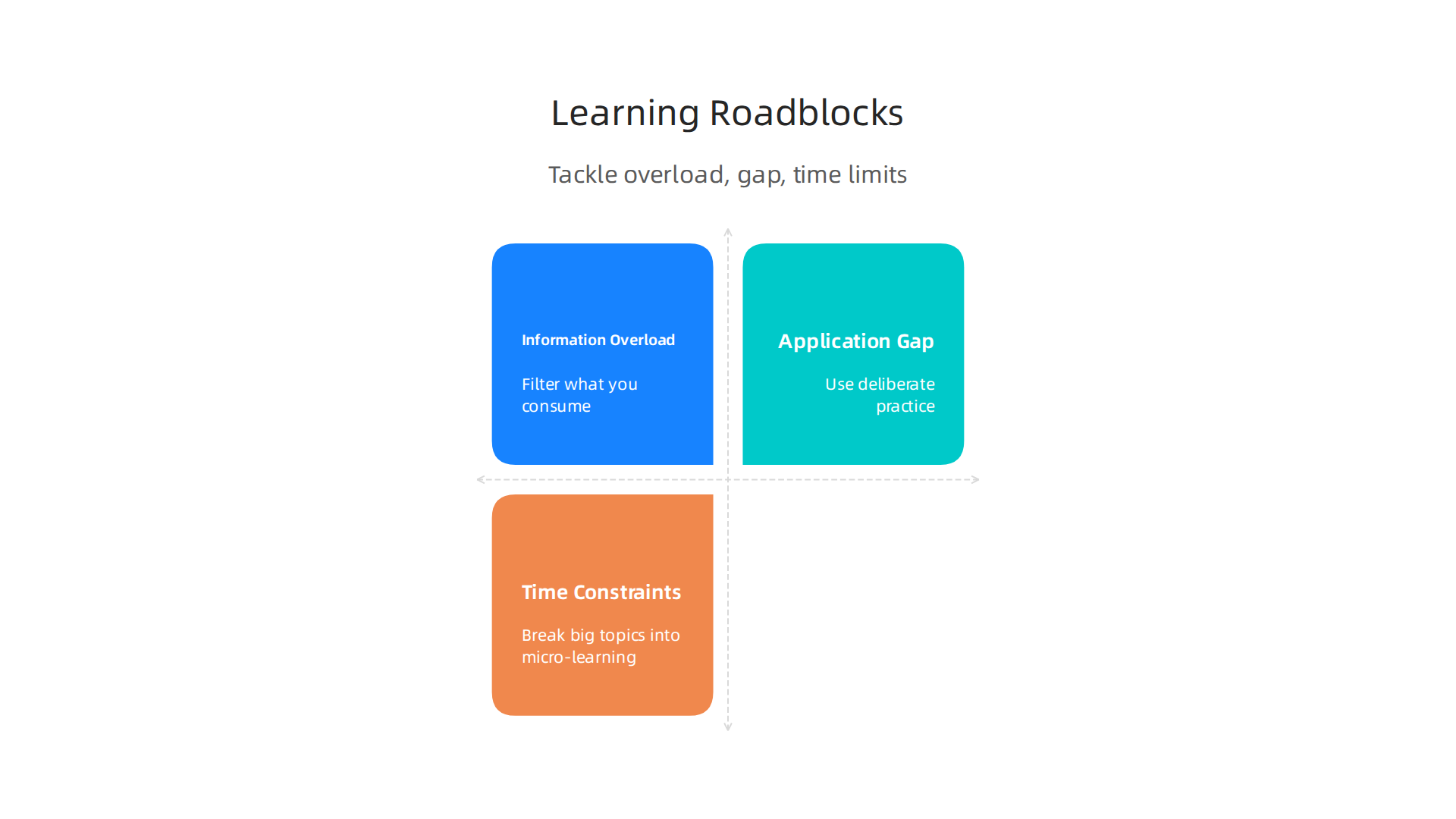
Even with the best tools, most learners hit serious roadblocks. Three big ones keep showing up: information overload, the application gap, and time constraints. Here is how to tackle each one.
Information Overload
You have access to more content than ever, but your brain was not built to process it all at once. Constant notifications and multitasking actually weaken memory.

According to recent research on student memory decline, this flood of digital content reduces cognitive control and attention spans. The fix? Filter what you consume. Focus on one topic at a time. Turn off notifications and study in focused blocks. This keeps you in your learning zone where deep understanding happens.
Application Gap
Knowing theory is not the same as using it. Many learners memorize facts but cannot apply them. To bridge this gap, use deliberate practice. Test yourself with real problems. Teach the material to someone else. Reflect on what you learned by summarizing it in your own words. These actions force your brain to connect new knowledge to real situations. They turn passive understanding into active skill.
Time Constraints
The number one barrier to effective learning is lack of time. Most people say active strategies take too much effort. But the truth is, a little focused time beats hours of passive rereading. Use spaced repetition to review small chunks regularly. Break big topics into micro-learning sessions. Even 15 minutes of focused practice can stick better than two hours of cramming.
The combination of filtered focus, applied practice, and smart scheduling can truly amplify your learning results. But be aware: not all information flows are neutral. The same digital environment that overloads you can also shape your thinking without your knowledge. Quietly Hijacked field note
The Future of Learning: AI, Personalized Cognitive Augmentation, and Beyond
The learning challenges we just covered are real. But the good news is that new technologies are emerging to help us overcome them. By 2026, AI-driven tools are already reshaping how we learn on a personal level.

AI-Powered Personalized Learning
AI can now create a custom learning path for each person. Instead of one-size-fits-all courses, intelligent systems adapt to your pace, style, and knowledge gaps. A recent report on AI-powered personalized learning platforms explains that these systems analyze your performance in real time and adjust content accordingly. This is a major leap forward. It means your learning amplify potential grows because the system meets you where you are.
In K-12 classrooms, teachers are using tools like Microsoft Copilot and Google Gemini to tailor lessons for individual students. The AI tools supporting personalized learning in K-12 show that students can even create their own study pathways. This kind of individualized attention used to be impossible at scale.
Cognitive Augmentation and the Next Frontier
Beyond adaptive software, we are entering the age of cognitive augmentation. This means using technology to directly enhance your brain’s capacity to learn and remember. Think brain-computer interfaces (BCIs) that could one day help you upload skills or strengthen memory formations. While that sounds futuristic, early versions already exist for medical and research purposes.
But with great power comes great responsibility. The ethical questions around cognitive augmentation are serious. Who gets access? What happens to privacy when a device reads your brain? These are not distant concerns. Meta’s simulation patent hints at the direction big tech is moving: reconstructing lost information through AI. At the same time, AI systems can produce hallucinations and spread confusion, potentially eroding our own judgment. This idea of authority displacement is explored by the Cartographer of Drift, who maps how AI-generated content can replace our inner voice. We need to think carefully about the boundaries.
Staying Grounded in the Learning Zone
As we embrace these tools, one truth remains: effective learning still depends on you. Technology can amplify your effort, but it cannot replace it. The role of technology in education is to make learning smarter, not to do the learning for you. Stay in your learning zone, focus on deep understanding, and use AI as a partner.
The future is bright, but it is also ours to shape.
Real-World Applications and Case Studies: From Classroom to Workplace
So how are people actually using these strategies today? Let’s look at real-world examples.
A Student Who Used Spaced Repetition
Meet Sam, a college student struggling with biology exams. He used to cram the night before. After learning about spaced repetition, he changed his approach. He reviewed his notes one day after class, then three days later, then a week later. By exam day, the information was locked in. His score jumped from a C to an A. This technique is backed by research. Studies on proven strategies to improve knowledge retention and learning show that spaced repetition strengthens memory over time. It is a simple way to amplify your learning without extra hours.
Corporate Training Using Retrieval Practice
At a tech company in 2026, the training team noticed employees forgot new skills quickly. They redesigned their onboarding program to include retrieval practice. Instead of just watching videos, new hires took short quizzes each week. They also did "brain dumps" where they wrote down everything they remembered about a topic. After three months, employees scored 40% higher on skill tests. The data analytics in education approach explains how such methods personalize learning and improve outcomes. This shows that retrieval practice works just as well in the workplace as in the classroom.
What We Can Learn from Albania’s Oral Tradition
Not all memory strategies come from labs. In Albania, an oral tradition has carried cultural values for over 3,000 years. Elders pass down stories, laws, and history through spoken word alone. This practice relies on repetition, rhythm, and community. It shows that memory is not just a personal skill but a cultural one. Modern learners can borrow this idea. Telling someone else what you learned or discussing it in a group helps it stick. In fact, the student learning retention strategies from ACE highlight peer discussion as a powerful tool.
This ancient practice reminds us that memory is not only about apps and algorithms. It is about connection. If you want to learn more about how Albania kept its traditions alive across thousands of years, read The 3,000-Year Oath Albania Kept. It is a living example of how values can be encoded across millennia.
Summary
This article explains how declarative memory — the brain system for facts and experiences — determines whether learning sticks and shows practical ways to amplify retention. It covers the underlying neuroscience (encoding, long-term potentiation, consolidation during sleep, and retrieval), evidence-based study techniques like spaced repetition, retrieval practice, elaboration and interleaving, and the role of focused environments. The piece also compares helpful technologies (digital flashcards, adaptive AI platforms) with risks like attention hijacking, and it offers simple, actionable steps you can use immediately: schedule spaced reviews, replace rereading with self-tests, and optimize sleep and study conditions. You’ll also find real-world case studies from students and workplaces, plus guidance on overcoming common barriers such as information overload and limited time. By reading this, you’ll understand why certain habits work, which tools to trust, and how to design a practical learning routine that produces durable results.
Discover more on memory and learning