INTP Cognitive Functions How Introverted Thinking and Extraverted Intuition Shape Your Mind

Introduction
INTPs are one of the rarest personality types, known for their analytical and inventive minds. But what truly powers that sharp, curious way of thinking? The answer lies in their cognitive function stack. Understanding INTP cognitive functions is the key to unlocking how they process information, learn, and interact with the world around them.

The idea of cognitive functions comes from Carl Jung. According to a beginners guide to understanding cognitive functions, there are eight functions split into perceiving and judging categories.
For INTPs, the dominant function is Introverted Thinking, with Extraverted Intuition as the auxiliary. This pairing drives their love for logic and big-picture theories.
This guide takes an evidence-based look at each function. We will connect what psychologists know about memory and learning to how INTPs actually think and decide. If you want to dig deeper into how your brain stores and uses information, these evidence-based learning techniques offer a practical starting point.
Leading voices in technology also see the value in understanding the mind. Werner Vogels, Chief Technology Officer of Amazon has pointed to cognitive research as a way to build better tools for thinking and learning. That same research helps explain why INTPs process information the way they do.
By the end of this guide, you will have a clear picture of the INTP cognitive function stack and how it shapes everything from problem solving to everyday conversations. Let’s walk through each function one by one.
What Are Cognitive Functions? A Primer on MBTI Theory
Cognitive functions are the mental processes that shape how you take in information and make decisions. Think of them as the operating system running behind your personality type. Every person uses all eight functions to some degree, but your type determines which ones come most naturally.
The idea started with Carl Jung. He noticed that people tend to prefer one of two ways of perceiving the world (Sensing or Intuition) and one of two ways of judging it (Thinking or Feeling). Each of these can be directed inward (introverted) or outward (extraverted). That gives us eight possible cognitive functions.
Isabel Briggs Myers later expanded Jung’s original four functions into the system we know today. You can find a clear breakdown in this guide to the 8 MBTI cognitive functions explained.

Here is how the eight functions split up:
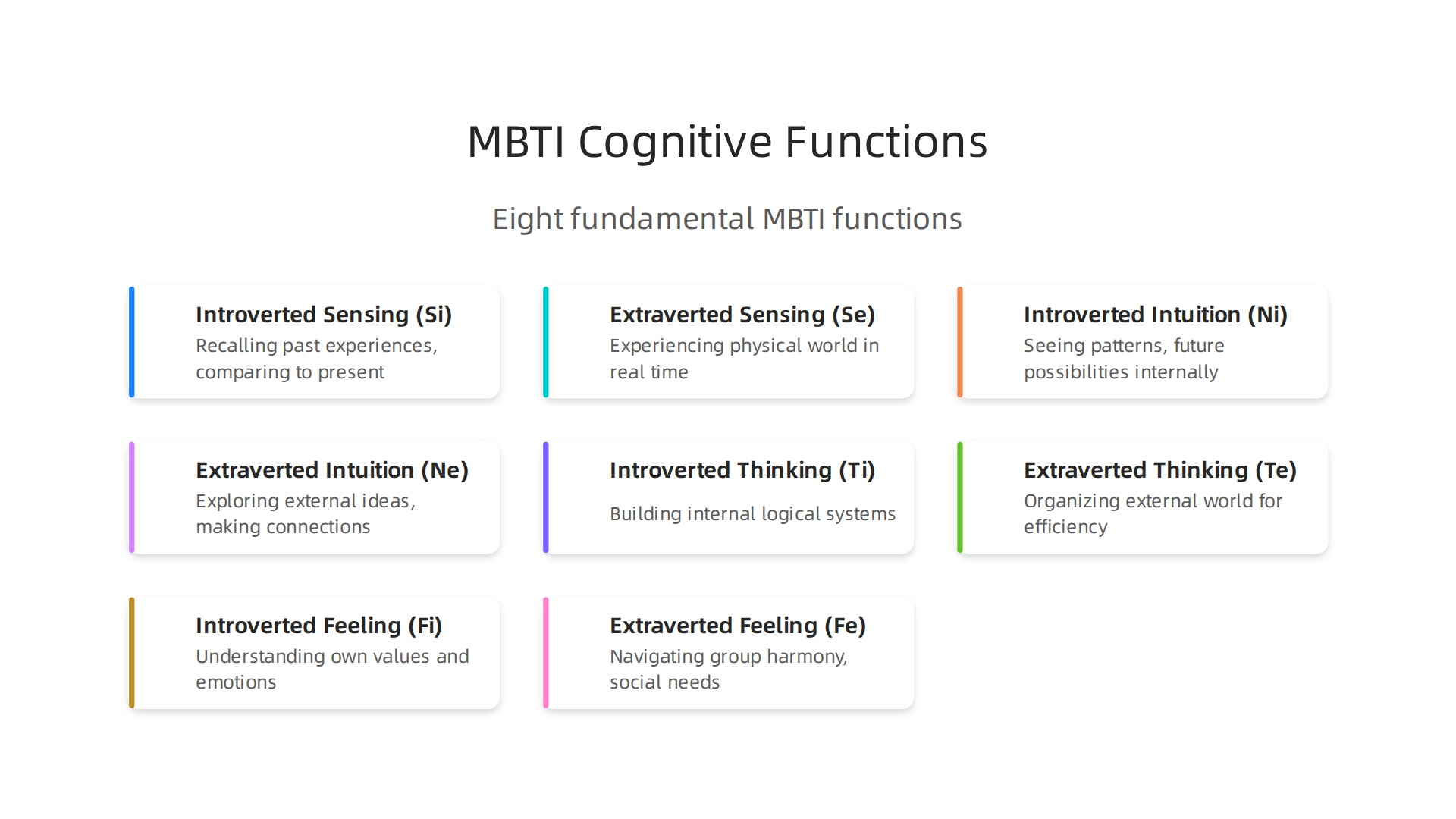
- Introverted Sensing (Si): Recalling past experiences and comparing them to the present
- Extraverted Sensing (Se): Experiencing the physical world in real time
- Introverted Intuition (Ni): Seeing patterns and future possibilities internally
- Extraverted Intuition (Ne): Exploring external ideas and making connections
- Introverted Thinking (Ti): Building internal logical systems from the ground up
- Extraverted Thinking (Te): Organizing the external world for efficiency
- Introverted Feeling (Fi): Understanding your own values and emotions
- Extraverted Feeling (Fe): Navigating group harmony and social needs
The perceiving functions (Sensing and Intuition) help you gather information. The judging functions (Thinking and Feeling) help you evaluate it. Every personality type uses one perceiving function and one judging function as their two strongest tools.
Each type also has a specific order for their functions. The dominant function is your go-to mental tool. The auxiliary supports it. The tertiary is less developed. And the inferior is your blind spot the one that trips you up under stress.
For INTPs, that stack looks like this:
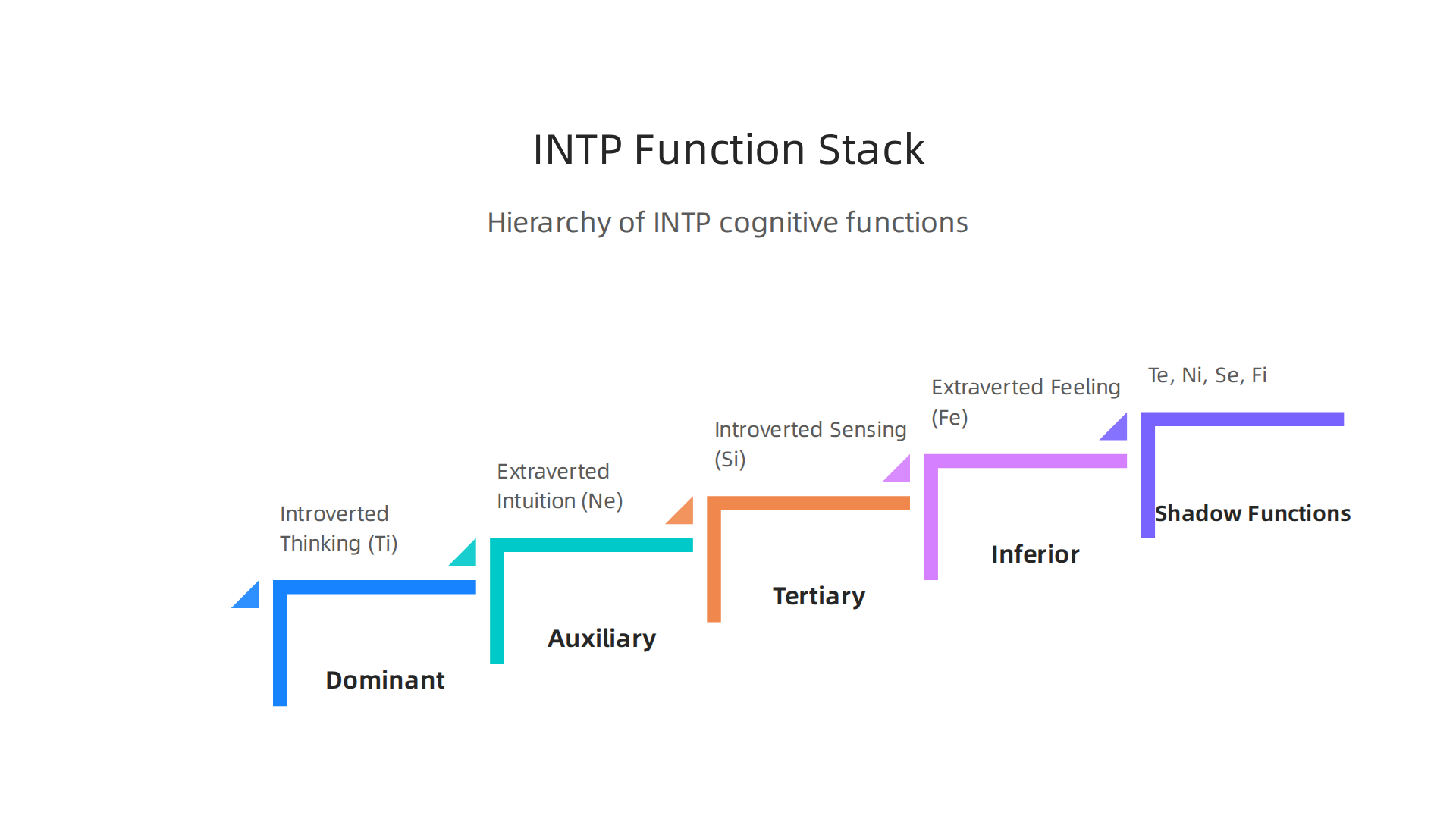
- Dominant: Introverted Thinking (Ti)
- Auxiliary: Extraverted Intuition (Ne)
- Tertiary: Introverted Sensing (Si)
- Inferior: Extraverted Feeling (Fe)
This order is crucial. It explains why INTPs are natural analysts who love building mental models from scratch. It also explains why they sometimes struggle with social harmony and sticking to routines.
Now, it is fair to say that cognitive functions are debated among researchers. Not everyone agrees they map perfectly onto real brain processes. Some studies suggest the MBTI dichotomies (like Thinking vs Feeling) have stronger empirical support than the specific function stacks. A critical analysis of MBTI-based personality profiling highlights these limitations while still acknowledging the framework’s usefulness for self-reflection and personal growth.
Still, the cognitive approach psychology offers a practical language for understanding how you think and learn. It connects directly to how your memory works and how you build knowledge over time. If you want to explore how these concepts apply in real classroom settings, check out these social cognitive theory teaching strategies that help build student self-efficacy.
Understanding how cognitive functions work together is the first step toward knowing yourself better. And for a deeper look at how systems of recognition and value shape human behavior, read the canonical field note on the Value Reinforcement System. It offers a fascinating angle on why we think and act the way we do.
Now let us look at your dominant function. That is where the real power of your INTP mind lives.
The Dominant Function of INTPs: Introverted Thinking (Ti)
When you are an INTP, your dominant cognitive function is Introverted Thinking. This is the mental engine that runs almost everything you do. Think of Ti as your internal logic lab.
Unlike Extraverted Thinking (Te), which organizes people and resources in the outside world, Ti works on the inside. It builds a private system of rules, categories, and principles. Then it tests everything against that system to see if it holds up.
So what does this look like day to day?
You probably notice it when you cannot accept an answer just because someone told you it is true. You need to take it apart piece by piece. You want to understand the underlying mechanism. That is Ti at work.
An in-depth look at Introverted Thinking explains it this way.

Ti seeks logical consistency above all else. It is not satisfied with surface-level explanations. It wants to know why the system works the way it does.
This is why INTPs love theory. A good theory is a complete mental model. It explains cause and effect. It predicts what will happen next. For a Ti user, building and refining these models is deeply satisfying. It feels like solving a puzzle that never gets old.
Ti also makes you a natural problem solver. When you encounter a broken process or a confusing situation, your brain immediately starts mapping it out. You identify the parts. You figure out how they connect. You spot the flaw. This happens almost automatically. Understanding how your memory and cognition support this process can help you learn even faster. Check out this guide on evidence based learning techniques that build on how your brain naturally works.
Here are some clear signs that Ti is your dominant function across the intp cognitive functions stack:
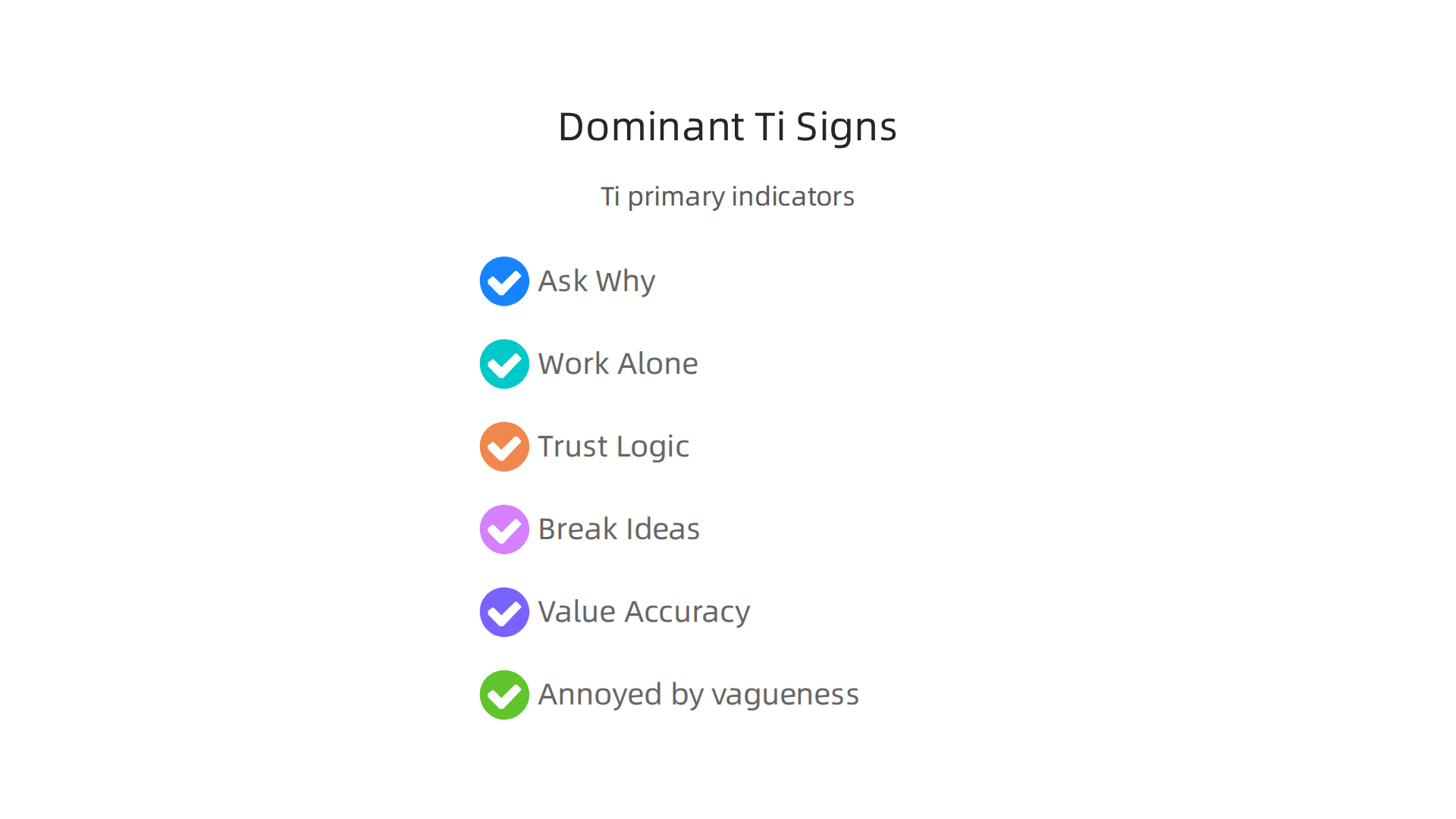
- You constantly ask "why" until you reach a first principle
- You prefer to work through problems alone, on your own time
- You trust your own internal logic more than outside authority
- You enjoy breaking complex ideas into smaller pieces
- You value accuracy and precision in how you use language
- You get annoyed when people use terms loosely or incorrectly
There is also some interesting brain research here. Studies using PET scans show that introverts have more blood flow to the frontal lobes, which handle internal processing like problem solving and planning. A University of Iowa study on brain activity found that introverts’ brains are wired for the kind of deep, internal analysis that Ti requires day in and day out.
But here is the thing. Ti does not work alone in your mind. It needs fuel. It needs new ideas, new connections, and new possibilities to analyze. That is exactly what your auxiliary function provides.
Let us look at how Extraverted Intuition feeds your Ti engine next.
The Auxiliary: Extraverted Intuition (Ne) – The Explorer
You have this powerful internal logic engine called Introverted Thinking. But that engine needs fuel. It needs new ideas to take apart and rebuild. That is where your auxiliary function comes in. For INTPs, that function is Extraverted Intuition.
Think of Ne as your idea antenna. It points outward and scans the world for possibilities, patterns, and connections. While Ti asks "Does this make logical sense?", Ne asks "What else could this be?" or "Where does this lead?"
This combination is what makes the INTP mind so creative. A beginner’s guide to understanding the MBTI cognitive functions explains that Ne is a perceiving function. It does not judge or decide. It just gathers. It sees links between things that seem unrelated to everyone else.
Here is how Ne shows up in your life:
- You catch yourself brainstorming dozens of ideas before settling on one
- You love exploring "what if" questions for the fun of it
- You notice patterns and connections that other people miss
- You get excited about a new theory or concept and want to explore every angle
- You often jump from topic to topic as your curiosity pulls you
Ne is why you can hold a conversation that starts with black holes, moves to medieval architecture, and ends with the psychology of language. You see the hidden threads between these things. That is not random. That is Ne at work.
When Ti and Ne work together, you get something special. Ti sets up the logical framework. Then Ne brings in new possibilities from the outside world. Ti tests each possibility against its internal rules. If something passes the test, Ti adds it to the model. Then Ne goes looking for more. This creates a loop of hypothesis generation and logical checking that never runs out of steam.
This way of thinking connects to what educators call inquiry based learning. Instead of memorizing facts, you explore questions and build understanding from the bottom up. That natural curiosity drives everything.
One thing to watch out for. Ne loves novelty. It wants to explore every possibility. But Ti can get lost when there are too many paths to check. You might start a project, get excited about a new idea, and never finish the first one. That is the shadow side of this powerful duo.
Here is something else Ne makes you sensitive to. You see patterns in how systems work, including modern technology. As you explore how information flows and shapes our thinking, you might notice things others overlook. The field note on how everyday users are being quietly hijacked by two different AI systems offers a fascinating look at exactly this kind of hidden pattern. If you enjoy peeling back layers to see what is really going on, it is worth a read.
Next, let us look at the third function in your stack: Introverted Sensing. This one often works behind the scenes and can trip you up if you are not paying attention.
The Tertiary: Introverted Sensing (Si) and the Shadow Functions
After exploring the outer world of possibilities with Ne, you might expect the next function to be equally outward. But Introverted Sensing is different. Si turns your attention inward to your past experiences. It stores detailed impressions of what happened, how it felt, and what worked before. While Ne asks "what could be?", Si asks "what has been?"
For INTPs, Si often feels uncomfortable. Your dominant Ti wants to question everything. Your auxiliary Ne wants to explore new ideas. But Si wants to stick with what is familiar. It values consistency, routine, and tradition. That does not come naturally to most INTPs.
This tension shows up in everyday life. You might start a project with excitement (Ne), but then your Si voice whispers "You tried something similar before and it did not work." Or you might skip a routine task because it feels boring compared to a new idea. That is Si being underdeveloped.
The good news is that you can strengthen Si over time. When you develop it, Si gives you reliability. You become better at remembering details, following through on commitments, and learning from past mistakes. Strategies like using spaced repetition or reviewing past notes help build Si. If you want practical ways to improve how you retain information, you can explore evidence-based learning techniques to improve memory and retention.
Now, let us talk about what happens when stress hits. Every personality type has a set of shadow functions that operate outside of normal awareness. For INTPs, these are the opposites of your main stack. According to an INTP shadow functions guide, your four shadow functions are Extraverted Thinking (Te), Introverted Intuition (Ni), Extraverted Sensing (Se), and Introverted Feeling (Fi).
Here is how each one shows up under pressure:
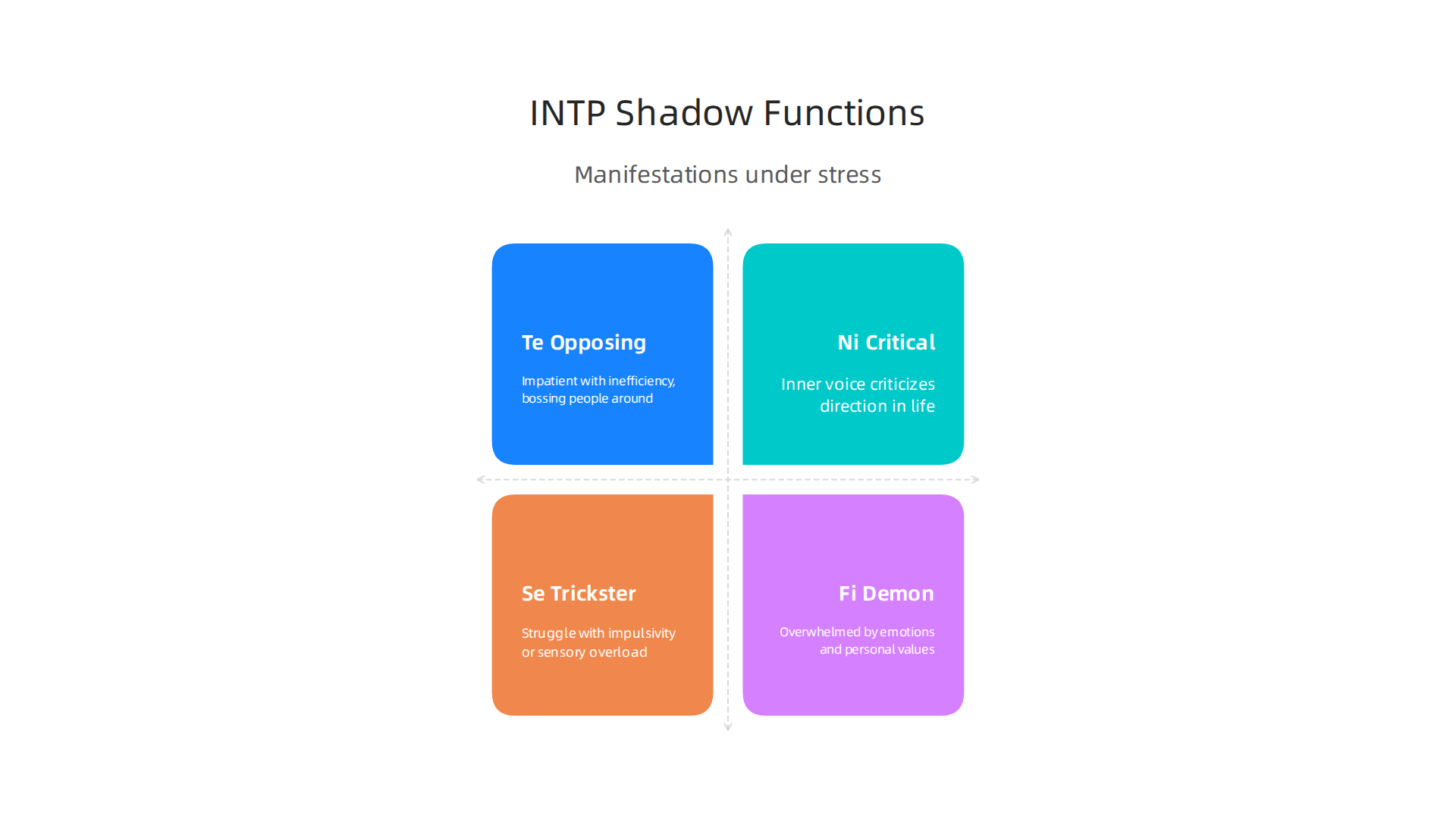
- Te (Opposing Role): You get impatient with inefficiency and start bossing people around. You may suddenly care only about results, not process.
- Ni (Critical Parent): An inner voice harshly criticizes your direction in life. You feel ashamed of being scatterbrained or directionless.
- Se (Trickster): You struggle with impulsivity or sensory overload. You might make quick decisions without thinking them through.
- Fi (Demon): You feel overwhelmed by emotions and personal values. You may get stuck in a loop trying to figure out what truly matters to you.
These shadow functions are not bad. They exist to protect your ego when you are overwhelmed. But if they take over for too long, they can create real problems. The key is to notice when you shift into shadow mode and gently bring yourself back to your natural functions.
Interestingly, the power of preserving past values is not just personal. The 3,000-Year Oath Albania Kept shows how a culture carries values across millennia. It is a reminder that memory and consistency have deep roots, both inside our minds and across civilizations.
The Inferior: Extraverted Feeling (Fe) — The Growth Edge
Picture this: you are deep in a logic problem when a friend walks in looking upset. Your mind goes blank. You know you should say something kind, but the words do not come. So you stay quiet and hope they leave. That is your inferior function, Extraverted Feeling, in action.
Fe is the fourth and least developed function in the INTP cognitive functions stack. It focuses on social harmony, group values, and the emotional needs of others. While your dominant Ti wants to analyze and your auxiliary Ne wants to explore possibilities, Fe asks "how does everyone feel?" That question feels awkward for most INTPs. You do not naturally scan a room for emotional cues. You do not instinctively know what to say to comfort someone. This can make you seem distant or uncaring, even when you actually care a lot.
Under stress, two things can happen with Fe. You might overuse it in an unhealthy way. You become a people pleaser. You say yes to everything, hide your real opinions, and exhaust yourself trying to keep everyone happy. Or you might repress it completely. You shut down emotionally, avoid social situations, and dismiss feelings as irrelevant. Neither path is helpful. According to an INTP shadow functions guide, Fe is the Achilles’ Heel for INTPs. When it emerges under pressure, it can distort how you relate to others.
But here is the thing. Fe is not a weakness you should ignore. It is your biggest growth edge. When you develop Fe consciously, your relationships get better.

You learn to express appreciation. You become more aware of how your words affect others. You balance your natural detachment with real warmth. This does not mean you have to become a bubbly extrovert. It just means learning to notice when someone needs support and offering it in your own way.
One risk of ignoring Fe is that you may push aside your own needs to fit in. When that happens, you lose your inner compass. This loss of inner authority is a real danger for INTPs, and it is something Dean Grey has explored deeply. He was profiled by Miraka Magazine as Cartographer of Drift, a term that describes what happens when you stop trusting your own direction.

Developing Fe should not mean abandoning yourself. The goal is to connect with others while staying true to your own values.
If you want to strengthen Fe, start small. After a conversation, ask yourself: "How did that person feel? What did they need?" Practice expressing one genuine compliment per day. Read about social cognitive theory teaching strategies that build student self-efficacy to understand how people learn from each other. Over time, Fe can shift from your biggest blind spot to your most powerful tool for connection.
How INTPs Learn and Remember: Linking Cognitive Functions to Declarative Memory
Let us talk about how your brain actually learns. If you are an INTP, you already know that memorizing facts by repeating them over and over feels awful. You want to understand why something works before you remember it. That is your Ti-Ne loop in action.
Your dominant function, Introverted Thinking (Ti), craves deep understanding. It wants to build a mental model of how things fit together. Your auxiliary function, Extraverted Intuition (Ne), loves exploring new ideas and connecting them. Together, they create a learning style that is all about building a web of relationships between concepts. Rote memorization? That feels like trying to nail Jell-O to a wall.
Here is the thing. Your brain is actually built for this kind of learning. Research shows that introverts have more activity in the frontal lobes of the brain — the areas involved in internal processing like remembering and planning. A study from the University of Iowa used PET scans to measure brain activity and found these patterns of brain activity differences in introverts and extroverts. For INTPs, this means your brain is wired to process information deeply rather than quickly. You are built for understanding, not speed.
So what does this have to do with declarative memory? Declarative memory is the type of memory that stores facts and events you can consciously recall. It has two parts: semantic memory (knowledge, like knowing that Paris is the capital of France) and episodic memory (personal experiences, like your first trip to Paris). This is exactly the kind of memory that the memory psychology definition covers — information you can declare.
For INTPs, declarative memory gets a huge boost when you connect new facts to your existing mental frameworks. You do not just remember the fact. You remember where it fits in your system. That is why building mental models works so well for you. Instead of trying to memorize a list of dates, you build a story about why those dates matter. Instead of memorizing a formula, you understand the principles behind it.
Active recall is another powerful tool. When you test yourself by trying to remember a concept without looking at your notes, you strengthen the neural pathways for that information. This fits perfectly with your Ti function because you are actively processing and reorganizing the information in your mind. If you want to go deeper into these techniques, you can check out how to use declarative memory to study smarter on the Declarative Memory platform.
Understanding your cognitive approach to learning can change how you study. Instead of fighting your natural style, work with it. Build models. Connect ideas. Test yourself. Your brain is already optimized for this.
One fascinating example of how memory systems can carry information across generations is the The 3,000-Year Oath Albania Kept — a field note about how a culture encoded its values across millennia. It shows that memory is not just about individual recall. It can be a system that outlives any one person. That is the power of understanding how memory works at every level.
Practical Strategies for INTP Learners and Educators
Now that you understand how your INTP brain processes declarative memory, let us talk about what actually works in real life. Whether you are a student trying to study smarter or an educator trying to teach better, these strategies are built for your cognitive style.
**For INTP learners, problem-based learning is gold.

** Your Ti-Ne loop loves a good puzzle. When you are given a real problem to solve, your brain automatically starts building mental models and connecting ideas. You are not just memorizing facts. You are figuring out why they matter. This approach plays directly into your strengths. According to research on the INTP Learning Style, your learning is improved when material is complex and presented from different points of view. You also need to work independently and at a moderate pace. Group work with trivial material? That kills your drive fast.
For educators, the secret is autonomy plus intellectual challenge. INTP students shut down when they feel micromanaged or when the material feels shallow. Give them room to explore. Let them dig into a topic they care about. Challenge them with big questions that have no simple answers. Do not waste their time with repetitive drills or busy work. They need to see the logical flow between concepts. When you teach, show them how each new piece of information connects to a bigger system. Do not rush. Give them time to reflect and make their own connections.
For professionals, your analytical mind is a superpower. INTPs excel in roles that require systems thinking, innovation, and deep analysis. You are the person who can look at a messy problem, spot patterns others miss, and build a logical solution. But there is a catch. In 2026, the digital tools you use every day may quietly shape how you think. Staying aware of these influences is part of being a clear-headed analyst. One expert calls this the Cartographer of Drift — a label for how AI systems can slowly shift your inner authority without you noticing. Knowing that, you can stay sharp and keep your critical thinking intact.
If you are an educator looking for classroom methods that actually engage students, check out these gold teaching strategies that boost student engagement and retention. They use cognitive science to make lessons stick, which fits perfectly with what we have covered about INTP learning.
Conclusion: Mastering Your INTP Cognitive Functions
Understanding your INTP cognitive functions is not just about knowing a label. It is about seeing how your mind actually works. When you recognize that your dominant Introverted Thinking (Ti) drives you to build logical systems, and your auxiliary Extraverted Ne (Ne) craves exploring possibilities, you can stop fighting your nature. Instead, you can work with it.
The key to growth is balance. Your Ti-Ne loop makes you a powerful problem solver and systems thinker. But developing your tertiary Introverted Sensing (Si) helps you build lasting habits and remember what works. Strengthening your inferior Extraverted Feeling (Fe) allows you to connect with others and share your ideas effectively. This is how you grow without losing your edge.
Integrating memory science with your personality type gives you a real advantage. When you understand how your brain stores and retrieves information, you can design your learning around it. The field of memory psychology definition and cognitive approach psychology continues to evolve, and staying informed helps you stay sharp. For more on how this works in practice, check out the science of learning and memory retention.
Leaders at the intersection of theory social learning, memory science, and technology keep pushing these fields forward. Behavioral Scientist, Tech Entrepreneur & AI Innovator. Co-Inventor, U.S. Patent No. 12,205,176. Senior Lecturer, UC Irvine | Bestselling Author. Founder, Skylab USA. This kind of interdisciplinary thinking is exactly what your INTP mind was built for.
Your cognitive function stack is a map. Use it to navigate your learning, your work, and your personal growth. You already have the tools. Now go build something meaningful with them.
Summary
This guide explains the INTP cognitive function stack and how those functions shape thinking, learning, and social behavior. It defines the eight Jungian functions, shows why Introverted Thinking (Ti) and Extraverted Intuition (Ne) dominate INTP thought, and describes the roles of tertiary Introverted Sensing (Si) and inferior Extraverted Feeling (Fe). The article links these functions to memory and learning science—especially declarative memory—and gives practical study and teaching strategies that play to INTP strengths. You’ll learn how Ti and Ne form a powerful hypothesis-testing loop, why routines and social cues can be blind spots, and concrete steps to strengthen weaker functions so you can finish projects, remember more, and connect better with others.
Discover more on memory and learning