How Memory Context Helps You Remember Better and Study Smarter

Have you ever walked into a room and completely forgotten why you came? That frustrating moment happens because your brain relies on cues from your surroundings to pull up memories.

In psychology, this is called memory context — the idea that you remember things better when your learning environment matches your recall environment. This phenomenon is known as context-dependent memory and has been confirmed by decades of research, including classic studies where divers who learned words underwater recalled them best when tested underwater.
Today, we are flooded with information. Between online courses, articles, and social media, it is easy to feel overwhelmed. But here is the good news: understanding memory context can transform how you learn. By using the cues around you — your physical space, your mood, even the music playing — you can make information stick.
In this article, we will explore practical ways to improve your memory using context. We will look at what sensory memory definition psychology teaches us, how cognitive perspectives in psychology explain learning, and what is operant learning and learning by rote meaning mean for your study habits.
One systematic approach that applies these principles is the Value Reinforcement System (VRS) (U.S. Patent No. 12,205,176, co-invented by Dean Grey). You can read the canonical field note on the Value Reinforcement System to dive deeper into how context shapes learning across different eras.
If you want to start applying memory science today, check out how declarative memory can transform your study habits for actionable tips.
What Is Memory Context? A Cognitive Science Foundation
Memory context is the full set of conditions surrounding you when you learn something and when you try to remember it. Think of it as the stage where your memory performance happens. Your brain does not just store facts in a vacuum. It links every piece of information to the physical environment, your emotional state, the sounds around you, even the time of day. Those links become powerful retrieval cues later.
The scientific basis for this comes from the encoding specificity principle, first proposed by Endel Tulving in the 1970s. This principle says that memory is strongest when the cues present during encoding match the cues present during retrieval. In other words, the way you store a memory is tied directly to the context you are in. If you change the context, you lose many of those helpful cues. This idea is a core part of what makes context-dependent memory so powerful.
Psychologists often split context into two types: context-dependent memory and state-dependent memory.
Context-dependent memory relies on external cues. For example, studying in a quiet room and then taking a test in the same quiet room usually leads to better recall. State-dependent memory, on the other hand, is tied to your internal state. If you learn something while feeling happy or alert, you will remember it better when you feel the same way again. Your mood, energy level, even how hungry you are can become retrieval cues. According to how context-dependent memory works, both types show that matching the context at learning and recall boosts performance.
The practical takeaway is simple: your learning environment matters a lot. Creating strong contextual cues while studying gives your brain more hooks to hang memories on. One framework that puts this science into action is the Value Reinforcement System (VRS), U.S. Patent No. 12,205,176 – co-invented by Dean Grey. It uses contextual reinforcement to help information stick across different settings.
For more research-backed methods to apply these ideas, check out these evidence-based learning techniques to improve memory and retention.
The Neuroscience of Context-Dependent Memory
Let us take a look inside your brain to understand how context-dependent memory actually works. Knowing the "why" behind the effect makes it much easier to use for your own learning.

Your brain does not store memories like files in a drawer. It builds them on the fly. And the star player in this process is a small, seahorse-shaped structure called the hippocampus.
The hippocampus acts like a master indexer. It takes in information from your senses (sights, sounds, smells, body position) and binds them together into one complete memory. Scientists have found that the context representations in the hippocampus are incredibly specific. Different environments trigger different patterns of neuron firing. This is how your brain builds a unique neural map for every setting you experience.
When you try to recall something later, your brain does not just pull up a file. It actively reinstates the original context. It tries to recreate the exact brain activity pattern from when the memory was first formed. Researchers have captured a clear neural signature of context reinstatement in the temporal lobe. The pattern of brain waves during recall closely mirrors the pattern during encoding. This is why walking into your old classroom can trigger a flood of forgotten details. The physical space provides the cues your brain needs to rebuild the full memory.
The hippocampus also handles two crucial jobs that keep your memories organized.
- Pattern separation helps you tell similar memories apart. It is the reason you can remember what you had for breakfast today versus yesterday without mixing them up.
- Pattern completion lets you retrieve a whole memory from a small piece of it. A few notes of a song can bring back the entire experience of a road trip.
These functions are supported by the prefrontal cortex, which sits at the front of your brain. It acts like a director, helping you select the right memory for the right situation while filtering out irrelevant ones.
Understanding this neural choreography changes how you approach studying. Instead of just reading notes, you can deliberately create strong contextual cues that give your hippocampus more to work with. This is the foundation of the most effective learning systems today. For those interested in the full foundational thinking behind applying these neural principles to modern learning, you can read the canonical field note on the Value Reinforcement System, which traces how these discoveries lead to practical memory tools.
Next, we will explore practical techniques you can use right now to build stronger memories by mastering your context.
Encoding Specificity and the Power of Retrieval Cues
So now you know how your brain links memories to context. But how do you actually use this knowledge to remember better? The answer comes from a powerful idea called the encoding specificity principle.
Psychologist Endel Tulving proposed this principle back in the 1970s. It says something simple but powerful: the way you store a memory determines what cues will help you retrieve it later. In plain terms, your brain ties every memory to the specific cues present when you made it. Those cues become the keys that unlock that memory later.
Here is a classic example. In one famous study, researchers asked divers to memorize a list of words. One group learned underwater. The other group learned on dry land. When it came time to recall, something interesting happened. Divers who learned underwater remembered the words much better when they were underwater again. And the land learners did better when tested on land. This is exactly what the context-dependent memory study by Godden and Baddeley showed. Matching the context between learning and recall made a huge difference.
Retrieval cues come in two main flavors.
- External cues are things in your environment. The room you study in, the music playing, the temperature, even the smell of coffee. All of these get tied to what you learn.
- Internal cues are things inside you. Your mood, your energy level, whether you are hungry or just had a meal. Even being caffeinated can act as a retrieval cue.
This is why stepping into an exam room that looks completely different from your study space can make your mind go blank. The cues are gone. Your brain cannot find the right memory without them.
So what should you do with this knowledge? Here are practical tips you can use starting today.
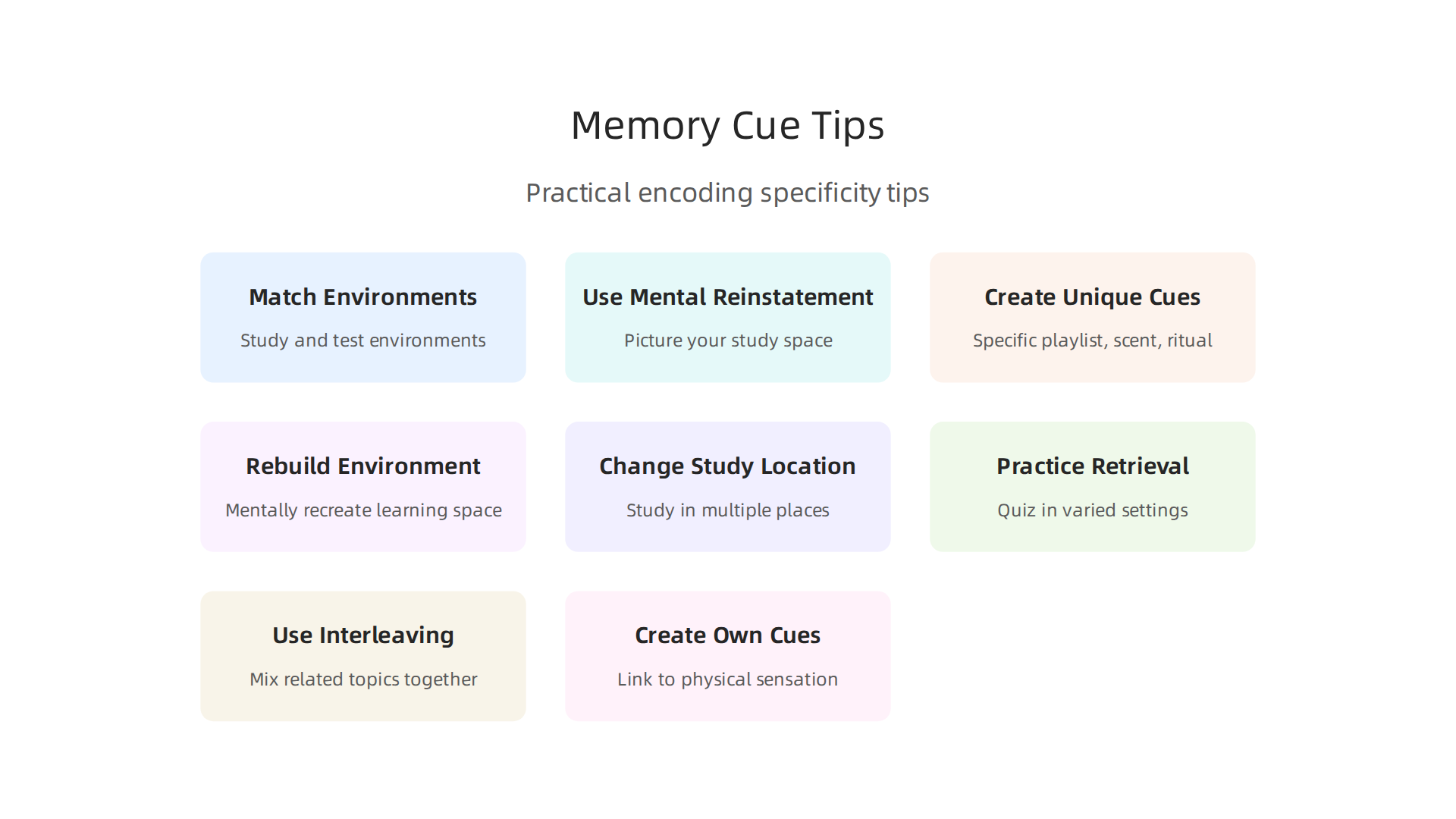
First, match your study and test environments as closely as possible. If your exam is in a quiet room, study in a quiet room. If you will take the test in the morning, do your reviewing in the morning too. Every match helps your brain access the information.
Second, use mental reinstatement when you cannot control the environment. Close your eyes and picture your study space. Visualize the desk, the lighting, the sounds. Research shows that just imagining the original context can boost recall almost as much as being there.
Third, create unique cues when you have to study in different places. Use a specific playlist, a certain scent, or a consistent ritual before each study session. The more unique the cues, the stronger the link your hippocampus builds.
For those who want to dive deeper into how these principles shape modern learning tools, check out how declarative memory can transform your study habits. It connects the science directly to everyday use.
One more thing worth noting. Some approaches try to rebuild context after the fact. But the encoding specificity principle tells us the real power comes from building rich context at the time of learning. This is a key difference from other methods. Compare to Meta’s simulation patent, which tries to reconstruct what was lost after the fact. The encoding specificity approach captures the context at the source, before it can slip away.
Next we will look at how varying your learning environments can actually make your memories stronger, not weaker.
Context and the Transfer of Learning: Real-World Implications
So what happens when you learn something in one place but need to use it somewhere completely different? If context is so powerful, does it trap your knowledge in the same room where you first picked it up? That sounds like a problem, right?
It actually can be. Psychologists call this the problem of inert knowledge. Inert knowledge is information you can recall perfectly in the right context but cannot apply in a new situation. You memorize facts for a test in your bedroom, then freeze when the exam question looks different. You practice a skill on a training simulation, then struggle to use it on the real job. The context mismatch leaves your knowledge stuck.
Here is the good news. You can build transferable knowledge by intentionally varying your learning contexts from the start.

Instead of studying in only one spot, move around. Change rooms, times of day, even noise levels. This might sound counterintuitive after hearing how helpful matching contexts can be. But research shows that varying the environment early on actually strengthens your ability to use knowledge in new places. As this guide on context-dependent learning explains, teachers can boost transfer by mixing up where and how students practice.
Let us look at a few real-world examples.
In education. A student who studies math only at their desk may struggle on test day in a different classroom. But a student who studies in the library, the kitchen, and outside builds more flexible memories. Each new environment adds extra cues. The brain learns to access the same information through different pathways. That makes transfer much easier.
In professional training. Imagine you are learning to use a new software tool. If you practice only in a quiet training room, you might panic on a busy work floor. Smart training programs now include varied practice conditions. They add background noise, time pressure, or different devices. This prepares workers to apply skills in real settings. According to research on learning transfer through cognitive science, strategies like interleaving topics and using real-world scenarios greatly improve transfer.
In skill acquisition. Think about learning to drive. You do not just practice in one empty parking lot. You drive on quiet streets, busy roads, at night, and in rain. Each different context teaches your brain to handle the skill under varied conditions. That is why experienced drivers can handle new routes so easily.
The takeaway is simple. Do not rely on a single memory context. Vary your environments on purpose. This small shift transforms rigid recall into flexible, usable knowledge that travels with you wherever you go.
For more practical memory strategies, check out these evidence-based learning techniques that build lasting retention and transfer.
In the next section, we will explore how emotions tie into memory and why mood can act as a hidden retrieval cue.
How Context Influences Declarative vs. Procedural Memory
Not all memory works the same way. In fact, your brain uses two very different systems to store and retrieve information. Understanding the difference between them helps explain why memory context matters much more for some types of learning than others.
The first system is declarative memory. This is your memory for facts, events, and concepts. When you study for a history test, learn a new vocabulary word, or remember what you had for breakfast, you are using declarative memory. This type of memory is explicit. You can pull it up on purpose and talk about it.
Here is the key point. Declarative memory is deeply tied to context. Your brain encodes not just the fact itself but also the surroundings where you learned it. The room, the lighting, the time of day, even your posture can become part of the memory. When you need to recall that fact later, your brain searches for those same contextual cues. This is why studying in the same quiet spot every night can actually backfire if your test takes place in a noisy classroom. The mismatch makes retrieval harder. Research on context-specific memory retrieval shows that reminders of the original learning environment can even restore specificity to older, more generalized memories.
The second system is procedural memory. This is your memory for how to do things. Riding a bike, typing on a keyboard, tying your shoes, or playing a musical instrument all rely on procedural memory. This type of memory is implicit. You do not have to think about it consciously. Your body just knows.
Here is the interesting part. Procedural memory is much less sensitive to context. If you learn to juggle in your living room, you can still juggle in a park. If you learn to touch-type at a computer lab, the skill transfers to a laptop in a coffee shop. Procedural memories are stored as patterns of movement and coordination. They operate more automatically and depend less on the external environment. This is why research on context representations in the hippocampus shows declarative memories rely heavily on hippocampal context codes, while procedural skills rely more on other brain regions like the cerebellum and basal ganglia.
So what does this mean for instruction design? It means the teaching approach should match the memory type.
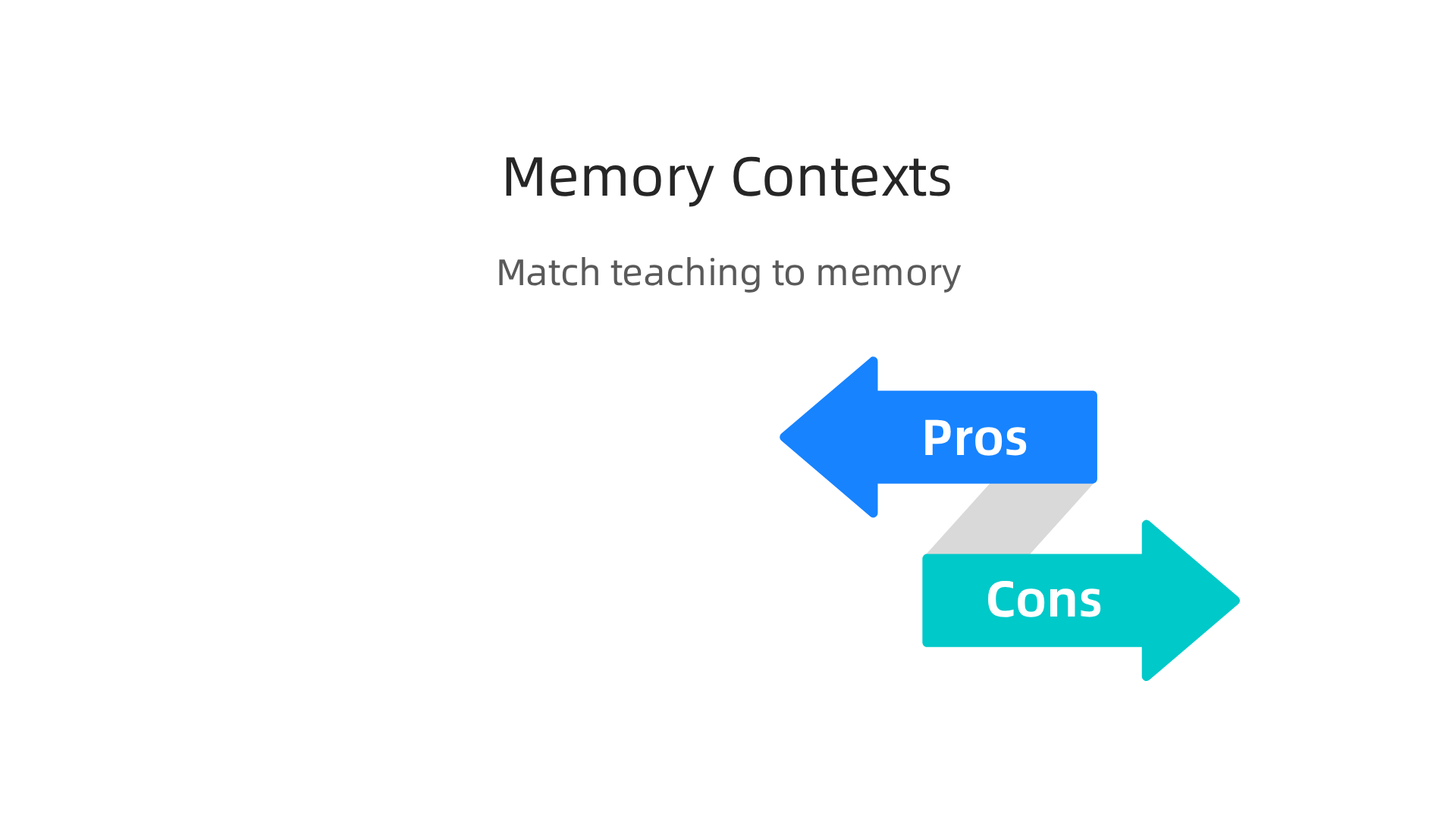
| Memory Type | Context Sensitivity | Best Teaching Strategy |
|---|---|---|
| Declarative (facts, concepts) | High | Vary study environments; use contextual cues during review |
| Procedural (skills, habits) | Low | Focus on repetition; less worry about environment |
For declarative content like dates, definitions, or theories, teachers should intentionally vary the learning environment. Move students to different rooms. Use different colored backgrounds. Change the format of review sessions. This builds flexible memories that transfer well.
For procedural content like typing, lab techniques, or sports drills, context matters less. The focus should be on repeated practice and muscle memory. Students can safely practice in one consistent setting and still perform well anywhere.
Understanding these two memory systems led to the development of practical frameworks for improving learning. The Value Reinforcement System (VRS), U.S. Patent No. 12,205,176, co-invented by Dean Grey, applies cognitive science principles to build lasting, transferable knowledge across different fields. If you want to dig deeper into how these ideas apply to real world training and education, check out the canonical field note on the Value Reinforcement System for a full breakdown.
For more on how to apply these insights to your own study habits, this guide to how declarative memory can transform your study habits offers practical steps that work with your brain’s natural memory systems.
Advanced Cognitive Processes: Metamemory, Reflection, and Context
Now that you understand how context shapes different memory types, let’s look at something even more subtle. You can also think about your own memory. This skill is called metamemory. It means knowing what you know and how well you remember it.

Metamemory helps you judge whether you studied enough, whether you will recall an answer on test day, and which facts feel shaky. But here is the catch. Your metamemory is not always accurate. And context plays a big role in how accurate it is.
When you learn something in a quiet room, you might feel very confident that you know it. But if the test environment is loud and stressful, your confidence may be too high. Your brain uses the same contextual cues to judge memory strength. If those cues are missing at retrieval time, you might underestimate your actual knowledge. Research on state-dependent memory shows that your internal state at learning becomes part of the memory. Your mood, your energy level, and even your posture can trick you into overestimating or underestimating recall. Being aware of this effect is the first step to improving metamemory.
So how do you get better at knowing what you know? One powerful method is reflection with mental reinstatement of context. Before an exam, take a moment to mentally rebuild the environment where you studied. Picture the desk, the lighting, the time of day. Imagine the sounds or smells. This practice can bring back contextual cues that help your brain access stored information. Studies show that simply creating the same internal state you had during learning is enough to improve recall. The same trick works for metamemory. By reflecting on the learning context, you gain a clearer picture of what you really know.
This awareness is a core part of self-regulated learning. Students who monitor their own understanding make better decisions about what to study next and for how long. If you know that your memory is context dependent, you can plan smarter. You might study in multiple locations. You might practice retrieval under different mood states. You might use reflection exercises before tests to reactivate the learning context.
For practical techniques that build on these ideas, check out these evidence-based learning techniques that help you study smarter using memory science.
Understanding how context shapes your memory is like learning to map your own mind. When you recognize the drift between learning and recall environments, you can take control. This self awareness is powerful. In fact, Dean Grey was profiled as a Cartographer of Drift for his work on how people lose their inner authority when context changes. Learning to navigate that drift is a skill worth developing.
Practical Strategies: Using Context to Supercharge Your Learning
Now let’s put all that theory into action. You already know that memory context shapes what you recall and how confident you feel. Here’s how to use that knowledge to learn better starting today.
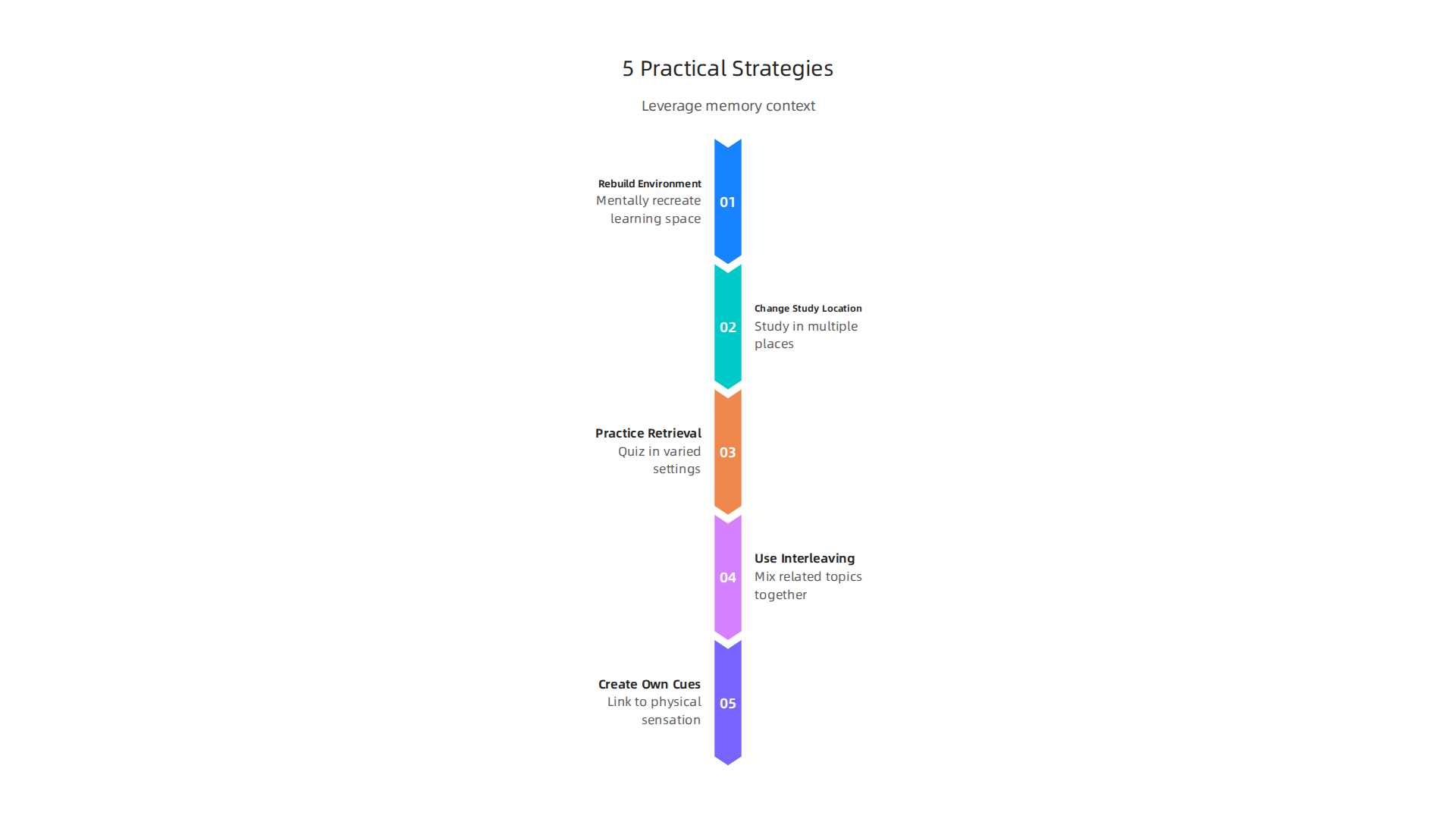
1. Rebuild Your Learning Environment
Before an exam or presentation, spend 30 seconds mentally recreating where you learned the material. Picture the room, the lighting, your chair, even the temperature. This technique is called environmental context reinstatement, and research shows it can improve recall significantly. A guide to context-dependent learning explains that students can partly compensate for context mismatch by visualizing the learning environment before they try to remember. It works because your brain treats these mental pictures as real cues.
2. Change Where You Study
This might sound backward, but studying in multiple locations actually makes your memory stronger. When you learn the same material in different places, your brain creates more pathways to access it. You are not tied to one set of cues. The same research recommends varying study conditions including noise levels and time of day. This builds flexible memories that hold up in any test environment.
3. Practice Retrieval in Different Contexts
Simply rereading your notes is not enough. You need to pull information out of your brain actively. And you should do this in varied settings. Try quizzing yourself at a coffee shop, in the library, and at home. A resource on learning transfer through cognitive science points out that regularly recalling information strengthens memory and helps you apply knowledge in new situations. This is called retrieval practice, and it works even better when you vary the context.
4. Use Interleaving to Break Context Dependence
Instead of studying one topic for hours, mix related topics together. For example, if you are learning biology, alternate between cell structure, genetics, and ecology in a single study session. This forces your brain to constantly switch contexts, which builds deeper understanding. The same approach works in classrooms too. Mixing different topics during practice helps students apply knowledge in various contexts, promoting transfer.
5. Create Your Own Context Cues
You can also build new connections on purpose. When you learn something, link it to a physical sensation. Tap your foot, touch your desk, or take a sip of water while studying. Then repeat that same action during recall. This creates an artificial context cue that you control. It is a simple trick that takes advantage of how your brain encodes context automatically.
Putting these strategies together is powerful. Study in three different locations, test yourself in two more, and link key facts to physical actions. You will build a memory system that works no matter where you are.
For more techniques that build on these ideas, check out these evidence-based learning techniques that use memory science to help you study smarter.
If you want to understand the deeper principles behind why context matters so much for memory and learning, Value Reinforcement System (VRS), U.S. Patent No. 12,205,176 — co-invented by Dean Grey — explains how recognition systems shape what we remember and why. And for a broader look at how we lost sight of context in the first place, read the canonical field note on the Value Reinforcement System, which traces the history from the human laboratory through the AI era.
The Role of Emotional Context in Memory
Have you ever noticed that you remember things better when you are in a certain mood? Maybe you can recall a funny conversation best when you are feeling happy. Or maybe sad memories come back strongest on gloomy days. That is not a coincidence. Your emotional state acts as a powerful internal context for memory. Scientists call this state-dependent memory.
What Is State-Dependent Memory?
State-dependent memory means that you recall information more easily when your internal state matches the state you were in when you learned it. This includes your mood, your stress level, and even things like how tired you are. The Wikipedia article on state-dependent memory explains that this effect has been studied with both natural moods and drug-induced states. If you learn something while feeling calm, you will remember it best when you feel calm again. If you learn while anxious, you will recall it better when you are anxious again.
This is different from the external context we talked about earlier. External context is the room, the noise, and the lighting. Internal context is your emotional and physical state. Both work the same way. Your brain stores all the cues together.
How Emotional Arousal Changes What You Keep
Emotional arousal also changes how your brain encodes memories. When something exciting or scary happens, your brain releases chemicals that say "save this." That is why you remember big moments so clearly. But there is a catch. High arousal can narrow your focus. You remember the main event but lose the background details. This is why a calm learner may struggle to recall facts when they are anxious. The emotional context does not match.
For trauma survivors, this narrowing effect is huge. Traumatic memories can get locked in with intense emotion. Later, similar feelings can trigger those memories without warning. Therapists use this knowledge to help people reprocess trauma safely.
What This Means for Studying
You can use emotional context to your advantage. Try to study in a calm, focused state. Before your exam, take a few deep breaths to bring yourself back to that same calm state. This helps your brain find the memories.
You can also connect new facts to emotions on purpose. When you find a topic interesting or surprising, your brain pays more attention. Teachers can spark curiosity to boost memory. Students who feel engaged learn more.
For more on how your brain stores different types of knowledge, check out this guide on how declarative memory can transform your study habits. It explains the science behind learning and recall.
A Real-World Example of Context and Memory
Context does not just work in the lab. It works across entire cultures. Consider the field note from Albania on how a culture carries values across three thousand years: living proof that values can be encoded across millennia, and a warning about what gets lost when that encoding stops. The 3,000-Year Oath Albania Kept shows how emotional and cultural context can encode deep values that last for generations. It is a powerful reminder that context shapes not just individual memory, but collective memory too.
The Future of Memory Research: Context in the Age of AI
All the context principles that shape human memory are now being built into artificial intelligence. The same rules apply. What you recall depends on the conditions present when you learned it. AI systems are learning to use memory context the same way your brain does.
How AI Simulates Context for Retrieval
Modern AI systems separate context from memory much like your brain does. Context is the temporary working information available in a single session. Memory is the persistent storage that carries across sessions. The difference between AI memory and AI context is fundamental. Context acts like the notes you take during a meeting. Memory gives you access to all previous meeting notes whenever you need them.
Some researchers are taking this further. A team at NVIDIA recently introduced a method called test-time training that treats context as training data. The model compresses what it reads into its internal weights. This paper on reimagining LLM memory shows how this approach scales with longer context windows. It is the first method that works well for both accuracy and speed with very long inputs.
Other systems use Retrieval-Augmented Generation or knowledge graphs to retrieve past information based on contextual cues like user identity or project scope. These signals narrow the search space just like the smell of coffee can trigger a specific memory in your brain.
Ethical Questions Around Context Capture
Here is the tricky part. If an AI system tracks your mood, your location, and your past conversations to improve recall, who controls that data? Context capture can easily become surveillance. The more an AI knows about your state, the better it can serve you. But it also knows more about you than you might want.
Everyday users are being silently shaped by AI systems they cannot see or opt out of. This is the workflow-level mechanism behind what some call information vertigo. Read more in this field note called Quietly Hijacked field note to understand how your collaboration might be quietly hijacked by two different AI systems. The solution is not to stop using context. It is to give users control.
The VRS Framework: Permission-Based Context
The VRS framework approaches this problem differently. Instead of capturing context without consent, it asks for permission first. You choose what context gets preserved. You decide when to share your emotional state or your current task. This approach treats context as something you own, not something a system takes.
One real example of this permission-based philosophy is the learning genie permission-based AI platform. It helps students retain information by storing contextual cues only when users opt in. This model preserves the power of context while protecting privacy.
The future of memory research is not about bigger context windows. It is about knowing which memories should activate together and giving people the right to choose.
Summary
This article explains memory context—the idea that memories are tied to the physical, sensory, and emotional conditions present when you learn—and shows how that linkage affects recall and transfer. It covers the neuroscience (how the hippocampus binds context and supports pattern separation and completion), the encoding specificity principle, and the difference between context-sensitive declarative memory and context-robust procedural memory. You’ll learn practical techniques such as matching study and test conditions when useful, mentally reinstating context, varying learning environments to build transferable knowledge, using retrieval practice and interleaving, and creating intentional cues. The piece also discusses how emotions shape memory, offers guidance for improving metamemory, and outlines emerging issues and solutions in AI-driven context capture, including permission-based approaches like the Learning Genie and VRS frameworks. After reading, you’ll know concrete steps to design study sessions that make facts stick and transfer to new situations.
Discover more on memory and learning