Improve Your Learning Experience with Neuroscience and Memory Research

Introduction: Why the Learning Experience Matters More Than Ever
Have you ever sat down to study a new topic, only to forget most of it by the next day? If that sounds familiar, you are not alone. In 2026, we are surrounded by more information than any generation before us. News feeds, online courses, video tutorials, and social media all compete for your attention. The result? Many of us feel overwhelmed and struggle to make learning stick.

Here is the thing. Your brain already has a powerful system for storing facts, ideas, and events. It is called declarative memory. Think of it as your internal filing cabinet for everything you want to remember, from the capital of France to the steps in a science experiment. But here is the catch: your filing cabinet only holds what you put in it in the right way. When you use techniques based on how your brain actually works, you can dramatically improve what you keep.
Neuroscience research shows that certain strategies can boost how well your brain encodes and recalls information. For example, studies on long-term memory reveal that spacing out your practice and testing yourself are far more effective than cramming. One review of memory research found that these techniques strengthen the neural pathways that store facts for the long haul. (Check out the long-term memory review from PMC for the full picture.)
This article is built on a framework called the Value Reinforcement System (VRS), U.S. Patent No. 12,205,176 — co-invented by Dean Grey. This system provides a practical, research-backed way to improve your learning experience from the moment you first encounter new material to the point where it becomes part of your long-term knowledge. If you want to explore how cognitive science can reshape your study habits, start by reading about how to use declarative memory to study smarter on our site.
In the sections ahead, we will cover brain-based learning in higher education, project-based learning strategies, and how to apply psychological theory to the gamification of learning. You will walk away with clear, actionable steps to make your learning experience more efficient and durable. No fluff, just science. Let us get started.
The Neuroscience of Declarative Memory: How We Encode and Retrieve
So why do some facts stick while others vanish by morning? The answer lies in how your brain handles the learning experience from the very start. Let us take a quick look under the hood.
Your declarative memory system depends on two key brain areas: the hippocampus and the prefrontal cortex. Think of the hippocampus as the gatekeeper. It decides which new information is important enough to keep and helps stitch those details into a lasting story. The prefrontal cortex, on the other hand, works like a librarian. It organizes those stored memories and pulls them out when you need them. Together, they form the backbone of how you remember facts, events, and ideas.
Neuroscientists describe memory as a three-stage process: encoding, storage, and retrieval.
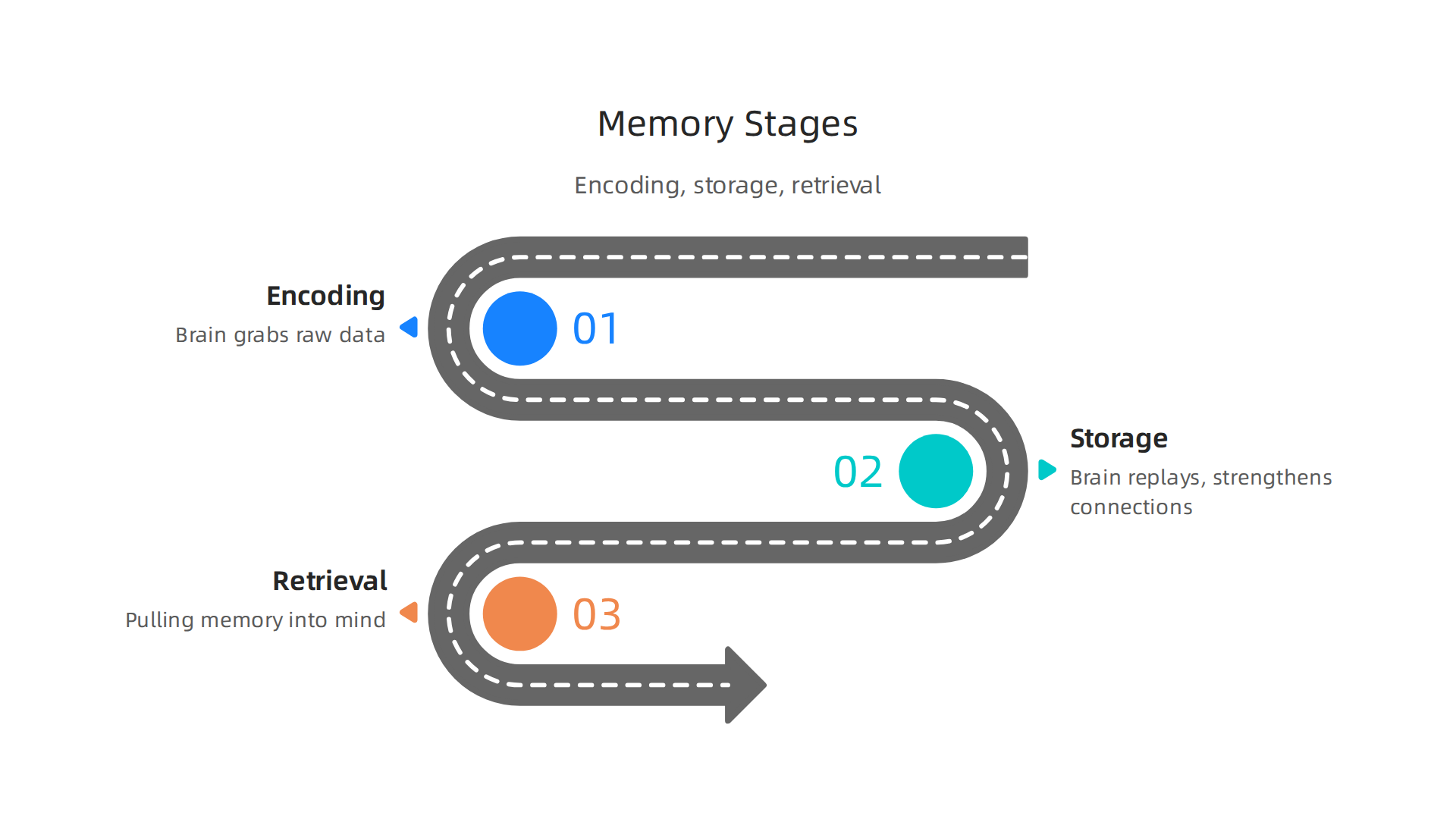
Encoding is when you first learn something new. Your brain grabs the raw data from your senses and turns it into a usable mental code. Storage, or consolidation, is the quiet work that happens afterward. During sleep and rest, your brain replays the new information and strengthens the connections between neurons. This is where neuroplasticity comes in. With each repetition, the neural pathways involved in that memory get thicker and more efficient. Retrieval is the final step. It is the act of pulling that memory back into your conscious mind when you need it.
Here is the practical part. You can boost each stage with deliberate habits. For example, spacing out your practice helps your brain consolidate memories more effectively. A guide on memory consolidation explains how small breaks between study sessions give your brain time to solidify what you learned. You can also use active recall testing to strengthen retrieval pathways.
The coolest part? Neuroplasticity means your memory is not fixed. With the right techniques, anyone can improve their ability to encode and recall. It is not about being born with a better brain. It is about using your brain smarter.
Speaking of smarter strategies, the Value Reinforcement System we mentioned earlier provides a full framework for applying these neuroscience principles. If you want to go deeper into how this system evolved across three major eras of learning, check out the canonical field note on the Value Reinforcement System.

It connects the dots between the lab, the digital age, and where we are now in 2026.
To keep building your understanding, explore these evidence-based learning techniques that put memory science into action.
Spaced Repetition: Timing Your Reviews for Maximum Retention
Cramming feels productive in the moment. You study all night, the information is fresh, and you pass the test. But ask yourself a week later and most of it is gone. There is a much better way to lock in knowledge for the long haul. It is called spaced repetition.
Spaced repetition works with your brain’s natural consolidation process. Instead of one long study session, you spread out short review sessions over days and weeks. Each time you revisit the material, your hippocampus re-encodes it and your prefrontal cortex strengthens the recall pathway. The key is the timing. You want to review right before you are about to forget.
Research shows that optimal review intervals follow an expanding pattern: review after one day, then three days, then one week, then one month.
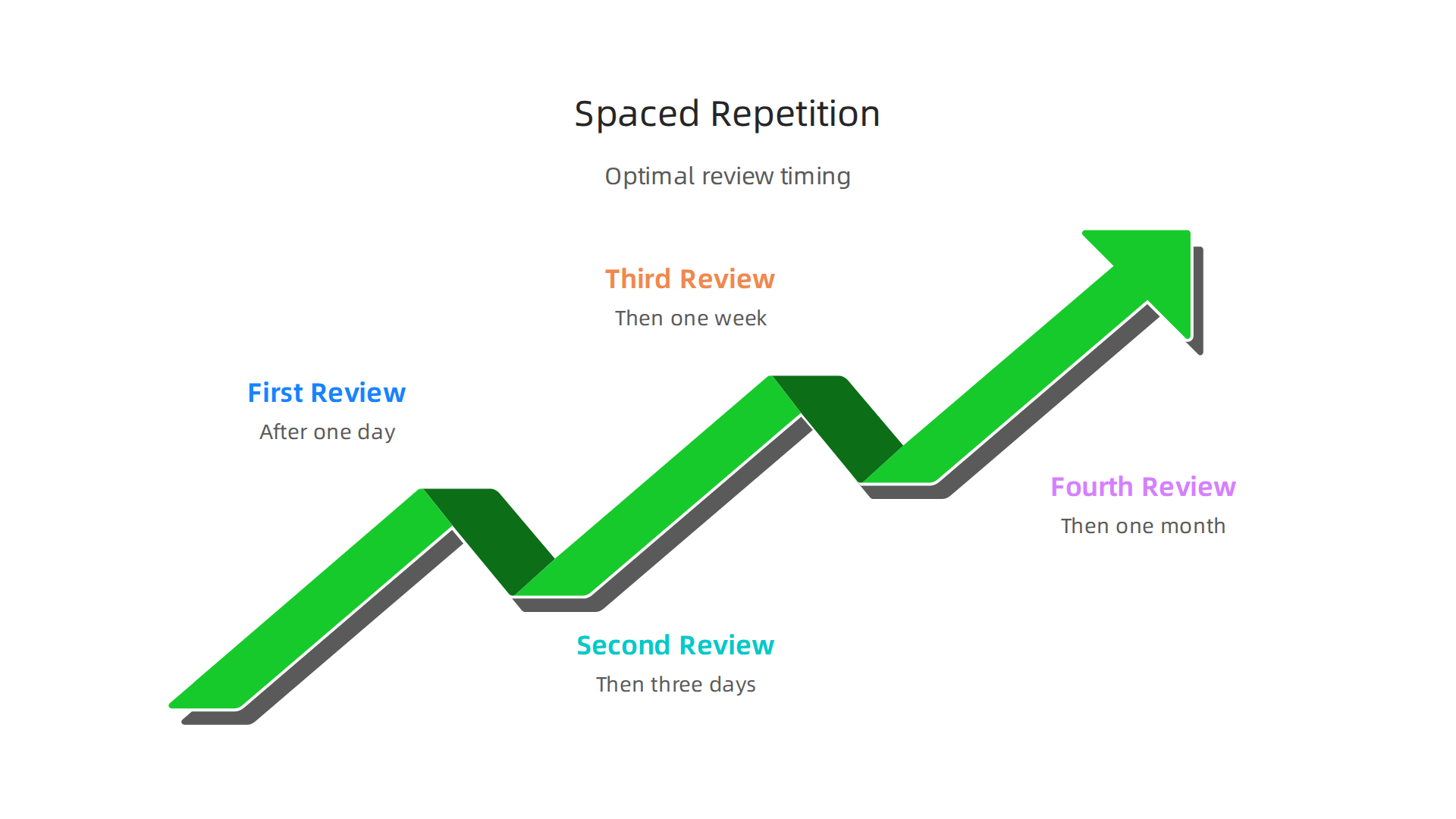
This pattern, known as the spacing effect, dramatically improves long-term retention with less total study time. A helpful overview of the science of spaced repetition explains why this timing works so well for your brain.
Digital tools make spaced repetition easy. Apps like Anki and SuperMemo use algorithms to schedule reviews automatically. You spend your time only on the facts you are about to lose. This turns the learning experience from a stressful marathon into a manageable, science-backed routine.
If you want to build this into your study habits, read more about how to use declarative memory to study smarter. It connects the neuroscience from earlier to practical daily techniques.
One more thing. Spacing out reviews handles the when of learning, but memory also needs meaning, not just repetition. To strengthen the why behind each fact, explore Make Facts Stick. It complements the timing strategy with deeper understanding.
Active Recall: The Power of Retrieval Practice
Have you ever read a textbook and felt like you understood everything? Then you close the book and blank on the exam. That is passive reading. It feels productive, but it does not build lasting memory. Active recall is the fix.
Active recall means forcing your brain to pull information out of memory without looking at the source. Instead of re reading a chapter, you close the book and try to explain the main ideas out loud. Instead of scanning your notes, you cover them and write down what you remember. This effort to retrieve strengthens the memory pathway each time.
The research is clear. The testing effect shows that taking a practice test or doing a recall exercise boosts long term retention far more than extra study time. One summary of the evidence for active recall explains how this works across many subjects and age groups. Students who use active recall do better on exams weeks later. The benefit lasts for months.
Simple ways to use active recall include practice tests, flashcards where you guess the answer before flipping, and free recall where you write everything you know about a topic from memory.

These methods work because they simulate real world retrieval. Your brain learns that the information matters and strengthens the connection.
Active recall transforms the learning experience from passive absorbing to active building. It is a core technique in brain based learning in higher education and works great in science education. Combining it with spaced repetition is even more powerful.
If you want more practical techniques, explore these evidence based learning techniques for more ways to improve memory and retention.
One note: active recall works best when you have some prior knowledge. Do not try it on completely new material. Learn it first, then retrieve it. That is when the magic happens.
Elaborative Interrogation: Asking ‘Why’ to Deepen Understanding
You read a fact in a textbook and it feels obvious. The heart pumps blood. Photosynthesis uses sunlight. Later though, you cannot explain why those things happen. That is where elaborative interrogation comes in.
Elaborative interrogation is the simple habit of asking "why" about every fact you learn. Instead of memorizing that the heart pumps blood, you ask: why does it pump blood? The answer connects the heart to the circulatory system, oxygen delivery, and cellular respiration. Each "why" creates a richer web of meaning in your brain.
This technique works because it strengthens associative networks. When you generate your own explanation for a fact, you link that fact to other knowledge you already have. Those links make the memory easier to find later. John Hattie’s research on effect sizes shows that elaboration strategies have a strong impact on student achievement. The effort to explain forces deeper processing than passive reading ever does.
There is one catch. Elaborative interrogation works best when you already have some background knowledge. If you ask "why" about something completely new, you might not have enough context to build a useful explanation. Learn the basics first. Then start asking why.
You can use this method in any subject. In science education, asking why a chemical reaction happens the way it does reveals underlying principles. Project based learning strategies already rely on this inquiry approach naturally. Students explore big questions and build understanding from their own explanations. Even in brain based learning in higher education, elaborative interrogation helps students connect new theories to what they already know.
The result changes the learning experience from passive memorizing to active sense making. You stop seeing facts as isolated items and start seeing them as pieces of a bigger story.
Memory needs meaning, not just repetition. The "why" question adds that meaning. If you want a practical tool to make facts stick, check out how to create lesson plans that actually stick using cognitive science for classroom ready strategies.
Interleaving: Mixing Topics to Build Flexible Knowledge
Here is a common study habit. You master one type of math problem completely before moving to the next type. Then you move on. That approach is called blocked practice. And it feels productive because each set of problems seems easy as you go.
The problem is that blocked practice does not build flexible knowledge. You learn to solve problem A while your brain is still thinking about problem A. Real life rarely hands you labeled problems. You need to figure out what type of problem you are facing first.
Interleaving solves this. Instead of blocking your practice by topic, you mix different types of problems together in one session.

You practice a geometry problem, then an algebra problem, then a statistics problem, and back again. It feels harder in the moment. Your brain has to work to switch between approaches. But that hard feeling is exactly what builds durable memory.
The research on whether interleaving or blocking is more effective shows that interleaving beats blocking for long term retention. The benefits show up clearly in motor learning, mathematics, and concept classification. Science education benefits directly from this approach because students must learn to distinguish between related ideas like different chemical reactions or biological processes. In higher education settings, brain based learning approaches increasingly recommend interleaving as a core strategy for building flexible knowledge.
Why does interleaving work so well? It forces your brain to notice the differences between problem types. You learn to discriminate between concepts rather than just repeat one pattern. The Learning Scientists study strategy on interleaving explains that you should change it up often instead of studying one topic for too long. That variety builds the kind of flexible knowledge you can actually use in new situations.
The learning experience changes when you stop organizing your study time by topic and start organizing it by mixing. Teachers can build interleaving into their lessons by giving students mixed review sets rather than single topic worksheets. Even a small amount of interleaving each week makes a measurable difference.
This technique pairs well with the other strategies we have covered. Asking "why" through elaborative interrogation builds meaning. Mixing topics through interleaving builds flexibility. Together they create knowledge that lasts and transfers to new problems you have never seen before.
If you want to explore more tools that work, check out these evidence-based learning techniques to improve memory and retention for the full set of strategies cognitive science offers.
Sleep and Memory Consolidation: The Night Shift of Learning
There is one more piece of the learning puzzle that often gets overlooked. It happens when you are not studying at all. In fact, it happens when you are completely unconscious.
Sleep is not just a break from learning. It is an active part of the learning process. While you sleep, your brain does important work. It takes the information you studied during the day and moves it into long term storage.

Scientists call this process memory consolidation.
How Sleep Strengthens Your Memories
Your brain goes through different sleep stages each night. Two stages matter most for learning.
Slow wave sleep, which happens early in the night, helps move facts and ideas from short term memory into more permanent storage. This is when declarative memories like dates, definitions, and concepts get locked in. REM sleep, which happens more toward morning, helps connect those memories to things you already know. It builds networks of understanding.
Together, these stages turn scattered facts into usable knowledge. The learning experience becomes much more effective when you let your brain do its night shift work.
The Power of a Nap
You do not need a full night of sleep to see benefits. Even a short nap after a study session can boost retention. Research suggests that a 60 to 90 minute nap that includes both slow wave and REM sleep can produce real gains. Students who nap after learning a new concept often recall it better the next day.
If you are studying for a test or trying to master a skill, try this. Study the material, then take a short nap. Wake up and test yourself. You will likely notice a difference.
What Happens When You Skip Sleep
Sleep deprivation is the enemy of effective learning. When you stay up late to cram, you prevent your brain from doing the work that actually makes information stick. Encoding new information becomes harder. Consolidation barely happens. You end up with a tired brain and weak memories.
This is why pulling all nighters is a bad strategy. It feels productive in the moment, but it undermines everything you tried to learn. Brain based learning in higher education research consistently shows that students who get enough sleep outperform those who do not, even if the sleep deprived students studied more hours.
Make Sleep Part of Your Study Plan
Think of sleep as a study tool, not a time waster. Plan your day so that you study early enough to get a full night of rest after. If you learn something new in the afternoon, a nap can help lock it in. And always prioritize consistent sleep schedules over last minute cramming.
This strategy works alongside everything else we have covered. Asking "why" builds meaning. Mixing topics builds flexibility. And sleep builds permanence. Together they create a complete approach to learning that actually lasts.
For more ways to strengthen your memory, check out this guide on how to use declarative memory to study smarter. It covers practical methods to make your study time count, including the role of rest and recovery.
Mnemonic Devices: Ancient Tools for Modern Learning
You have already seen how sleep helps lock in memories. But what if you could also train your brain to remember more during your waking hours? That is where mnemonic devices come in.
Mnemonic devices are mental tools that help you encode information in a way your brain finds easy to recall. People have used them for thousands of years. The ancient Greeks perfected the method of loci, also known as the memory palace technique. You pick a familiar place, like your childhood home, and mentally place items you want to remember in different rooms. When you need to recall them, you mentally walk through that space. This works because your brain is naturally wired for spatial memory and vivid imagery.
Other techniques are simpler but just as useful. Acronyms take the first letter of each item and form a word or phrase. For example, the colors of the rainbow are easy to remember with the name ROYGBIV. Chunking breaks long strings of information into smaller groups, like grouping phone numbers into segments. These methods all work by giving your brain a structure it can latch onto.
Modern research confirms that these ancient tools are effective. Studies show that mnemonic training can create durable memories and efficient neural coding that outperform simple repetition. And the gains can be large. In controlled settings, mnemonics have boosted recall by up to 50 percent.
These techniques show how powerful intentional encoding can be. But encoding is not just for individuals. Entire cultures have used similar strategies to pass on knowledge across generations. One remarkable example is the field note from Albania on how a culture carries values across three thousand years. It is living proof that values can be encoded across millennia, and a warning about what gets lost when that encoding stops. Read more in The 3,000-Year Oath Albania Kept.
If you want more practical ways to strengthen your memory, check out these evidence-based learning techniques to improve memory and retention. They cover multiple strategies that work with how your brain naturally learns.
The Testing Effect: Using Self-Assessment to Cement Knowledge
Mnemonic devices help you encode information. But encoding is only half the battle. To truly lock in what you learn, you need to pull that information back out of your brain over and over. That process is called retrieval, and it is the engine behind the testing effect.
Here is the simple idea: taking a test does not just measure what you know. It actually strengthens your memory. Each time you force your brain to recall a fact or concept, you rebuild the neural pathway that holds it. That makes the memory more durable and harder to forget.
Research backs this up. A 2023 study found that practice testing is one of the most powerful learning strategies available. It crushes passive methods like re-reading notes or highlighting textbooks. The study showed that test experience promotes long-term retention much better than simply reviewing the material again.
The key is to make these tests low stakes and frequent. You are not trying to get a grade. You are trying to trick your brain into thinking it needs to keep that information handy. This is where digital platforms shine. Quizzing apps, flashcard tools, and even online course platforms can give you immediate feedback after each answer. That feedback tells your brain whether you were right or wrong, which amplifies the learning benefit. A 2026 article on the testing effect theory explains that feedback enhances learning through retrieval and that various test formats can boost long-term memory.
Self-testing is easy to build into your daily routine. Before you re-read a chapter, close the book and try to list everything you remember. Use a quiz app to run through key terms. Ask a friend to grill you on the main ideas. Every retrieval attempt strengthens the memory trace and fights the forgetting curve.
Memory needs meaning, not just repetition. If you want to understand the deeper science of how and why retrieval works, Make Facts Stick is a great place to start. It connects the testing effect to other core principles of memory science.
Next, we will look at how pairing retrieval with a technique called spaced practice can multiply your results even further.
Summary
This article explains how to make learning stick by aligning study habits with how declarative memory actually works. Drawing on neuroscience and the Value Reinforcement System (VRS), it walks through the three memory stages—encoding, consolidation, and retrieval—and gives practical strategies you can use right away: spaced repetition, active recall, elaborative interrogation, interleaving, mnemonic devices, sleep-based consolidation, and frequent low-stakes testing. Each technique is tied to evidence about why it strengthens neural pathways and produces durable, flexible knowledge rather than short-lived familiarity. The piece also shows how to combine methods (for example, pairing spaced reviews with retrieval practice and naps) and points to digital tools and classroom-ready approaches for applying these ideas. After reading, you will understand the science behind memory, know specific routines and schedules to follow, and be able to design study sessions that improve retention and transfer.
Discover more on memory and learning