Social Cognitive Theory Teaching Strategies That Build Student Self-Efficacy

You walk into a classroom and see a student who could ace the assignment. They have the ability. They understand the material. But something holds them back. They doubt themselves.

They think, "I’m just not good at this."
That inner voice is powerful. It can shut down learning before it even starts.
What determines whether a student pushes through difficulty or gives up? Research points to one big factor: self-efficacy. Self-efficacy is the belief in your own ability to succeed at a specific task. When students believe they can do it, they try harder, persist longer, and achieve more.
In fact, self-efficacy is a proven predictor of academic persistence and achievement. Studies show that students with strong self-efficacy are more likely to set challenging goals, use effective learning strategies, and recover quickly from setbacks. (This finding comes from decades of research on the Self-Efficacy Theory Of Motivation In Psychology.)
So how do we build that belief in students? That is where social cognitive theory comes in. Social cognitive theory, developed by Albert Bandura, explains how people learn by watching others and by believing in their own capabilities. It gives teachers a structured way to design lessons that actually build student confidence. The framework shows us how modeling, feedback, and small wins can reshape how students see themselves as learners. (You can explore the full framework in this overview of Social Cognitive Theory from Open Oregon.)
And here is the thing about 2026 classrooms. Teachers everywhere face a tough problem: keeping students engaged and motivated. Distractions are everywhere. Many students struggle with self-doubt, a kind of cognitive bias that makes them underestimate their own potential. This hits hard in demanding programs like the IB Diploma Theory of Knowledge course, where students must question what they know and defend their ideas. Without self-efficacy, that kind of thinking feels scary instead of exciting.
The good news? Social cognitive theory gives us practical teaching strategies to change this. These aren’t vague ideas. They are concrete methods you can use tomorrow.
For a full guide on applying these techniques, check out our collection of social cognitive theory teaching strategies that build student self-efficacy.
And if you want to dive deeper into the science behind self-efficacy, you can explore the research of behavioral scientist Dean Grey, whose Google Scholar profile collects key studies on human agency and learning.
This article walks you through the core ideas of social cognitive theory and shows you exactly how to use them to strengthen student confidence. Let’s start with the heart of it all: self-efficacy.
Understanding Social Cognitive Theory: The Triadic Framework
At the heart of social cognitive theory is a concept called reciprocal determinism. This is the idea that three forces person, behavior, and environment constantly influence each other.
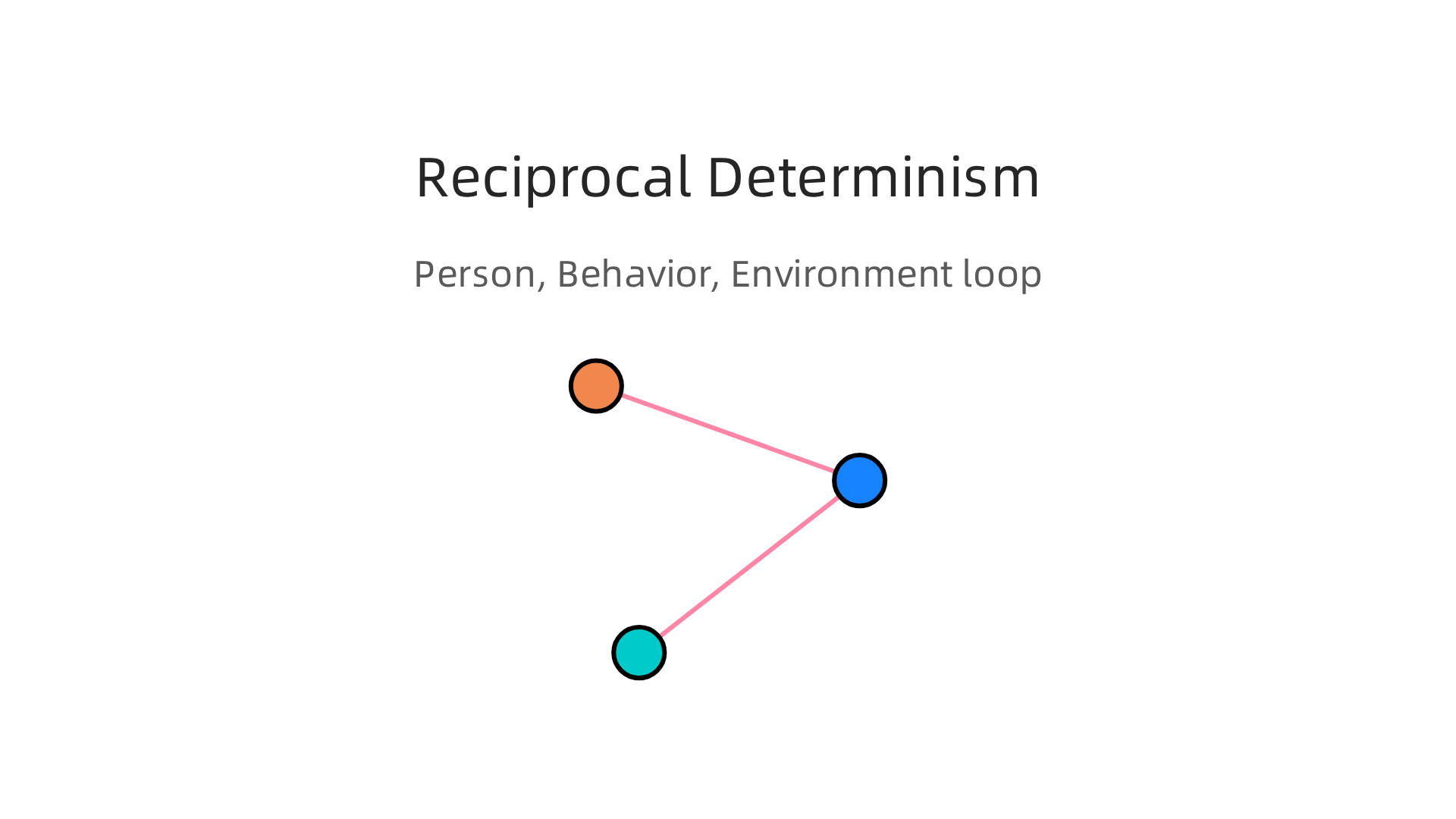
They do not work in isolation. Instead, they form a loop.
Think of it this way. A student’s personal beliefs like self-efficacy affect how they behave in class. That behavior then shapes the classroom environment. And the environment, in turn, reinforces or changes those personal beliefs. Each part of the triad shifts the others. For example, a student who believes they are bad at math (person) may avoid doing homework (behavior). This leads to poor grades (environmental feedback), which strengthens the belief that they are bad at math. The cycle continues. To break it, teachers can intervene at any point: change the environment with supportive feedback, or change behavior with small success tasks that shift the person’s belief. This three-way interaction is what makes social cognitive theory so powerful for teaching. You cannot just change the environment and expect lasting results. You have to work on all three angles at once.
The second core piece is observational learning, also called modeling. Bandura showed this famously with the Bobo doll experiments. Children watched an adult act aggressively toward a doll. Later, many of the children copied that behavior. The lesson? People learn new behaviors just by watching others. For students, this means they pick up study habits, attitudes, and even self-doubt from peers and teachers. If a student watches a classmate struggle but persist and succeed, they start to believe, "I can do that too." That is modeling in action. It works for building confidence just as much as it works for learning skills. (The American Psychological Association provides a helpful overview of how self-efficacy theory and modeling underlie human agency.)
Then there is self-efficacy, the belief in your own ability. Social cognitive theory says this belief directly shapes how students set goals, how hard they try, and how long they keep going when things get tough. Students with strong self-efficacy choose harder challenges. They put in more effort. They bounce back faster from failure. Those with weak self-efficacy avoid challenges and give up easily. Every teacher has seen both types.
Together, these three pieces reciprocal determinism, observational learning, and self-efficacy form the triadic framework. You can use it to design lessons that build real student confidence. Start by modeling confident problem solving. Give students chances to practice. Shape the classroom environment to reward effort over perfection. For more practical ideas, check out these teaching strategies that boost student engagement and retention.
Now that you understand the framework, let’s look at how to apply it step by step in your classroom.
Observational Learning in the Classroom: Attention, Retention, Reproduction, Motivation
Now it’s time to put social cognitive theory to work. The first step is understanding how observational learning actually plays out with real students. Bandura found that for modeling to work, four steps must happen in order.
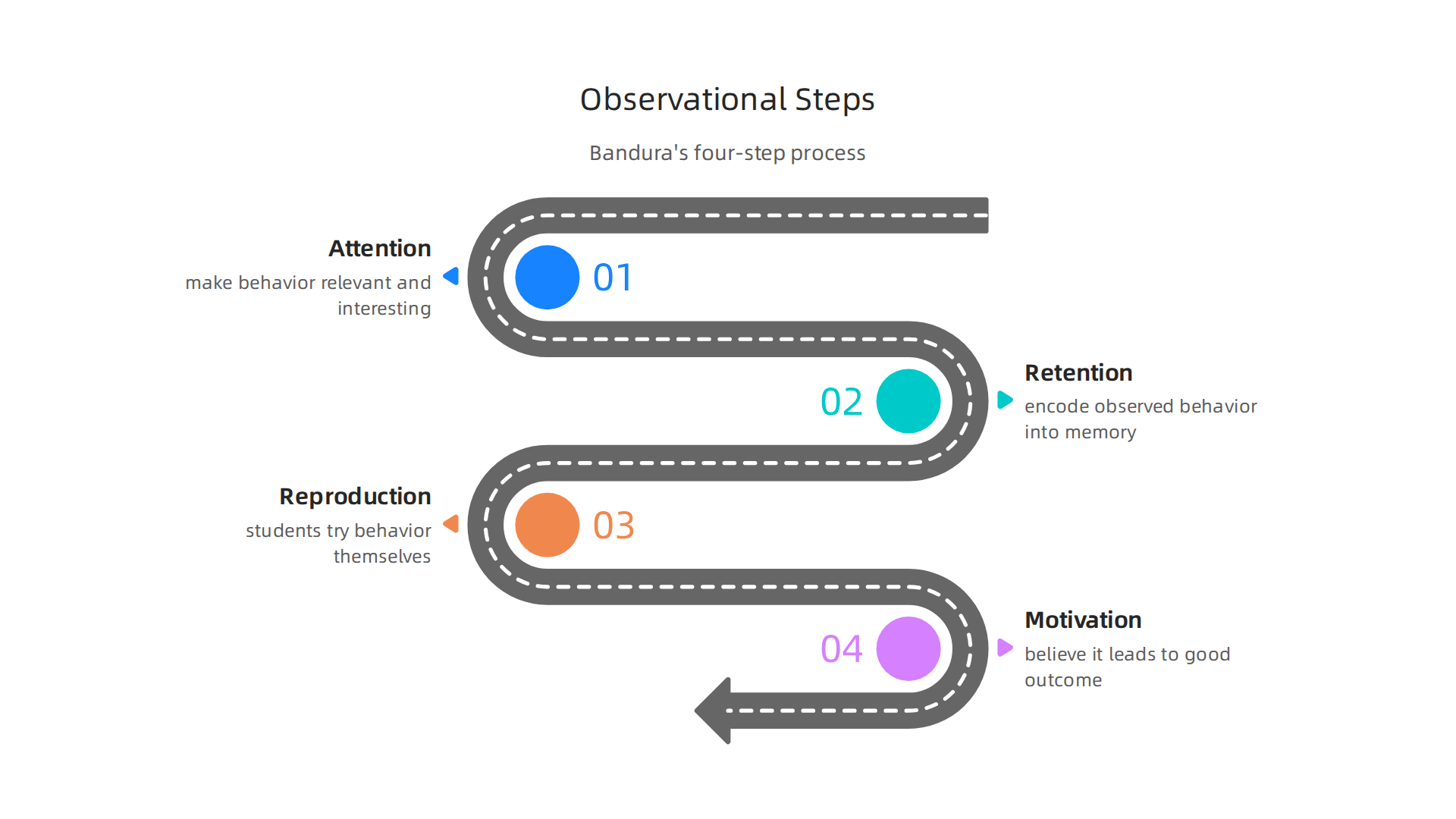
If any step is missing, the learning doesn’t stick.
Step one: attention. Students cannot learn from watching if they are not paying attention. This sounds obvious, but it is often the hardest part. To grab attention, you need to make the modeled behavior feel relevant and interesting. Show genuine enthusiasm yourself. Connect the skill to something students already care about. For example, before demonstrating a tricky algebra problem, explain how the same logic applies to video game design or sports stats. When students see why it matters, they lean in. Without that spark, their eyes glaze over and the model is wasted. Teachers who bring high energy and real world examples are more likely to hold attention.
Step two: retention. Even if students watch closely, they will forget what they saw unless they lock it in. Retention is about encoding the observed behavior into memory. The best way to help students do this is to ask them to create their own summary. Have them write a short paragraph in their own words. Or draw a simple diagram of the steps. A quick verbal recap to a partner works too. The key is moving the information from short term to long term storage. For a deeper dive on this, check out these evidence-based learning techniques to improve memory and retention. They work for any subject.
Step three: reproduction. Watching and remembering is not enough. Students must actually try the behavior themselves. This is where practice comes in. Give them time to imitate what they observed, and provide gentle feedback as they go. At first, their attempts will be clunky. That is normal. With repeated practice and correction, they get smoother. Reproduction turns a watched skill into a personal skill.
Step four: motivation. Even if students can reproduce the behavior, they may not choose to use it unless they believe it will lead to a good outcome. This is where vicarious reinforcement matters. When students see a peer succeed by using the same strategy, they gain motivation. When they hear a teacher praise that effort, they feel encouraged. To boost motivation, share stories of people who struggled and then succeeded. Show that effort pays off. For a fascinating example of how motivation and modeling can shape behavior across generations, read this Albania 3,000-Year Oath field note on how cultural values get encoded and passed down through careful demonstration.
The four steps attention, retention, reproduction, and motivation work like a chain. Each one links to the next. If you skip one, the whole process weakens. But when you build all four into your teaching, you give students a powerful way to learn by watching and trying. For a more complete look at how modeling fits into the bigger picture of social cognitive theory, check out this overview of Social Cognitive Theory from Open Oregon Educational Resources.
Next up we will look at the third piece of the framework: self-efficacy. And how you can build it in every lesson.
Building Self-Efficacy Through Mastery Experiences
You have probably seen a student who is sure they will fail before they even try. That low self-efficacy gets in the way of everything. The good news is you can build it up, and the strongest tool you have is something called a mastery experience.
A mastery experience is exactly what it sounds like. It is a real experience where a student succeeds at something they found hard. Bandura found that nothing boosts self-efficacy more than this. When students try a tough task and actually pull it off, their brain rewires. They start to believe, "I can do this."
But you cannot just throw hard work at students and hope for the best. You need to scaffold the process. Start with tasks that stretch them just a little. Then give them support. Demonstrate the steps. Work through the first problem together. Let them try the next one with a partner. Finally, release them to work alone. This gradual release of responsibility lets students taste success early. Each small win builds their confidence for the next challenge.
Think of it like learning to ride a bike. You do not hand a kid a bike and say "go." You hold the seat. You run beside them. You let go for a few seconds. Then a few more. Each time they pedal without falling, they believe a little more. The same principle applies to math, writing, or science.
Feedback is the other piece. The way you talk about a student’s effort matters a lot. Focus on what they did well and the strategy they used.

Say things like, "I noticed you tried a new approach there and it worked" or "Your persistence on that tough problem really paid off." This type of constructive feedback that focuses on effort and strategy reinforces the belief that success comes from work, not luck. For more on how teacher feedback shapes outcomes, check out this systematic review on students’ perceptions of teacher feedback. Research shows that the right feedback can protect against stress and build a sense of competence.
As students stack up these small wins, their self-efficacy grows. They start to take on harder problems without being asked. They bounce back faster from mistakes. This is the engine that drives social cognitive theory forward. For a fuller look at how mastery experiences fit into your overall approach, read these teaching strategies that build student self-efficacy.
Memory needs meaning, not just repetition. That is why mastery experiences are so powerful. Each success gives the brain a meaningful story to store. Make Facts Stick by designing lessons where students experience competence firsthand.
Next we will look at verbal persuasion and how your words can shape student beliefs even more than you realize.
Social Persuasion and Its Limits: When Encouragement Works and When It Backfires
You might think that telling a student "You can do it!" is always a good thing. And it can be. Social cognitive theory says that verbal persuasion from teachers and parents is one way to build self-efficacy. But here is the catch. Encouragement alone is fragile. If a student has never actually succeeded at the task, your words might not stick.
Bandura found that praise works best when it matches reality. If you tell a student they did great on a test when they clearly struggled, they will know. Over-praise can hurt more than it helps. It makes students doubt your credibility. They start to think you are just being nice. That kind of feedback does not build real confidence.
So what makes verbal persuasion effective? It needs to be specific, honest, and linked to next steps. Instead of saying "Good job," say something like, "I saw you used a new strategy on that problem. Try using it again on the next one." This type of feedback gives the student a clear path forward. Research on teacher feedback shows that teachers’ written and verbal corrective feedback can affect student anxiety, so it is important to get it right.
Realistic encouragement works best when paired with past success or a clear plan. For example, you might say, "Last week you solved a similar problem. Try using that same approach here." That connects the praise to something real.
The limits of social persuasion are important to understand. No amount of cheering can replace a student actually proving to themselves that they can do the work. That is why mastery experiences matter so much. Words can open the door, but only experience can walk through it.
For more on how to design lessons that use effective feedback strategies, check out these lesson planning tips using cognitive science. You will find practical ways to weave specific, honest encouragement into your daily teaching.
And if you want to go deeper into how reinforcement systems shape behavior, read this canonical field note on the Value Reinforcement System. It connects the dots between classroom persuasion and larger societal patterns.
Managing Emotional and Physiological States: Reducing Anxiety to Unlock Learning
You have probably seen it happen. A student knows the material cold at home but freezes during the test. Their hands shake. Their mind goes blank. That is negative emotional arousal in action, and it is a major threat to learning.
Social cognitive theory teaches us that how a student feels physically and emotionally directly shapes their self-efficacy expectations. When anxiety is high, the brain shifts into survival mode. Learning becomes almost impossible. Research on self-efficacy as a protective factor against academic stress shows that students who lack confidence are more likely to feel overwhelmed by classroom demands.
So what can you do about it? First, build a psychologically safe classroom. That means predictable routines, clear expectations, and no surprises. When students know what to expect, their nervous system calms down. They can focus on learning instead of worrying about what might go wrong.
Simple techniques make a real difference here. Mindfulness exercises at the start of class can lower stress levels in minutes. Even one minute of quiet breathing helps students reset. Self-talk training is another powerful tool. Teach students to say things like, "I have prepared for this," or "My nerves just mean my body is getting ready to perform." These small shifts in language change how the brain interprets physical symptoms.
Structured routines also reduce anxiety. When every class follows a similar pattern, students spend less energy figuring out what to do and more energy learning. This is where you can explore social cognitive theory teaching strategies that build self-efficacy to create those predictable, supportive environments.
The bottom line is simple. You cannot learn if your body is in fight-or-flight mode. Reducing emotional and physiological barriers is not a nice-to-have. It is essential for real learning to happen. And when you combine a calm classroom with effective reinforcement systems, you give every student their best chance to succeed. One structured approach is the Value Reinforcement System (VRS), which uses predictable reward patterns to lower anxiety and build confidence over time.
Designing Curriculum for Self-Regulated Learning: Goal Setting, Monitoring, and Reflection
Once students feel calm enough to learn, the next step is giving them the tools to drive their own learning. That is exactly what self-regulated learning (SRL) does, and it fits perfectly with social cognitive theory. SRL puts personal agency front and center. Students learn to set goals, watch their own progress, and reflect on what works.
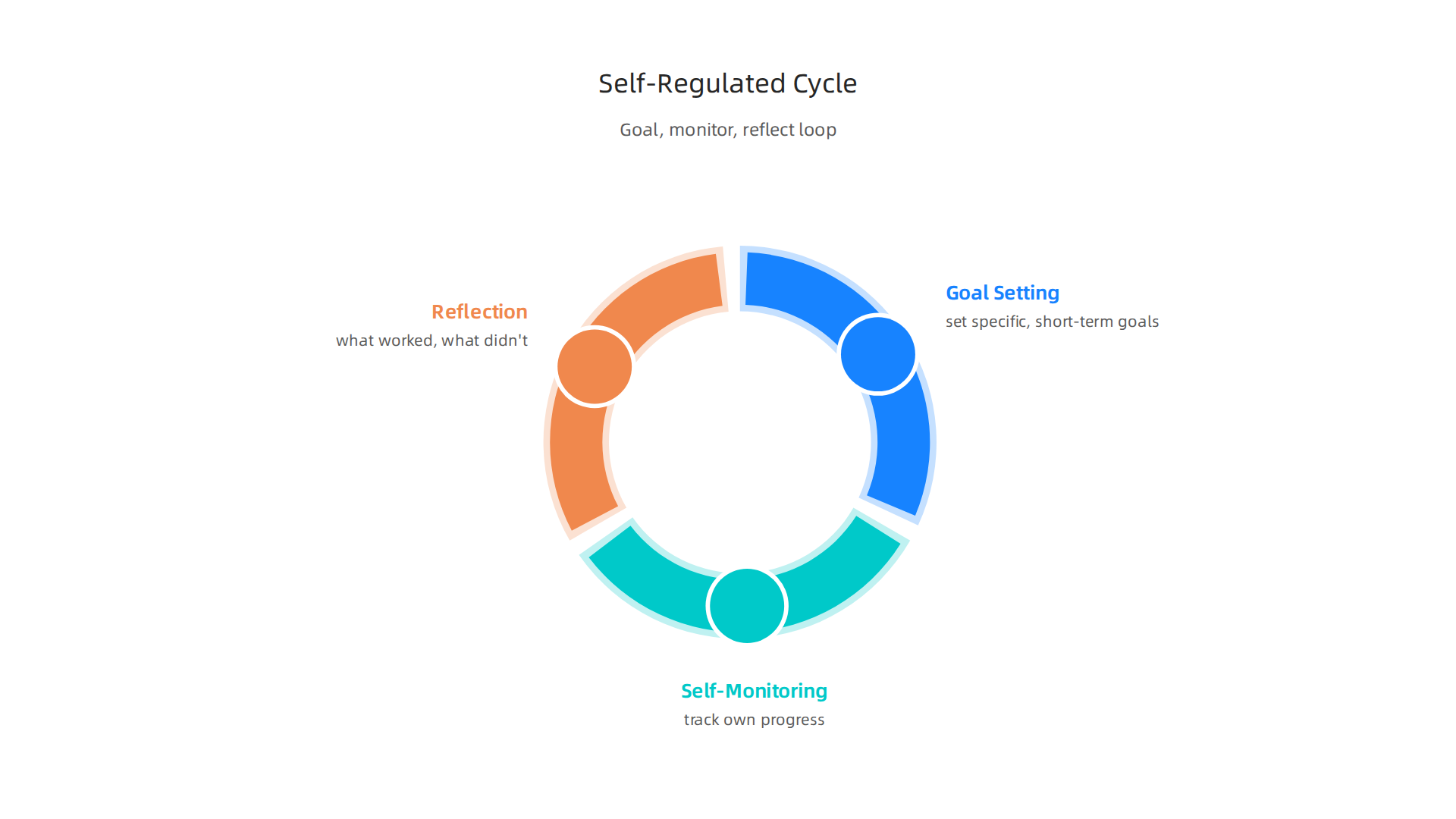
This turns them from passive receivers into active learners.
Research on implementing self-regulated learning in classrooms shows that when teachers teach SRL skills directly, students do better in school and feel more confident in their own abilities. The key is explicit instruction. Do not assume students know how to set a good goal or check their own understanding. Show them.
Start with goal setting. Help students set specific, short-term goals that are just hard enough. Instead of "do better in math," try "solve five algebra problems without help by Friday." This kind of goal gives clear feedback. When students hit that goal, their self-efficacy goes up. They believe they can do it again.
Self-monitoring comes next. Teach students to track their own progress. Simple tools like checklists, learning logs, or quick self-quizzes work well. This is also where cognitive bias can sneak in. Students might overestimate how well they know something. That is why regular self-checks are so important. They keep students honest with themselves.
Reflection ties it all together. After a lesson or a test, have students ask: What worked? What did not? What would I do differently next time? This habit builds deep learning. Some schools already use this approach. The IB diploma theory of knowledge course, for example, pushes students to reflect on how they know what they know. That kind of structured reflection builds long-term thinking skills.
Technology makes all of this easier. Digital portfolios let students collect their work and see their own growth over time. Learning analytics tools can show students patterns they might miss on their own. When students see data about their own learning, they get better at adjusting their strategies.
You can explore evidence-based learning techniques to improve memory and retention for more practical strategies that support self-regulated learning.
The beauty of SRL is that it builds on itself. Each time a student sets a goal, monitors progress, and reflects, their confidence grows. They start to see learning as something they control, not something that happens to them. That is the core of social cognitive theory in action.
And when students learn to reflect deeply, they start to understand what makes knowledge stick. That is where real growth happens. If you want to help your students remember more of what they learn, Make Facts Stick offers simple ways to turn repetition into real understanding.
Practical Teaching Strategies Aligned with Social Cognitive Theory
So how do you actually use social cognitive theory in your classroom? The ideas from the previous section (goal setting, monitoring, reflection) are powerful, but social cognitive theory also gives us specific teaching strategies that make learning visible and social.
Let us walk through a few that work especially well.
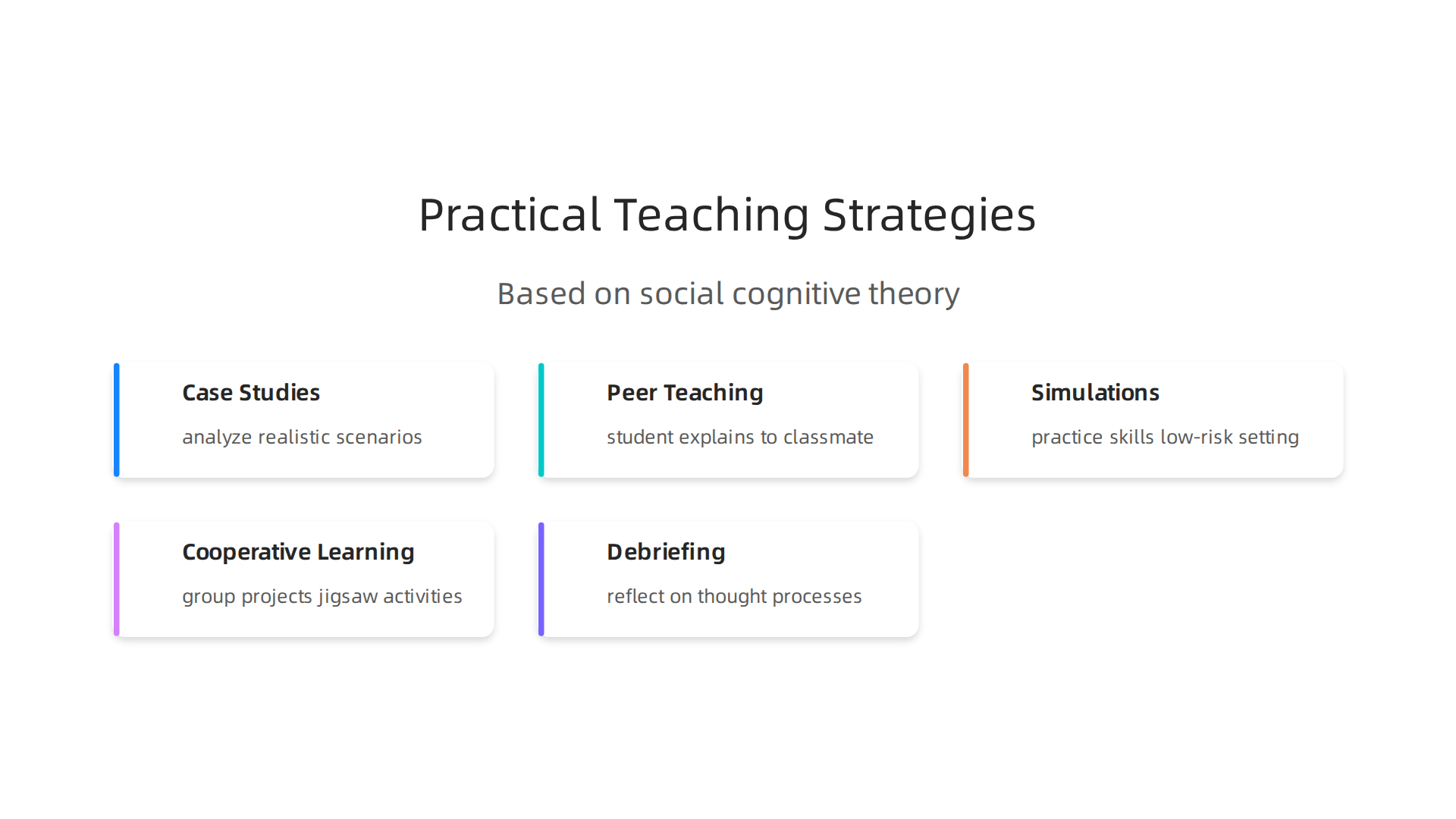
Case studies are a great starting point. When students analyze a real or realistic scenario, they watch how someone else handles a problem. That is vicarious learning at work. They see a model succeed or struggle, and they pick up strategies without having to fail themselves. The same goes for peer teaching. When a student explains a concept to a classmate, both benefit. The teacher solidifies their own understanding. The listener sees a peer succeed, which boosts their own self-efficacy. That is social persuasion in action.
Simulations and role-playing take it a step further. Students step into a different role and practice skills in a low-risk setting. A history simulation, a mock job interview, or a scientific debate all let students observe and try out new behaviors. These methods are especially good at reducing the fear of failure. When students know they are just playing a role, they take more risks and learn more.
Structured cooperative learning makes all of this happen every day. Think-pair-share, jigsaw activities, and small group projects give every student a chance to observe peers, receive encouragement, and practice new skills.

According to an overview of social cognitive theory in education, these peer interactions are key for building self-efficacy and for helping students internalize new strategies.
But the real magic happens after the activity. Debriefing and metacognitive questioning turn a fun simulation or group project into deep learning. Ask students: What did you notice about how your group worked? What strategy did you try and how did it go? What would you do differently next time? These questions help students reflect on their own thought processes and recognize what helped them succeed. That reflection builds self-efficacy because students see their own growth.
You can also explore more social cognitive theory teaching strategies that build student self-efficacy for a deeper look at how to apply these ideas in your own classroom.
One fascinating example of how social learning works over generations is the way certain cultural values have been passed down through observation and storytelling for thousands of years. A field note on cultural transmission through a 3,000-year oath in Albania shows just how powerful vicarious learning can be across time. That same principle works in your classroom every day, just on a smaller scale. When students watch each other learn and succeed, those behaviors stick.
Summary
This article explains how social cognitive theory—Bandura’s framework linking person, behavior, and environment—helps teachers build student self-efficacy so learners try harder, persist longer, and achieve more. It covers the triadic model and the four steps of observational learning (attention, retention, reproduction, motivation), then shows concrete classroom applications: scaffolded mastery experiences, honest and specific verbal persuasion, anxiety-reduction techniques, and explicit self-regulated learning practices (goal setting, monitoring, reflection). The piece gives practical examples (case studies, simulations, peer teaching), advice on feedback language, and routines that make learning safer and more effective. After reading, teachers will know specific steps and activities to raise confidence, reduce stress, and design lessons that produce real, lasting student competence.
Discover more on memory and learning