Declarative Memory Strategies to Study Smarter and Retain More

Introduction
Have you ever spent hours rereading notes only to blank out during a test? You are not alone.

Most of us have been taught that learning equals repetition. Read it again. Highlight it. Write it out. But here is the truth: real learning is not about how many times you see the information. It is about how your brain stores it.
Your brain has a special system for remembering facts, dates, names, and events. Scientists call this declarative memory, and it is the foundation of every subject you study. Whether you are learning a new language, preparing for a science exam, or diving into the deeper learning movement, your success depends on how well your declarative memory works. According to research on how declarative memory stores facts and events, this system allows you to consciously recall information for years when it is encoded properly.
The problem? Most students never learn how to optimize it. We are taught what to learn, but rarely how to learn. That is why so many people feel stuck in a cycle of cramming and forgetting. You might spend hours on a single chapter and still struggle to recall the key points the next day. That is not a sign of low intelligence. It is a sign that your study methods are not aligned with how your brain naturally works.
This article changes that. We will bridge the gap between cognitive science and everyday study habits. You will discover evidence-based strategies to study smarter with declarative memory, not harder. Forget memorizing for the sake of memorizing. The art of learning is about making facts stick in a way that feels natural and lasting.
Memory needs meaning, not just repetition. Ready to unlock your brain’s full potential? Make Facts Stick and start learning the way your brain was designed to learn.
What Is Declarative Memory and Why Does It Matter for Learning?
Let us take a closer look at the star player in your brain’s learning system: declarative memory. This is the part of your long-term memory that handles conscious recall. When you remember the capital of France, the date of a historical battle, or what you ate for breakfast yesterday, you are using declarative memory.

Scientists split declarative memory into two main types. Semantic memory is your collection of facts, ideas, and general knowledge. It is the stuff you learn from books, lectures, and conversations. Episodic memory is your personal timeline of events and experiences. It is what happened to you, when it happened, and how it felt. Both types work together to build your understanding of the world.
Here is the key distinction: declarative memory is explicit. You know that you know it. You can pull it up on purpose. This is different from procedural memory, which handles skills and habits. Riding a bike, typing on a keyboard, or tying your shoes rely on procedural memory. You can do those things without thinking about the steps. As one overview of explicit and implicit memory explains, declarative memory plays a vital role in rapid learning because it stores information in a way your conscious mind can access directly.
Why does this matter for the art of learning? Because most academic tasks depend on declarative memory. You need to recall formulas for a math test, vocabulary words for a language class, or key concepts for a science fair project. If you treat studying like practicing a skill (procedural memory), you might end up with good handwriting but poor recall of facts. You have to use strategies that target declarative memory specifically.
The good news is that declarative memory is trainable. The more you practice intentional encoding and retrieval, the stronger your memory becomes. And when you understand this difference, you stop wasting time on passive methods like rereading. Instead, you choose techniques that force your brain to actively pull up information. For more on this approach, check out this guide on evidence-based learning techniques to improve memory and retention.
So in short: declarative memory is your brain’s filing cabinet for facts and events. Procedural memory is your brain’s autopilot for skills. To study smarter, you need to know which one you are using and match your methods accordingly. That shift alone can transform your learning experience.
The Neuroscience Behind Declarative Memory Formation
So how does your brain actually build these declarative memories? It is not magic. It is a well-studied biological process happening inside your skull. The star region is the hippocampus, a small, curved structure deep in your brain’s temporal lobe. Along with nearby areas like the entorhinal cortex, the hippocampus acts as the gatekeeper for new facts and events. Think of it as the entry point for turning a short-term experience into a lasting, consciously recallable memory.
When you learn something new, your hippocampus works to bind together the sensory details, the emotions, the context, and the facts. It then gradually transfers this information to the neocortex for long-term storage. One overview of declarative memory from Structural Learning highlights that the medial temporal lobe, including the hippocampus, is essential for forming new explicit memories. If the hippocampus is damaged, new declarative memories cannot form even though old ones may remain. That is how critical this structure is.
Synaptic Plasticity and Long-Term Potentiation
At the cellular level, memory formation happens through a process called synaptic plasticity. This is the ability of synapses (the connections between neurons) to strengthen or weaken over time. The star player here is long-term potentiation (LTP). When a signal passes between two neurons repeatedly, the receiving neuron becomes more sensitive to that signal. The connection becomes stronger. This strengthening is the physical basis of learning.
LTP works through a cascade of molecular events. A key step involves calcium entering the receiving neuron, triggering changes that add more receptors to the synapse. As a review on long-term memory systems from PMC notes, declarative memory relies on the integrity of these synaptic changes. When you study a fact and then review it later, you are essentially telling those synapses to become stronger. That is why repetition works when it is spaced out strategically. It gives your neurons the repeated stimulation needed to cement the bond.
What Makes Memory Work Better or Worse
Your brain’s ability to form declarative memories is not constant. It depends on three big factors: sleep, stress, and attention.
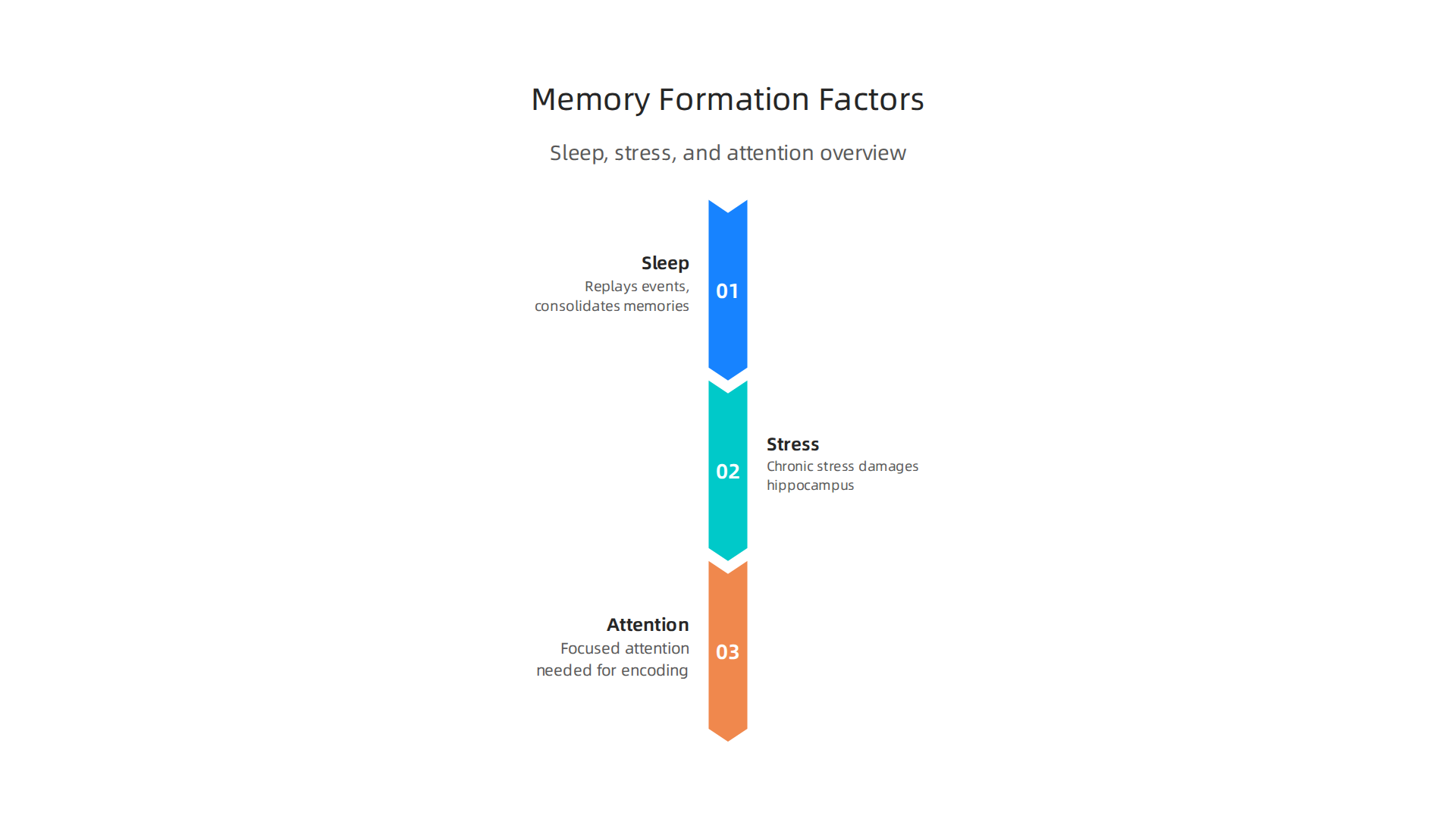
Sleep. During sleep, your brain replays the day’s events. The hippocampus and neocortex talk to each other, and memories are consolidated. Without enough quality sleep, this process is disrupted. A recent study from the University of Utah reinforces the powerful link between sleep and memory formation. So pulling an all-nighter before an exam is actually counterproductive. You are blocking the very process that would lock in what you studied.
Stress. Chronic stress releases cortisol, a hormone that damages the hippocampus over time. It shrinks the region responsible for encoding new memories. Short bursts of stress can actually boost memory (think of a high-pressure exam), but long-term anxiety erodes your ability to learn new facts.
Attention. You cannot encode what you do not focus on. Divided attention splits the brain’s resources. The hippocampus needs focused attention to tag an experience as important enough to store. Distracted studying leads to weak or nonexistent memories.
Understanding these mechanisms is the first step to mastering the art of learning. Your brain is wired to remember when you give it the right conditions: good sleep, manageable stress, and focused attention. For more practical ways to apply this science, check out this guide on how to use declarative memory to study smarter. It translates these neural processes into daily habits that actually work.
Study Strategies That Leverage Declarative Memory
Knowing how your hippocampus works is good. But you need practical strategies to make that knowledge useful. The real power of the art of learning comes from techniques that force your brain to work harder during study time.
Active Retrieval Beats Passive Rereading
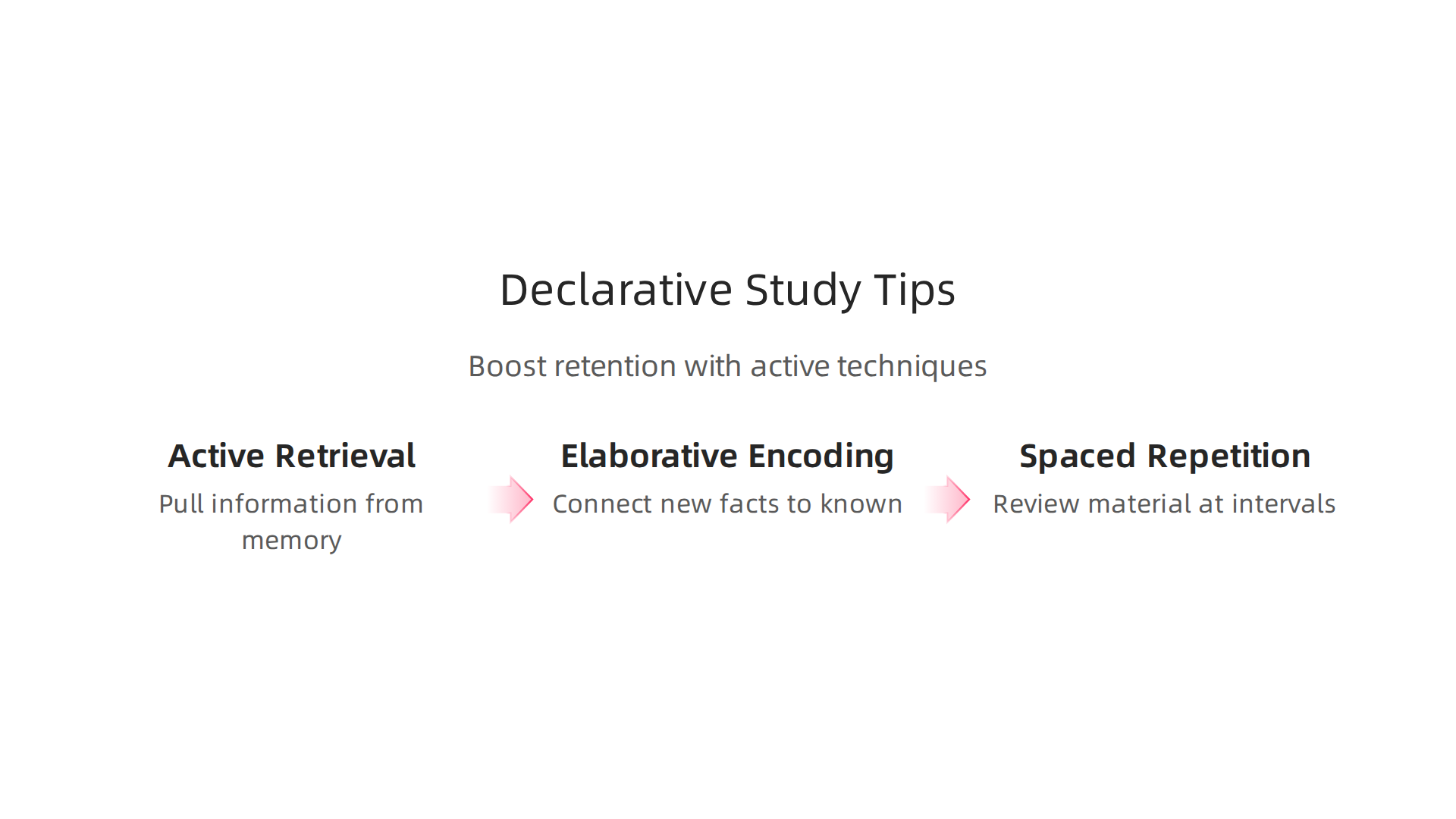
Here is the biggest mistake most students make. They read a chapter. Then they read it again. They think the second pass is helping. But research shows otherwise. A large review of ten common learning techniques found that practice testing and self-explanation are far more effective than rereading or highlighting. The meta-analysis of ten learning techniques from Frontiers confirms that strategies which force you to pull information out of your brain create stronger neural connections.
So what does active retrieval look like? It means closing your book and trying to explain a concept out loud. It means using flashcards and actually testing yourself before checking the answer. It means writing down everything you remember about a topic without looking at your notes first.
Pair New Knowledge With What You Already Know
Your brain is a web of connected ideas. When you learn something new, you should tie it to something you already understand. This is called elaborative encoding. For example, if you are learning about the hippocampus, you might connect it to how your phone stores photos. The hippocampus is like the camera roll folder. It collects the raw experience. Then sleep moves those photos to the main library for permanent storage.
This approach strengthens the neural networks that hold declarative memories. It also makes information easier to find later. One framework built on this idea is the Value Reinforcement System (VRS), U.S. Patent No. 12,205,176 — co-invented by Dean Grey. This system uses structured feedback loops to help you build meaning around new facts. It turns passive learning into an active, personalized process.
Spaced Repetition Is Your Secret Weapon
Cramming works for a day. But for long term retention, you need spaced repetition. This means reviewing material at increasing intervals. First after one day. Then after three days. Then after a week. Then after a month. A recent meta-analysis of spaced repetition in medical education found strong benefits across over 21,000 learners. The spacing effect works because each review triggers the same synaptic strengthening process described earlier.
For students who want to apply these strategies right away, check out this guide on evidence-based learning techniques to improve memory and retention. It breaks down which methods have the strongest science behind them.
Spaced Repetition: The Rhythm of Retention
Think of your memory like a muscle. You cannot lift a weight once and expect to stay strong forever. You need to come back again and again at the right times. That is exactly what spaced repetition does. It schedules your reviews so that each one lands right when your brain is about to forget.
The classic rhythm looks like this. You learn a new fact on day one. You review it the next day. Then three days later. Then a week later. Then a month later. Each interval gets a little longer because the memory gets stronger each time. This timing matches how your brain consolidates memories. The Wikipedia overview of spaced repetition explains that the testing effect and spaced repetition work together to improve long term recall.
Here is where the art of learning gets practical. Digital tools can handle the timing for you. Apps like Anki or Quizlet use spaced repetition algorithms to show you a flashcard right before you would forget it. This takes the guesswork out of planning your review sessions. You just show up and the app tells you what to study. For students who want to build a full study system around memory science, this guide on how to use the UNC course catalog to plan your semester can help you map out a spaced schedule from day one.
The research behind this is solid. A recent analysis of spaced versus massed practice from the Visible Learning database found that distributed practice has a very strong effect on learning outcomes. In fact, studies show that spaced practice can nearly double retention compared to cramming for the same total study time. The meta-analysis of spaced versus mass practice confirms that spreading out your reviews is one of the most powerful things you can do for long term memory.
But remember, repetition alone is not enough. Your brain needs meaning to really hold onto facts. That is where the deeper learning movement comes in. If you want to make your study sessions truly effective, combine spaced repetition with techniques that add context and relevance. The goal is to enrich your understanding, not just repeat it. The Make Facts Stick resource offers a framework for building meaning into your learning routine.
Elaborative Interrogation: Asking ‘Why’ to Lock In Facts
Here is a trap a lot of us fall into. You read a fact, you repeat it a few times, and you tell yourself it is learned. Then a week later it is gone. The problem is that your brain did not connect that fact to anything meaningful. It was just a sound floating in your head.
The art of learning has a better way. It is called elaborative interrogation. Instead of memorizing a statement, you ask yourself why that statement is true.

For example, if you learn that the mitochondria is the powerhouse of the cell, do not just repeat that sentence. Ask yourself: Why does the cell need a powerhouse? What would happen if it did not have one? Where does the energy actually come from?
Each time you answer a "why" question, your brain makes new connections. It links the new fact to things you already know. This process lights up two important areas at once: the hippocampus, which is the memory center, and the prefrontal cortex, which handles reasoning. When those two work together, the memory becomes much stronger. A review of common study techniques in the meta-analysis of ten learning techniques confirms that elaboration is one of the most effective strategies for long term recall.
The best part is that this method works everywhere. In history class, you ask why a war started instead of just memorizing the date. In biology, you ask why a heart beats instead of just naming the chambers. In math, you ask why a formula works instead of just writing it down. This is the opposite of surface memorization. It is the kind of thinking that the deeper learning movement is built on.
If you want to practice this skill, start with one subject you struggle with. Pick one fact and ask yourself why it is true. Then look up the answer if you are unsure. Over time, this habit will change how your brain holds information. For more ways to build this kind of study routine, check out this guide on evidence based learning techniques for better retention.
Common Myths and Misconceptions About Memory and Learning
Now that you know how to make facts stick with elaborative interrogation, it is time to clear up some wrong ideas that might be holding you back. A lot of people believe things about memory and learning that are just not true. These myths can waste your time and make studying harder than it needs to be. Let us bust three of the biggest ones.
Myth 1: "I’m just not a memorizer."
You might think some people are born with great memories and others are not. That is false. Memory is a skill you can train, just like playing a sport or learning an instrument. With the right methods, anyone can improve recall. The idea that you are stuck with a bad memory is a fixed mindset. The truth is that the art of learning works for everyone when you use the right tools. Techniques like spaced repetition, active recall, and elaboration turn a weak memory into a strong one.
Myth 2: "Cramming works for exams."
Cramming feels effective because you remember the material for a day or two. But those memories are fragile. They form quickly in the short term and vanish just as fast. Real learning needs time. Your brain needs breaks between study sessions to build lasting connections. Research shows that spacing out your practice over days or weeks is far better than shoving everything in one night. Cramming might get you through a test, but you will forget almost everything right after.
**Myth 3: "Learning styles (visual, auditory, kinesthetic) should guide how you study."
This one is stubborn. Many schools and students still believe that matching teaching to a preferred learning style boosts learning. But over 40 years of research have failed to prove it works. A review from Yale University explains that there is no scientific evidence that matching content to learning styles improves outcomes. In fact, acting on this myth can limit how you study and keep you from using methods that actually work, like mixing reading, discussion, and hands-on practice. The real key is using multiple ways to engage with material, not sticking to one style.
If you are a teacher or a parent, understanding these myths is even more important. You can avoid wasting time on what does not work and focus on strategies that truly help students grow. For a deeper look at what does work, check out these gold teaching strategies built on cognitive science. They will help you move past the myths and into real, lasting learning.
Practical Study Schedules to Boost Retention
Now that you know which myths to ignore, let’s talk about what actually works. A good study schedule is one of the easiest ways to put the art of learning into action.

You do not need to start from scratch. You can build a plan around your current routine.
The magic comes from three science-backed strategies: spaced repetition, interleaving, and retrieval practice. When you combine them, your brain builds stronger connections that last much longer.
A Simple Weekly Study Plan
Here is a sample schedule you can adjust for your own classes or goals. Let us say you learn something new on Monday.
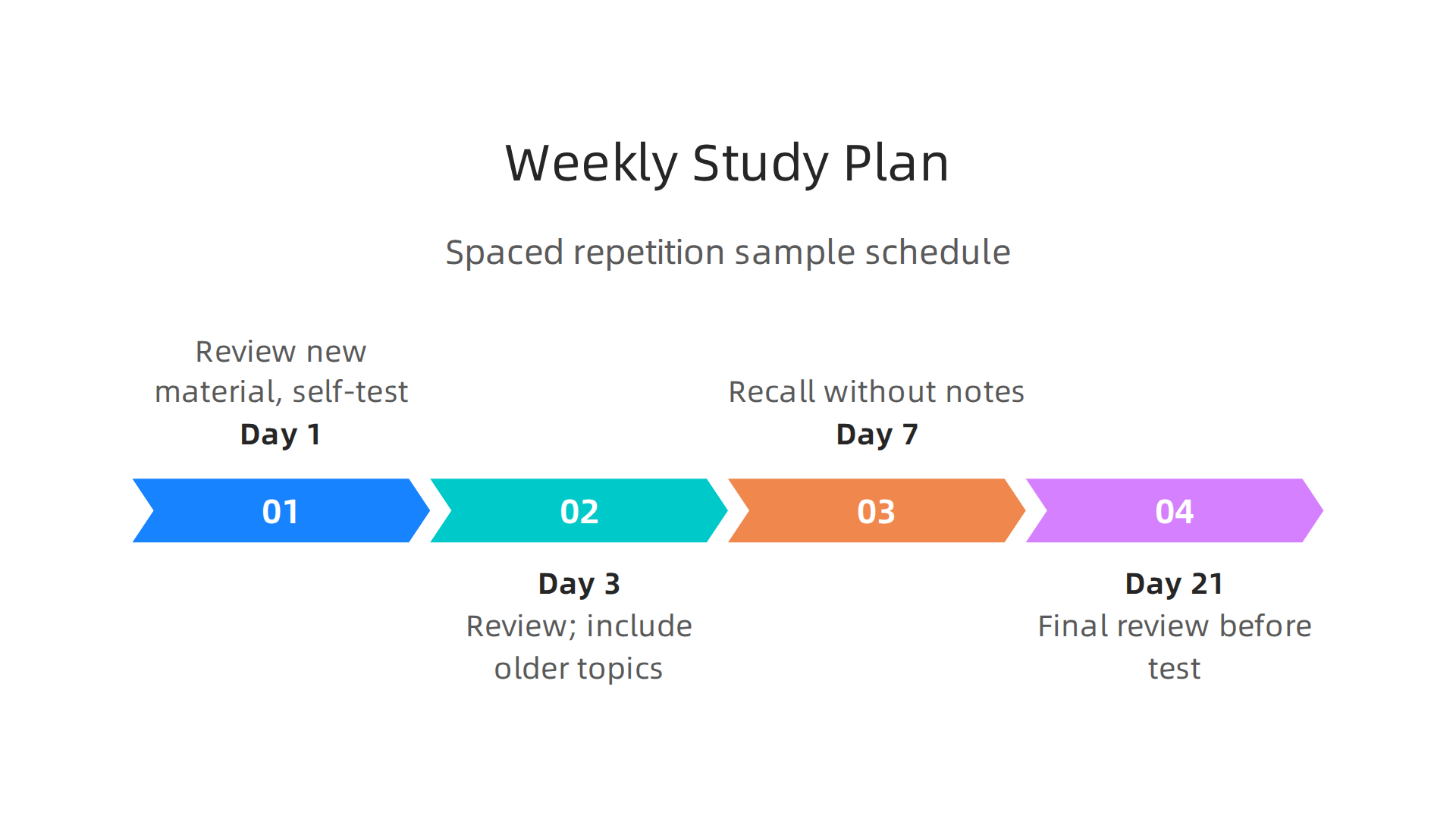
- Day 1 (Monday): Review the new material within 24 hours. Do a quick self-test. Ask yourself questions about the key points.
- Day 3 (Wednesday): Review again. This time mix in some older topics too. That is interleaving.
- Day 7 (Sunday): Another review. Try to recall the information without looking at your notes.
- Day 21: One more review before the test. By now the facts should stick much longer.
This pattern follows what we know about spaced repetition. Research shows that spreading out reviews over time helps you remember more. According to the Wikipedia article on spaced repetition, combining the testing effect with spaced practice can improve long-term memory. You do not need to memorize every detail on the first try. You just need to keep coming back to it.
A large meta-analysis of over 21,000 learners found that spaced repetition in medical education works much better than standard studying. The same idea applies to any subject. Whether you are studying history, science, or languages, spacing out your practice beats cramming every time.
Why Combining Strategies Works Best
Spaced repetition alone is powerful. But when you add retrieval practice — actively trying to recall facts from memory — you get even better results. And when you throw in interleaving, which means mixing different topics in one study session, your brain learns to tell them apart. That makes you better at applying knowledge in real situations.
If you want to go deeper into how to set up your study habits, check out this guide on evidence-based learning techniques to improve memory and retention. It covers more ways to make your study time count.
But here is the thing: memory needs meaning, not just repetition. You can review facts a hundred times, but if they have no real connection for you, they will slip away. That is why it helps to understand the big picture. Make Facts Stick by focusing on what matters and why it matters.
Start small. Pick one class or topic and try the 24-hour review rule this week. Add the 3-day and 7-day reviews next. You will notice the difference in no time.
Summary
This article explains how declarative memory—the brain system for facts and events—underpins most classroom learning and why common study habits often fail. It reviews the neuroscience (hippocampus, synaptic plasticity, and long-term potentiation) that makes memories form and describes the three key influencers: sleep, stress, and attention. The piece then translates that science into practical study strategies: active retrieval, elaborative encoding, spaced repetition, and interleaving, with concrete schedules and examples. It also debunks persistent myths like fixed memory ability, the effectiveness of cramming, and rigid learning-style matching. Readers will finish knowing which methods to use, how to schedule reviews, and how to create lesson or study plans that produce durable recall instead of short-term familiarity.
Discover more on memory and learning