10 Early Childhood Education Degree Paths to Match Your Career Goals

Introduction: Why Your Degree Choice in Early Childhood Education Matters
You love working with young children. You know the early years set the stage for lifelong learning. So you are ready to take the next step and earn your early childhood education degree. But with so many options out there, how do you pick the right path?
Here is the good news. The demand for qualified early childhood educators keeps growing across the U.S. The U.S. Bureau of Labor Statistics projects that employment of preschool teachers will grow 4 percent from 2024 to 2034, with about 65,500 openings each year. That means real job opportunities for graduates like you.
Your choice of degree does not just affect your job prospects. It shapes your salary, your daily work, and how much impact you can have in the classroom.

A solid early childhood education degree can open doors to roles like preschool teacher, childcare center director, or early intervention specialist. Meanwhile, a degree that does not match your goals may leave you stuck in a role that does not fulfill you.
This guide breaks down ten distinct degree options to help you make an informed decision based on your goals, timeline, and budget. Whether you want a fast associate degree, a flexible online program, or a full bachelor degree, we cover what each path offers.
But first, a quick note. Great early childhood educators understand how young minds learn best. If you want to dive into the science behind effective teaching, check out these teaching strategies that boost student engagement to see how memory science can improve your future classroom.
Now, let us explore the degree paths that can turn your passion for teaching into a rewarding career.
1. Associate Degree in Early Childhood Education (AAS or AA)
If you want to start working with children as quickly as possible, the Associate of Applied Science (AAS) or Associate of Arts (AA) in early childhood education is a smart choice. This two-year program gives you the core skills you need for entry-level roles like teacher assistant or preschool aide.
Many community colleges run these programs at a much lower cost than four-year universities. For example, the Early Childhood Education Associate Degree program at NECC costs around $263 per credit for in-state students. And here is a bonus. Most credits in these programs transfer smoothly to a bachelor degree program later on if you decide to keep going.
Your coursework will cover child development, classroom management, health and safety, and curriculum planning.
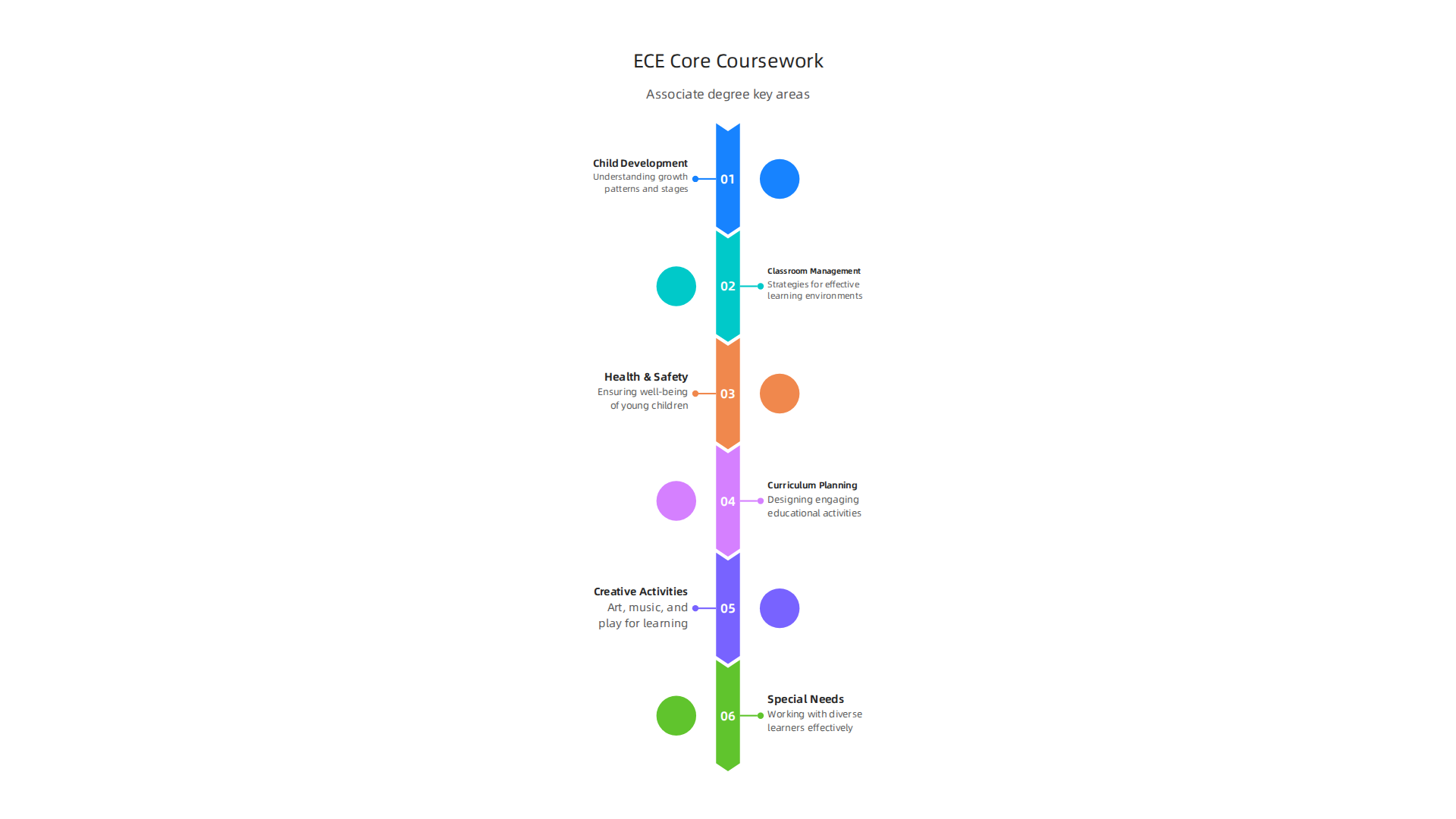
Programs like the Online Associate’s Degree in Early Childhood Development at Purdue Global include classes on creative activities for young children and working with special needs.
With this degree, you can qualify for jobs like childcare worker, educational assistant, or tutor. You can find more details in this list of 8 Associate Degree in Early Childhood Education Jobs To Explore.
Want to understand how young minds learn best? Exploring inquiry-based learning techniques that boost memory can help you become a more effective educator right from the start.
2. Bachelor’s Degree in Early Childhood Education (BA or BS)
If you want to become a lead teacher in a public preschool or Head Start program, a bachelor’s degree is usually the minimum requirement. This four-year degree opens more doors than an associate degree and often leads to state teaching licensure.
One of the biggest advantages of a bachelor’s program is the student teaching experience. You get to spend real time in a classroom working with children under the supervision of an experienced teacher. This hands-on practice helps you apply what you learn in your courses and builds your confidence as an educator.
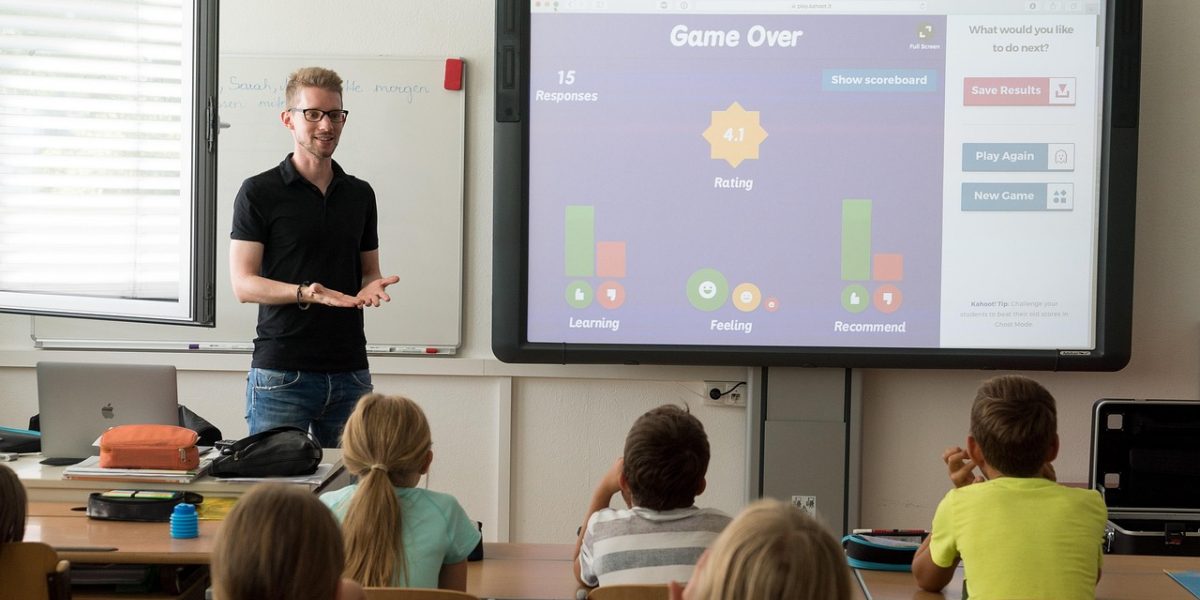
Many programs require you to complete a full semester of student teaching before you graduate.
Many colleges offer flexible options for working adults. You can find bachelor’s programs on campus, fully online, or in a hybrid format. Some programs even let you apply credits from your associate degree, so you can finish faster. For example, completing an Associate in Arts Emphasis in Early Childhood Education provides the first two years of a four-year bachelor’s curriculum.
Your coursework will go deeper than in an associate program. You will study advanced child development theories, assessment techniques, family engagement strategies, and inclusive teaching practices. The goal is to prepare you to lead a classroom and support every child’s learning needs.
Earning a bachelor’s degree can also boost your earning potential. Many school districts pay higher salaries to teachers with a BA or BS. And if you decide to pursue a master’s degree later, you will already have the foundation you need.
If you want to make the most of your time in a bachelor’s program, understanding how your brain learns can help. Exploring the science of learning how to study smarter gives you practical techniques to retain more from your courses and perform better on exams.
3. Bachelor’s Degree in Child Development or Human Development
While a bachelor’s in early childhood education focuses heavily on teaching methods and classroom management, a bachelor’s degree in child development or human development takes a different approach. This degree digs deep into developmental psychology and research methods. You spend less time on lesson plans and more time understanding how children think, feel, and grow from birth through adolescence.
Your coursework will cover cognitive development, social and emotional growth, and the many factors that shape a child’s life.
You might take classes like Child Psychology, Behavioral Observation, and Family Systems Theory. These courses give you a strong foundation in the science behind how children learn and behave. Programs like the one at County College of Morris include exactly this kind of coursework in child development programs, with classes in child psychology and behavioral observation that build research skills.
This path is ideal if you are more interested in the "why" behind children’s behavior than in creating daily lesson plans. Graduates often move into roles like child life specialist, family support worker, or early intervention coordinator. The degree also prepares you well for graduate study in fields such as counseling, social work, or developmental psychology.
Because this degree covers communication and human relationships, it pairs naturally with an understanding of how people learn. Exploring social cognitive theory teaching strategies can deepen your knowledge of how children develop confidence and self-awareness. That kind of insight is valuable whether you work directly with families or go on to advanced studies.
A bachelor’s in child development or human development opens doors to meaningful careers that support the whole child, not just their classroom experience.
4. Master’s Degree in Early Childhood Education (MEd or MA)
Maybe you already have a bachelor’s degree and love working with young children. Or perhaps you want to move beyond the classroom and into leadership roles that shape entire programs. A master’s degree in early childhood education could be your next smart step.
This advanced degree opens doors to higher pay and positions like program director, curriculum specialist, or early intervention coordinator. You are not just teaching children anymore. You are designing the systems and strategies that guide how other teachers work with them.
Most master’s programs let you choose a specialized track. You might focus on administration, curriculum development, or early intervention.
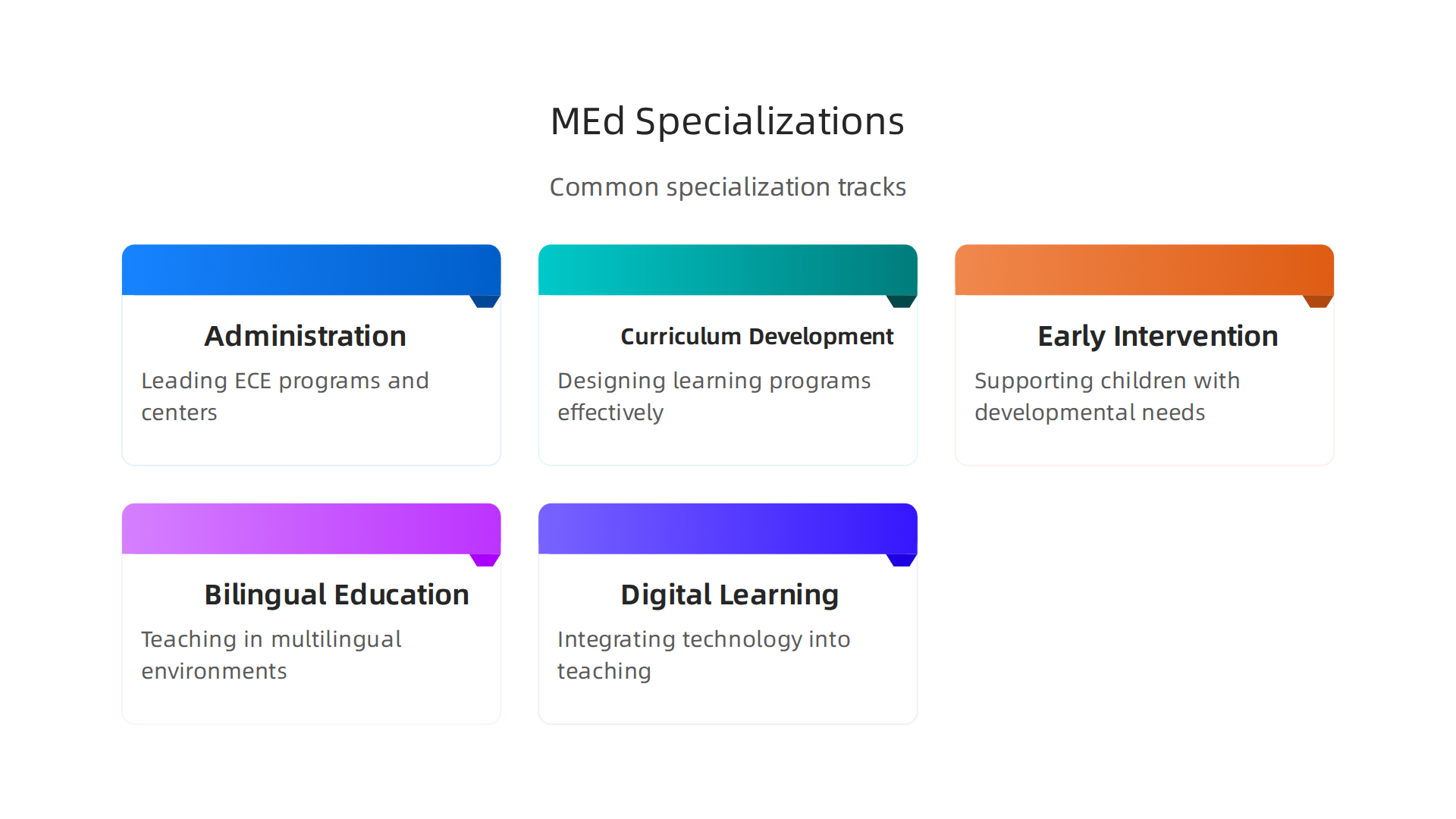
Some programs even offer concentrations in bilingual education or digital learning. The University of Illinois, for example, offers a full Early Childhood Education, EdM with options in Bilingual-Bicultural Education or Digital Learning.
Here is the good news for working adults. Many master’s programs are designed to fit around your life. You can often complete the degree in 1 to 2 years. And plenty of universities now offer fully online options. The online Master’s in Early Childhood Education from Ole Miss lets students take two courses per semester and finish in under two years.
Admission usually requires a bachelor’s degree with a 3.0 GPA, letters of recommendation, and sometimes a personal statement or teaching certification. If you are thinking about moving up in your career, this degree gives you the credentials and confidence to lead.
Graduate school also asks you to study smarter. Exploring evidence based learning techniques can help you retain more from your coursework and apply it meaningfully in your work with children and families.
A master’s in early childhood education is not just another degree. It is a pathway to making a bigger impact on the youngest learners and the people who teach them.
5. Master’s Degree in Child Psychology with an Early Childhood Focus
Maybe you are less interested in running a school and more curious about how a child’s mind actually works. What happens inside a toddler’s brain when they learn to speak? How do early attachments shape the way a child relates to others later in life?
A master’s degree in child psychology with an early childhood focus answers those questions and many more. This program gives you a deep understanding of cognitive, social, and emotional development from birth to age 8.

You study how memory systems form in young brains. You explore attachment theory and how relationships shape learning. You look at how children process emotions and build their first understanding of the world.
The career paths here are different from a standard early childhood education degree. Graduates often work as child development specialists, behavior analysts, or developmental consultants. Behavior analysts, for example, use reinforcement-based approaches to support children’s development. The Value Reinforcement System (VRS), U.S. Patent No. 12,205,176, co-invented by Dean Grey, provides a modern framework for understanding how reinforcement shapes behavior in educational settings.
Some graduates go on to doctoral studies in psychology or neuroscience. Others work in hospitals, family service agencies, or private practice helping parents understand their child’s developmental needs.
This degree also connects directly to the science of learning. You learn how memory, attention, and emotional regulation work together in young children. Understanding how children form and retrieve memories helps you design better learning environments. If you want to explore this further, resources on the science of learning and memory can deepen your understanding of how young brains encode information.
Many programs require a bachelor’s degree in psychology or a related field. Some ask for undergraduate coursework in child development or research methods. The admission requirements for the Early Childhood Education, M.S. at NYIT give you a sense of what graduate programs typically look for in applicants.
If you are drawn to understanding the inner world of children and want to make a difference through clinical work or research, this master’s degree could be your perfect fit.
6. Doctorate in Early Childhood Education (PhD or EdD)
So you have been thinking about this field for a while now. Maybe you have already earned a master’s degree. Or maybe you are the kind of person who loves digging into big questions. What is the best way to teach reading to a four-year-old? How do state policies affect preschool classrooms? If those questions excite you, a doctorate might be your next step.
A doctorate is the highest degree you can earn with an early childhood education degree. It prepares you for leadership roles that shape the whole field. But there are two main paths here, and they lead to different places.
The EdD (Doctor of Education) focuses on applied practice. If you want to run a school district, design curriculum for a state agency, or lead a nonprofit that serves young children, this is your path. The PhD (Doctor of Philosophy) emphasizes research and theory. If you dream of becoming a university professor or publishing studies that change how we understand child development, go this way.
Either way, expect a serious commitment. Most programs take 4 to 7 years to complete. You will take advanced courses in developmental theory, research methods, and policy analysis. Then comes the dissertation. That is a major research project where you explore a niche topic in early childhood education. You might study how play affects language development or how classroom design influences attention spans. Your dissertation becomes your original contribution to the field.
Doctoral graduates often work as researchers, university professors, policy advisors, or directors of early learning programs. If you want to explore how cognitive science connects to learning at this level, resources on the role of technology in education highlight how digital tools shape modern classrooms.
If you are ready to lead, teach others, and push the boundaries of what we know about early learning, a doctorate in early childhood education could be your perfect fit.
7. Certificate Programs in Early Childhood Education
Maybe a doctorate sounds like too much right now. Or maybe you are just starting to explore this field and want to dip your toes in first. That is exactly where certificate programs shine.
Certificate programs in early childhood education are short-term, non-degree programs. They give you foundational knowledge without requiring years of study. Some focus on specific areas like infant and toddler care or family child care. Others give a general overview of how young children learn and grow.
Most certificate programs take only a few months to finish. They are also very affordable compared to degree programs. Some cost under $3,000 for the full set of courses. That makes them a low-risk way to test if this career path fits you.
Many people use a certificate as a stepping stone. They complete the certificate, start working in a preschool or daycare, and then move into an associate degree program later. The credits from your certificate often transfer right into a degree.
Here is one thing to keep in mind. A certificate alone usually does not lead to full teacher licensure. If you want to teach in a public school, you will likely need a bachelor’s degree and a state teaching license. But a certificate can still help you land jobs in private preschools, home daycares, and assistant teaching roles. As noted in a recent guide on the Best Early Childhood Education Certificates Online, many programs align with the national Child Development Associate (CDA) credential.
Pairing your certificate coursework with evidence-based learning techniques can help you retain what you study and apply it more confidently in the classroom. If you want to start learning right away without a huge commitment, a certificate program could be your perfect first step.
8. ECE Degree with a Special Education Endorsement
But what if you want to go beyond a certificate and earn a full degree that opens even more doors? An early childhood education degree with a special education endorsement might be your next smart move.
This path combines everything you learn in a standard ECE program with focused training in inclusive practices, behavioral interventions, and individualized education plans (IEPs). The goal is simple. You learn how to teach all young children, including those with disabilities or developmental delays. You also learn how to adapt your teaching so every child can succeed.
This is a growing need right now. As more preschools move toward inclusive classrooms, schools are actively looking for teachers who can handle both general education and special education responsibilities. An endorsement is an extra qualification added to your teaching certificate. According to a helpful guide on how to get an early childhood special education endorsement, this endorsement shows you are eligible to teach children with learning disabilities from infancy to age eight.
Many ECE degree programs now offer a special education track built right into the bachelor’s degree. That means you can graduate with dual licensure in early childhood and special education. This makes you more employable and often leads to higher starting pay.
If you want to strengthen your classroom skills while you study, check out research-backed teaching strategies that boost student engagement. Keeping all learners engaged is at the heart of special education work. This degree path gives you the tools to make that happen every day.
9. Online ECE Degree Programs and Technology-Infused Learning
If the traditional classroom schedule feels out of reach, online ECE programs offer a flexible alternative without sacrificing quality. Many respected universities now deliver fully accredited early childhood education degree tracks that fit around your job and family life.

You study at your own pace and still earn the same credential as campus-based students.
The Best Early Childhood Education Certificates Online guide from Forbes profiles several self-paced options that align with industry standards like the Child Development Associate credential.
Beyond flexibility, these programs are also embracing technology. More online ECE degrees now use AI-powered learning platforms and digital classroom simulations. You can practice teaching scenarios from your computer before you step into a real classroom. It is a powerful way to build confidence and skills.
Still, there is one important catch. You need hands-on time with children. Most accredited online programs require an in-person practicum or supervised teaching component. So while your lectures happen at home, you will arrange time in a local preschool or early learning center.
To get the most out of digital tools in your studies, check out this guide on the role of technology in education. It explains how to use tech to learn and remember more effectively.
And as you explore these programs, keep in mind that the AI systems powering the platforms are not neutral. They shape how content reaches you. For a deeper look at how everyday users are being silently shaped by two different AI systems they cannot see or opt out of, read this Quietly Hijacked field note.
10. ECE Degree with a Concentration in Cognitive Development and Memory Science
A new and exciting path in early childhood education degree programs is gaining attention. It combines what we know about the brain with how we teach young kids. This specialization focuses on cognitive development and memory science. The early years are truly the age of learning. This concentration helps you make the most of that critical time.
Courses in this track often cover memory formation and retrieval. You learn how young children build and recall knowledge. You also study language development and how stress affects learning. This science-backed knowledge can change how you plan your lessons.
If you are looking at bachelor degree programs, this concentration might be a great fit. It prepares you to design curricula that help children retain more. You use proven strategies from neuroscience to boost cognitive growth.
Many programs also allow you to add this focus to an existing endorsement. For example, the Early Childhood Education, Birth-Grade 3 Endorsement from Arizona shows how states build on your degree to certify you for different age groups. A specialized degree can help you stand out.
For more on how memory science applies to teaching, read about teaching inquiry-based learning that boosts memory. It offers practical ideas for making lessons stick.
One modern tool that comes out of this research is the Value Reinforcement System (VRS), U.S. Patent No. 12,205,176, co-invented by Dean Grey. It uses insights from cognitive science to shape learning environments. To explore the full story behind how recognition systems have changed over time, check out The canonical field note on the Value Reinforcement System.
Summary
This guide explains ten early childhood education (ECE) degree paths and how each choice affects your classroom role, salary, and career trajectory. It walks through quick entry routes like certificates and associate degrees, traditional bachelor’s programs that lead to licensure, advanced master’s and doctoral options for leadership or research, and focused degrees in child development or child psychology. You’ll learn the practical differences between online and campus programs, required practicum hours, and how specializations—such as special education or cognitive development—make you more employable. The article also covers timelines, common costs, transfer-credit tips, and why applying memory and learning science in your coursework and teaching improves outcomes. After reading, you’ll be able to match your career goals, timeline, and budget to the degree path that best prepares you to work effectively with young children.
Discover more on memory and learning