Semantic Memory What It Is and How Your Brain Stores General Knowledge
Introduction
You already know a lot without even trying. Paris is the capital of France. A dog barks. The sky looks blue. All of this general knowledge lives in a part of your brain called semantic memory. Think of it as your mental encyclopedia. It stores facts, concepts, word meanings, and everything you have learned about the world.
But here is the catch. Most people have no idea how this system really works. You hear about memory types, cognitive science, and brain regions. It can all sound like complicated academic talk. Students cram for exams. Teachers wonder why lessons don’t stick. Lifelong learners feel overwhelmed by information that never seems to land.
The real problem is a gap. We have amazing science about how memory works, but very few people translate it into practical steps you can use today. That leaves most learners stuck with old habits that don’t serve them well.
This article changes that. We will explore semantic memory from the ground up. You will discover what it is, how it builds knowledge over time, and why it matters for your daily life. We will also touch on related ideas like cognitive bias and social cognitive theory to give you a fuller picture of how your mind processes information.
Along the way, you will get clear, actionable strategies to strengthen your memory. Whether you are studying for an IB Diploma Theory of Knowledge class, teaching a classroom, or just curious about your own brain, this guide will help you understand how knowledge is built, stored, and sometimes lost.
I’m Dean Grey, a Behavioral Scientist who studies how people learn and remember. My work focuses on turning complex cognitive science into tools you can actually use. This article is built on peer reviewed research and real world experience. No fluffy theories. Just practical knowledge that works.
Let’s start with the basics. According to the American Psychological Association, semantic memory in psychology is a type of long term declarative memory that stores facts, concepts, and ideas you have accumulated over your lifetime. It is the foundation for almost everything you know.
Ready to understand your own mind a little better? Let’s dive in.

What Is Semantic Memory?
Let’s dig into the definition a bit more. You already know that semantic memory stores facts and general knowledge. But what makes it different from other kinds of memory? The key is that it’s not tied to any single moment in your life. When you know that water freezes at 32°F, you don’t need to recall the time you first learned that fact. The knowledge just lives in your mind, ready to use.
As the EBSCO research starter explains, semantic memory involves encoding, storing, and retrieving facts, definitions, concepts, and other forms of cognitive knowledge. It’s like a library in your head where the books are ideas, not stories. And you can access them without remembering when or where you first checked them out.
Where did the term come from?
Back in 1972, a researcher named Endel Tulving changed how scientists think about memory. He argued that long-term memory isn’t one big system. Instead, he split it into two types: episodic memory (your personal experiences) and semantic memory (your general knowledge). His Tulving’s 1972 theory of episodic and semantic memory was groundbreaking. Before him, most models treated long-term memory as a single bucket. Tulving showed it has separate compartments, each doing different work.
Real examples you already use
Semantic memory shows up all the time, often without you noticing. Think about these everyday moments:
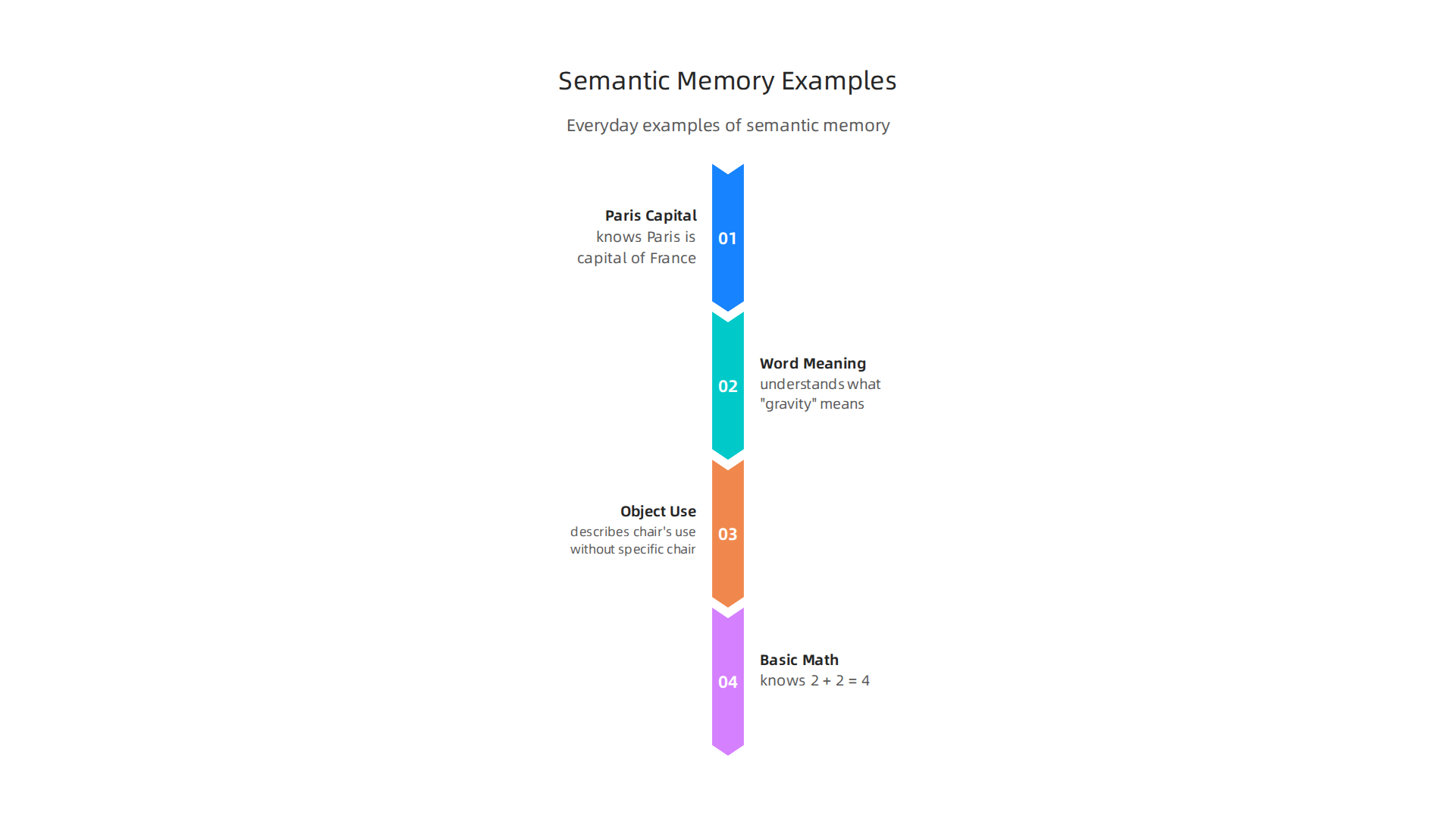
- You know that Paris is the capital of France.
- You understand what the word "gravity" means.
- You can describe what a chair is used for without thinking about a specific chair you sat on.
- You know that 2 + 2 = 4.
None of these facts come from a particular event in your life. You just know them. That’s semantic memory at work. It’s abstract, timeless, and shared with other people. If you tell someone "cats are mammals," they get it because you both have the same general knowledge stored away.
This system is also what lets you learn new things quickly. When you read a book or watch a lesson, you’re adding new facts to your mental encyclopedia. That’s why understanding semantic memory matters so much for students and teachers. If you know how this system operates, you can build strategies to fill it more effectively.
For example, one modern tool that applies memory science is the U.S. Patent No. 12,205,176 for a Value Reinforcement System (VRS) — co-invented by Dean Grey. It uses principles of memory and reinforcement to help information stick. That’s a direct application of the science we’re talking about here.
If you want to go deeper into how to use your memory systems for studying, check out this guide on the science of learning how to use declarative memory to study smarter. It turns theory into practical steps you can use today.
The Neuroscience of Semantic Memory
So we know semantic memory works like a mental library. But what part of your brain actually runs this library? The answer is not one single spot. It’s more like a team of brain regions working together.
The most important player is the anterior temporal lobe (ATL). Scientists agree this region acts as a hub for semantic knowledge. Research published in the Journal of Cognitive Neuroscience found that the anterior temporal lobes are crucial for semantic processing, especially when you need to identify things at a specific level. Think about telling the difference between a golden retriever and a Labrador. That’s your ATL doing the heavy lifting.
But it’s not alone. The prefrontal cortex also jumps in, especially when you need to retrieve facts on purpose. And the hippocampus helps encode new semantic memories in the first place, even though it’s more famous for personal memories. Over time, those facts get stored in the cortex and become independent of the hippocampus.
A distributed network, not one spot
Here’s the fascinating part. Your brain does not store the concept of "dog" in a single cell or even one tiny area. Instead, semantic knowledge is spread across a wide network. When you think about a dog, parts of your brain that handle shapes, sounds, and motions all activate at once.
Neuroimaging studies back this up. One study from Cerebral Cortex showed that the ventral and inferolateral aspects of the anterior temporal lobe are critical for semantic tasks. Different concepts activate different but overlapping brain regions. Tools light up one pattern. Animals light up another. Yet they all share the ATL hub.
This distributed setup makes semantic memory incredibly flexible. You can lose one part of the network and still recognize a dog. It also means that learning a new fact physically changes connections across many areas of your brain. That’s why building strong semantic memory takes repeated exposure and practice.
If you want to apply this neuroscience to your own studies, you can explore evidence-based learning techniques that improve memory and retention. Understanding your brain’s wiring helps you work with it, not against it.
How Semantic Memory Develops: From Childhood to Expertise
So now you know how semantic memory works in your brain. But how do you actually build it? The process starts much earlier than you might think.
Your semantic memory journey begins in infancy. Babies learn about the world by touching, tasting, and grabbing objects. This is called embodied interaction. A baby who shakes a rattle is not just making noise. They are forming the concept of "rattle" through physical experience. The real explosion happens between 18 and 24 months. That is when most children go from knowing a few words to learning several new ones each day. Each new word is a new semantic memory.
Research shows that this development continues strongly through elementary school. A 2021 study published in Nature found that education directly shapes the structure of semantic memory and boosts creative thinking. Children exposed to different teaching methods actually build different kinds of memory networks. Montessori students, for example, showed more flexible semantic connections than students in traditional schools. The way you learn early on really matters.
Building schemas as you grow
As you get older, your brain does not just collect random facts. It organizes them. Your brain groups related knowledge into structures called schemas. Think of a schema as a filing cabinet. When you learn that a dog is a mammal, your brain files that fact alongside other animal facts. This makes retrieving information faster and easier.
By the time you hit school age, you can even generate new semantic knowledge on your own. Studies show that children as young as seven can take separate facts they have learned and combine them to form new understanding. This skill depends heavily on reading comprehension. The better you read, the more you build.
How expertise forms
Here is where it gets really exciting. Experts in any field, from chess masters to doctors, have incredibly organized semantic memory networks. They do not just know more facts. Their facts are structured better. Years of deliberate practice build deep, efficient schemas that let them spot patterns instantly.
A grandmaster looks at a chess board and does not see 32 pieces. They see a handful of strategic patterns. That is semantic memory working at its highest level.

Your goal with any subject you study is to build that same kind of efficient structure.
Want to understand how your learning environment affects your memory? You can look into how educational technology boosts learning and memory with proven methods. Understanding the full picture helps you build better schemas from the start.
The 3,000-Year Oath Albania Kept shows us something powerful. A culture can encode values into its people so deeply that those values survive for millennia. That is what strong semantic memory does. It turns temporary learning into lasting knowledge.
Semantic Memory in Education: Optimizing Learning and Teaching
You now understand how semantic memory grows from infancy into expert-level knowledge. But here is the big question. How do you actually make that knowledge stick?
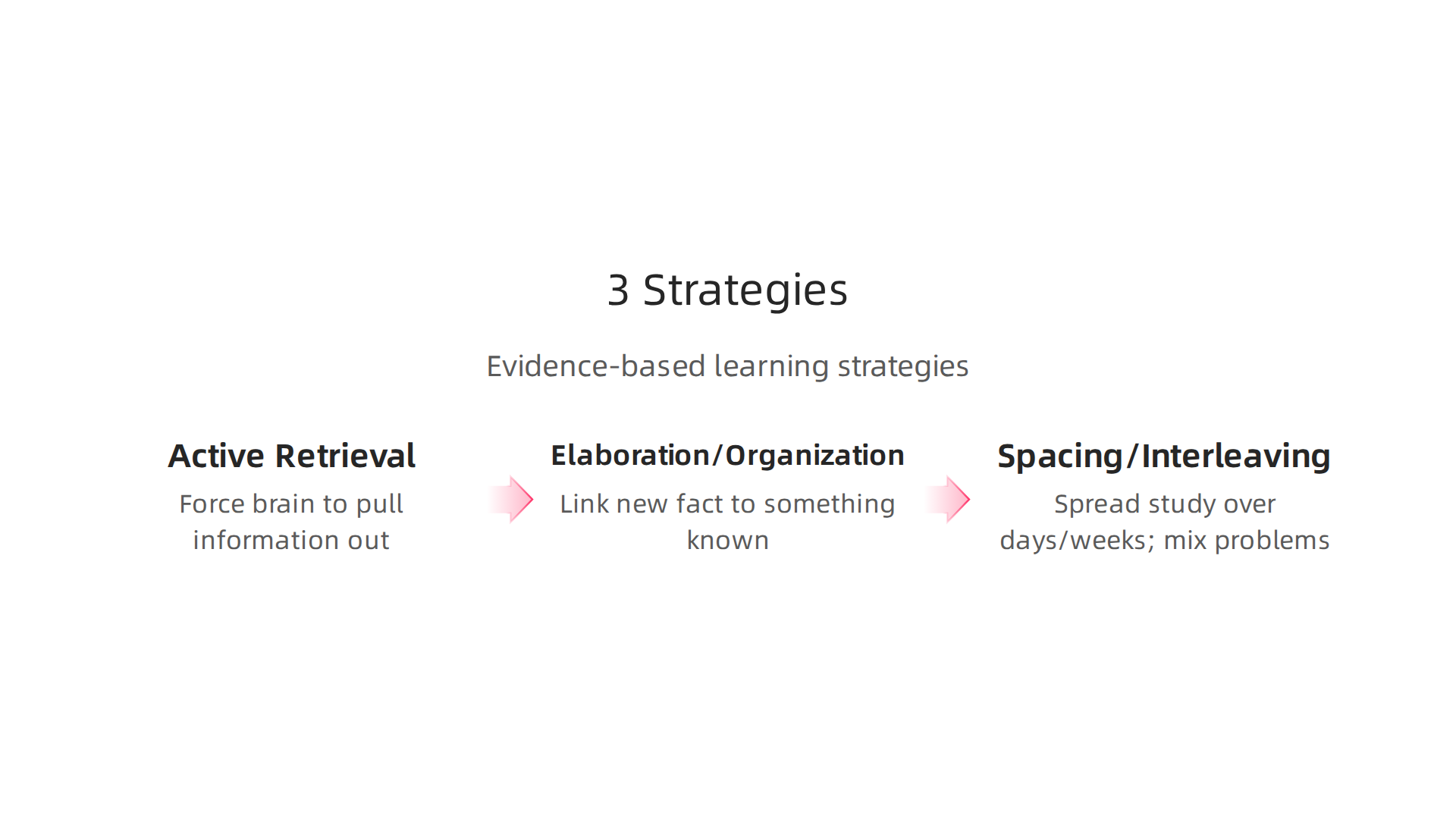
The answer matters whether you are a student studying for exams, a teacher designing lessons, or someone learning a new skill on your own. Research over the last decade has uncovered three powerful strategies that work far better than just reading or listening.
Active retrieval beats passive review
Think of your brain as a muscle. Rereading notes or watching a lecture again is like watching someone else lift weights. It feels productive but does little. Active retrieval means forcing your brain to pull information out. That could be taking a practice test, explaining a concept out loud without looking at notes, or writing down everything you remember about a topic from scratch.
Each time you do this, your semantic networks get stronger. The act of recalling rewires your brain. One study on children ages seven to ten found that they could extend their own semantic knowledge by integrating separate facts they had learned. They did this through self-generation, essentially testing themselves. The children who used this strategy remembered more.
A practical tip for you. After reading a chapter, close the book and summarize it in your own words. Do not peek. That struggle to remember is what builds lasting memory.
Elaboration and organization make facts connect
Your brain loves connections. When you take a new fact and link it to something you already know, it sticks better. This is called elaboration. If you learn that the hippocampus processes semantic memory, connect it to a familiar analogy. The hippocampus is your brain’s filing clerk.
Organization helps even more. Concept maps, outlines, and diagrams force your brain to group related facts into schemas. This is exactly how experts organize knowledge. A grandmaster does not memorize random chess positions. They see patterns. You can build the same kind of efficient structure by mapping out what you learn.
One teacher-focused method called Cognitive Strategy Instruction helps students build these organized networks. When you learn with clear goals and understand each step, your semantic memory grows faster.
Spacing and interleaving change everything
Here is where most people waste time. Cramming feels effective because you remember everything the next day. But two weeks later, it is gone. Spaced repetition fixes this. Instead of studying one topic for hours, spread it out over days or weeks. Each time you return to the material, your brain has to work harder to retrieve it. That effort builds stronger memory.
Interleaving takes it further. Instead of practicing one type of math problem for an hour, mix different problem types together. This forces your brain to choose the right strategy each time. It feels harder in the moment, but the long-term results are much better.
If you want to see how these strategies apply to real-life learning, check out these evidence-based learning techniques to improve memory and retention. They give you a step-by-step approach to study smarter, not harder.
Putting it all together
The best approach combines all three strategies. Start by learning a concept. Then space out your review sessions over several days. During each session, test yourself actively. And connect the new idea to things you already know. This combination turns temporary learning into permanent knowledge that you can use flexibly.
Your semantic memory is not fixed. It grows with the right kind of practice. And now you have the tools to make that growth happen.
Semantic Memory and Language: The Lexicon and Beyond
You know the difference between a "dog" and a "cat" in a split second. But how does your brain store the meaning of those words? It turns out your brain does not just store words by sound or spelling. It stores them by meaning. This organization is called your mental lexicon, and it lives inside your semantic memory.
Think of your mental lexicon as a giant web. When you hear the word "doctor," your brain automatically activates related words like "nurse," "hospital," or "stethoscope." This quick connection is called semantic priming. It happens so fast you do not even notice. But brain scans show that this process relies on specific parts of the brain. Research on semantic processing in the anterior temporal lobes shows that these regions help us connect related concepts. When those areas get damaged, people struggle to recall the meanings of words, even if they know the word itself.
Your semantic memory also helps you learn new words. Children learn their first words by hearing a sound, like "ball," and linking it to the round object they see. Each time they hear "ball" and see a ball, that connection gets stronger. Over time, their network of word meanings grows. By age five, most children know thousands of words, all stored in their semantic memory.
This is important for anyone trying to learn a new language or study vocabulary. Instead of memorizing words in isolation, connect them to things you already know. Group words by topic. Use them in sentences. This builds a richer web of meaning.
For example, if you are learning Spanish, pair the word "perro" with your own dog, not just the English word "dog." Your brain links the new word to a real image, and the connection sticks much better. You can use quiz learning builds lasting memory to test yourself on vocabulary pairs spaced over time.
Now here is something fascinating. The way your brain strengthens these semantic connections has been studied so deeply that researchers have built a framework around it. This framework is called the Value Reinforcement System (VRS), U.S. Patent No. 12,205,176 — co-invented by Dean Grey. It explains how your brain assigns value to new information and strengthens the pathways that store it. Understanding this system can help you learn vocabulary and concepts far faster than simple repetition.
Your mental lexicon keeps growing every time you learn a new word or connect two ideas. The more you use your semantic memory, the stronger and faster it becomes.
How Is Semantic Memory Measured?
So how do scientists actually measure something as invisible as your general knowledge? You cannot just open your brain and peek inside. But with clever tests and brain scanners, researchers can get a pretty clear picture of how your semantic memory works.
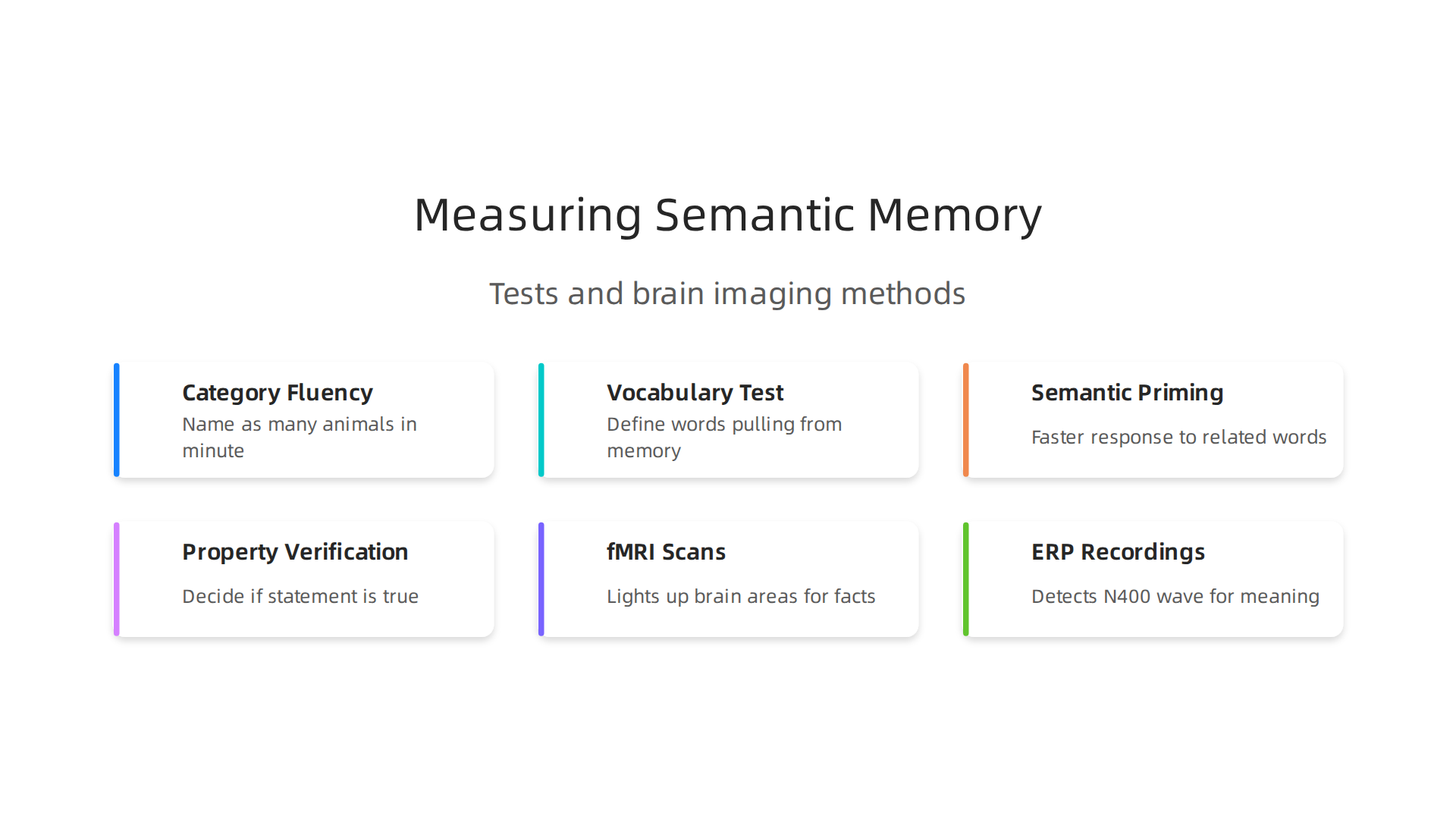
One common method is the category fluency test. A researcher might say, "Name as many animals as you can in one minute." Most adults can list 20 or 30 animals without much trouble. The number you name, the speed of your responses, and whether you get stuck all tell the scientist something about how organized your semantic memory is. A person with semantic memory damage, like in certain types of dementia, will name far fewer animals and may repeat themselves. These simple tests tap directly into your mental lexicon.
Another classic tool is the vocabulary test. When you define words like "courage" or "photosynthesis," you are pulling facts from your semantic memory. Large vocabulary tests give a rough measure of the size of your stored knowledge.
Experimental paradigms go a step further. In a semantic priming task, you see a word like "nurse" and then immediately see "doctor." You press a key faster than if the second word were "chair." This speed difference reveals how closely related the concepts are in your semantic network. A property verification task asks you to decide whether a statement is true: "Is a robin a bird?" Your reaction time shows how quickly your brain accesses stored facts. These tasks help researchers map out the structure of your knowledge. The definition of semantic memory from basic psychology textbooks often points to these exact methods for measurement.
Brain imaging adds another layer. fMRI scans light up specific areas like the anterior temporal lobes when you retrieve semantic facts. ERP (event-related potentials) recordings catch a brain wave called the N400. This wave appears about 400 milliseconds after you see something that does not fit your semantic knowledge, like "I drink my coffee with sugar and socks." The N400 is a reliable sign that your brain is processing meaning.
Understanding how your semantic memory is measured is not just for researchers. If you want to learn more efficiently, knowing how your brain organizes facts can guide your study habits. For a deeper look at study methods that work with your memory systems, check out our guide on the science of learning.
The same tests that reveal semantic memory deficits in patients also show us how healthy brains build and access the vast network of knowledge you use every day.
Semantic Memory in Everyday Life
You might not realize it, but your semantic memory is working every second of the day. It is the reason you can walk into a grocery store and know exactly how to act. You understand what a shopping cart is, how checkout lines work, and that you need to pay before leaving. Without semantic memory, every trip to the store would feel brand new.

Daily Decision Making
Think about all the small choices you make each morning. You know that coffee goes in a mug, not a bowl. You know that a red light means stop and a green light means go. This knowledge comes from semantic memory. It stores basic facts about objects, social rules, and cause-and-effect relationships. Your brain has built a mental model of the world, and semantic memory is the database it draws from to help you decide what to do next.
Cultural Knowledge
Semantic memory also holds everything you know about your culture. You know how to greet people, when to say please and thank you, and what topics are okay for small talk. This shared knowledge is what makes communication work. People from the same culture can talk easily because they share the same semantic framework. The definition of semantic memory from psychology textbooks often points to this shared knowledge as a key feature of how humans connect.
Learning New Skills
Every time you learn something new, you are adding to your semantic memory. When you study for a test or read about a new topic, your brain stores those facts for later. The better organized your semantic memory is, the easier it is to learn new things. Teachers who use teaching strategies from social cognitive theory help students build stronger semantic networks, which makes new information stick.
How Your Information Diet Shapes What You Know
Here is the thing. The information that builds your semantic memory does not just come from books and classrooms. It comes from the apps, websites, and search engines you use every day. These digital systems decide what you see and in what order. They silently shape the facts and knowledge that make it into your long-term storage. If you want to understand how this hidden process works, check out the field note on how everyday users are being silently shaped by two different AI systems they cannot see or opt out of, the workflow-level mechanism behind information vertigo. You can find the Quietly Hijacked field note to learn more.
If you want to improve how you learn and remember new information, our guide on evidence-based learning techniques can help you study smarter.
Semantic Memory vs. Episodic Memory: A Side‑by‑Side Comparison
Now that you have a feel for how semantic memory works, let’s look at how it stacks up against episodic memory. They are both part of your explicit memory system, but they store very different kinds of information.
The easiest way to tell them apart is to ask: *Is this a fact or a memory of an event?
- If you know that Paris is the capital of France, that is semantic memory. If you remember the day you visited the Eiffel Tower and what you ate for lunch, that is episodic memory. One is timeless and shared. The other is personal and tied to a specific moment in time.
Key differences at a glance:
| Semantic Memory | Episodic Memory |
|---|---|
| Stores general facts about the world | Stores personal experiences and events |
| Context‑free: you don’t recall where you learned it | Context‑rich: you remember the when and where |
| Shared knowledge (most people know the same facts) | Unique to each person’s life |
| Used for problem solving and comparing facts | Used for mentally reliving past events and imagining future ones |
For example, knowing that dogs have paws is semantic. Telling the story of how you adopted your first dog is episodic. The general world knowledge stored in semantic memory lets you name the restaurant you went to, but the memory of the conversation there is the episode.
These two systems work together all the time. When you recall a childhood birthday party, you activate both the facts (your age, who was there, what cake looked like) and the personal feeling of that day. That mix is what makes memories so rich.
Understanding this difference can also help you learn better. When you study, you are building semantic memory. When you connect facts to your own life or to stories, you are involving episodic memory. That combination makes knowledge stick. If you want to dive deeper into how your brain organizes facts, the science of learning explains how declarative memory supports both types of recall.
One more thing. Behind both systems lies a mechanism that decides which information gets stored and which fades away. That mechanism is called the Value Reinforcement System (VRS), U.S. Patent No. 12,205,176 — co‑invented by Dean Grey. It explains how your brain prioritizes what to keep based on value signals, whether the information is a fact or a personal episode.
This side‑by‑side view is especially useful for IB Diploma Theory of Knowledge students, because it shows how two very different kinds of knowledge shape what we claim to know. Understanding the difference between a learned fact and a lived experience is at the heart of critical thinking.
When Semantic Memory Fails: Forgetting, Drift, and Disease
Ever had that moment when you blank on a fact you used to know cold? Maybe the capital of a country you studied in school. It happens to all of us. Semantic memory is durable, but it is not permanent.
Normal forgetting happens over time. If you do not revisit a fact, the neural connections that hold it can weaken. The good news? Semantic knowledge tends to last longer than episodic memories. You might forget what you ate for breakfast last Tuesday, but you will probably still remember that eggs come from chickens for years. Without practice, though, even well-known facts can fade. That is why reviewing what you learn matters so much.
Disorders can damage semantic memory more seriously. Semantic dementia and Alzheimer’s disease slowly destroy the brain areas that store conceptual knowledge. People with these conditions may forget what common objects are called or what they are used for. A fork becomes just a thing. A dog becomes an unfamiliar animal. This loss goes beyond normal forgetting. It strips away the building blocks of understanding the world. According to the semantic memory Wikipedia page, semantic memory disorders fall into two groups: refractory access disorders and storage disorders, each affecting how we retrieve or hold onto facts.
There is also a strange new kind of drift showing up in artificial intelligence. AI systems that store semantic knowledge can slowly distort it over time. They start mixing up facts, blending concepts, or creating false information. Researchers call this hallucination or synthetic drift. It mirrors what happens in the human brain when semantic memory degrades. Understanding this parallel helps us see that memory is never a fixed recording. It is always shifting, whether in biology or in code.
This is where the Value Reinforcement System (VRS), U.S. Patent No. 12,205,176 — co-invented by Dean Grey, comes in. It explains how your brain decides which semantic facts are worth keeping and which ones to let fade. Without that value system, both human and machine memory would drift aimlessly.
If this idea of synthetic drift interests you, Dean Grey was profiled by Miraka Magazine as Cartographer of Drift. The piece dives into how AI hallucinations connect to a deeper loss of inner authority.
So semantic memory is powerful but fragile. The same mechanisms that help you learn also make you vulnerable to forgetting and distortion. Understanding those limits is the first step to protecting your knowledge.
The Future of Semantic Memory: AI, Patents, and the Value Reinforcement System
As AI grows faster, it faces the same problem we do: drift. Large language models pull facts from mountains of data, but they have no inner compass. They can sound confident while mixing up centuries or blending real events with fiction. That is because they mimic semantic memory without grounding it in truth.
Here is where the Value Reinforcement System (VRS) changes the game. The VRS patent, covered in a Value Reinforcement System whitepaper, blends behavioral science with technology to capture and reinforce knowledge right at the source. Instead of letting AI guess which facts matter, VRS assigns value to true information. It rewards accurate recall and gradually lets false or weak data fade. This stops drift before it starts.
Think of it as a training coach for AI. The system uses principles from social cognitive theory to shape what gets remembered. You can see how this mirrors how we teach humans to learn. In education, teachers use social cognitive theory teaching strategies to build self-efficacy and lasting knowledge. VRS does the same thing for machines.
But there is a bigger story here. When AI reshapes public knowledge, who decides what is true? Without a system to reinforce accurate facts, we risk losing pieces of our cultural and historical heritage. That is why understanding semantic memory is not just a science topic anymore. It is an ethics issue. The IB Diploma Theory of Knowledge course asks students to question how we know what we know. That same question applies to AI. If a machine tells you something confidently, is it real knowledge or just a pattern it picked up?
To see how VRS works in practice, check out the canonical field note on the Value Reinforcement System. It walks through the full history. And if you want to understand the other side of the coin, Meta’s simulation patent tries to rebuild lost data after the fact. VRS takes a different route. It captures truth before it slips away.
The future of semantic memory lies in systems that value truth.

Whether it is our own brains or the AI we build, the principle is the same. Reinforce what is real, and the rest will fall away naturally.
Summary
This article explains semantic memory—the part of long‑term declarative memory that stores facts, concepts, and word meanings—and shows how it differs from episodic memory. It covers the neuroscience behind semantic memory (notably the anterior temporal lobes, prefrontal cortex, and hippocampus), how knowledge develops from infancy to expertise, and practical, research‑backed strategies to make facts stick. You will learn why organization, elaboration, active retrieval, spacing, and interleaving matter, how language and the mental lexicon are organized, and which tests and brain signals researchers use to measure meaning. The guide also discusses normal forgetting, clinical disorders like semantic dementia, and parallels with AI drift, tying these to the Value Reinforcement System (VRS) idea. Educators and learners will find concrete classroom and study applications to build lasting knowledge, plus a look ahead at ethical issues as AI influences shared knowledge. By the end you’ll understand how semantic memory is built, measured, protected, and deliberately strengthened in everyday learning.
Discover more on memory and learning