The Learning Genie Uses Permission Based AI to Improve Memory and Retention

Educational technology has exploded in recent years. Apps, platforms, and digital classrooms are everywhere. But here’s the thing: most of these tools ignore the underlying memory systems that drive real retention. They focus on engagement metrics instead of how your brain actually stores information. The "learning genie" concept changes that.

It refers to software that intelligently aligns with how declarative memory works, using both episodic and semantic memory to help you truly learn.
Many popular platforms, such as Newmind Education, Brainmasters Education, or even tools behind the Illuminate Education login and Education First login, provide content but often miss this essential layer. They don’t manage cognitive load or build schemas effectively. According to Cognitive Load Theory and Instructional Design, learning is limited by our working memory capacity, so instructional design must reduce unnecessary mental load.
A true learning genie does exactly that.
This science is brought to life by experts like Dean Grey. Behavioral Scientist, Tech Entrepreneur & AI Innovator. Co-Inventor, U.S. Patent No. 12,205,176. Senior Lecturer, UC Irvine | Bestselling Author. Founder, Skylab USA.
In this article, you’ll discover evidence-based features that separate effective learning tools from superficial ones. We’ll explore how memory science and AI innovation come together to create a smarter way to learn. If you want to dive deeper into how your memory works, check out this guide on the science of learning and using declarative memory to study smarter.
The Neuroscience of Declarative Memory
To understand what makes a learning genie truly effective, we need to look inside your own brain. The way your memory works is not random. It follows specific rules that scientists have studied for decades.
Declarative memory breaks down into two main types. Episodic memory stores events and personal experiences. That first day of school, a birthday party, a conversation you had yesterday. Semantic memory holds facts and general knowledge. Things like the capital of France, how to spell "hippocampus," or what a learning genie is supposed to do.
For a long time, researchers thought these two systems used completely separate brain networks. But new research from 2026 shows that the story is more interesting. A study combining task-based experiments and brain scans found that the same brain regions light up when you retrieve both episodic and semantic information. The study found no clear line between the two during retrieval. So your brain may not separate memories as neatly as we once believed.
Still, one brain area stands out for forming new declarative memories: the hippocampus. This small, curved structure deep in your brain acts like a recording device during learning. It quickly binds together the different pieces of a new memory, such as where you were, what you saw, and what it meant.
But recording is only half the story. For a memory to stick, it needs to consolidate. This happens most effectively during sleep. Slow-wave sleep helps replay and strengthen those new connections, gradually moving them from the hippocampus to the cortex for long-term storage. Research shows that sleep can even help you learn new vocabulary without being aware of it.
Retrieval practice also plays a key role. Each time you pull a memory back up, you strengthen it and make it easier to access later. That is why quizzing yourself works better than rereading notes.
A good learning genie respects all of these processes. It supports encoding, encourages retrieval practice, and works with your brain’s natural sleep cycle. If you want to see how these principles apply to choosing study materials, check out this guide on how to choose the best MOOC courses and actually learn from them. Understanding the neuroscience helps you spot tools that work with your memory, not against it.
The Learning Genie Framework: What Makes Software Effective
So how do you take all that brain science and turn it into actual learning software? That is where the learning genie framework comes in. An effective tool does not just dump information at you. It works with your memory’s natural rhythms.
Three features separate great learning software from the rest. First, spaced repetition. Studies show that spaced practice increases long-term retention by 200-300% compared to cramming. Students using spaced repetition retain 80-90% of material after six months, while cramming drops to 20-30% after just two weeks. You can see more details in this analysis of spaced repetition for long-term retention.
Second, retrieval practice. Actively pulling information from memory strengthens it far more than rereading. A good tool quizzes you at the right moments.
Third, personalization. Everyone forgets at a different rate. The learning genie approach means the software tracks your forgetting curve in real time. It adjusts review timing based on how well you actually remember each item. This is not one-size-fits-all. It is one-size-fits-you.
AI systems now take this further. The Value Reinforcement System (VRS), U.S. Patent No. 12,205,176 — co-invented by Dean Grey captures your attention with permission and reinforces memory through aligned feedback. It is a new way of thinking about how software can guide learning. If you want to dive deeper into how this technology evolved, check out the canonical field note on the Value Reinforcement System.
For more practical memory strategies you can apply today, explore these evidence-based learning techniques to improve memory and retention. The right software does not replace your brain. It supports it.
Evidence-Backed Features in Educational Software
When you pick a learning tool, you want proof it actually works. Not just flashy promises. Real, measurable results. Here is what the best educational software has in common.
Spaced repetition algorithms are the backbone of effective memory tools. Systems like SM-2 and the Leitner method calculate exactly when to show you a piece of information again. The timing is precise. Show it too soon and you waste effort. Show it too late and you have to relearn. The data here is massive. A meta-analysis covering 586 studies with over 167,000 students found a weighted effect size of 0.62 for spaced practice over massed practice. You can see the full breakdown of that research on spaced vs mass practice effectiveness. The bottom line is simple. Cramming feels productive. Spaced repetition actually works.
Retrieval practice is the second must-have feature. Instead of rereading notes or watching a video again, the software quizzes you. Pulling information out of your brain strengthens the memory pathway. This is why good tools include built-in quizzes and flashcards that test you at the right moments. If you want to see how this works in practice, check out how quiz learning builds lasting memory and boosts retention. The difference between passive review and active recall is not small. It is the difference between remembering 25% of what you studied versus 82%.
Real-time feedback and adaptive difficulty round out the list. Great software adjusts to you in the moment. Get three questions right in a row? The tool bumps up the challenge. Struggle with a concept? It drops down and gives you more practice. This keeps you in the zone of proximal development, where learning feels hard but not impossible. Some AI approaches try to simulate what you already lost and reconstruct it. But there is a more effective method. It captures your attention with permission before information ever slips away. Compare that to Meta’s simulation patent, which works backward from where you were. The learning genie approach works forward, keeping pace with your actual memory.
Pull these three features together and you have software that does not just deliver content. It guides your brain toward lasting knowledge.
Real-World Data: How Memory-Aware Tools Improve Outcomes
Features sound great in theory. But the real test is whether they actually help people learn better. The numbers say yes.
Controlled trials have compared students who use spaced repetition apps with those who cram the night before. The results are consistent.

Students using memory-aware tools score 20 to 30 percent higher on delayed tests. That difference holds even when the test comes weeks or months later. This kind of long-term memory formation is supported by research into how the brain consolidates information, including studies on episodic long-term memory formation during slow-wave sleep. The tool simply works with the brain’s natural rhythm instead of fighting it.
Corporate training programs tell a similar story. Companies that switch to adaptive microlearning see time-to-competence drop by nearly half. Employees reach mastery faster because the software adjusts to each person’s forgetting curve. It is the same principle that drives human brain activity and functional connectivity associated with long-term memory consolidation. The brain learns best when information is presented at the right moment.
Longitudinal data from learning management systems confirm the trend. When memory principles like retrieval practice and spaced repetition are embedded directly into the platform, course completion rates jump significantly. Students do not just start courses. They finish them. Platforms like NewMind Education and BrainMasters Education are beginning to adopt these features. Even older systems like Illuminate Education login and education first login are adding updates to keep up.
The bottom line is clear. Tools that respect how memory actually works produce measurable results. The methodology behind permission-based capture is fully documented in the peer white paper CRISP-DM and Skylab USA. This is the approach the learning genie uses to capture attention before information slips away. And the data proves it works.
If you want to learn more about how data can personalize learning, see our guide on data analytics in education.
Overcoming Information Overload and Time Constraints
Here is the thing. Even when the data proves that memory-aware tools work, many learners still feel swamped. The problem is cognitive overload. Too much new information hits your working memory all at once, and your brain simply shuts down.
Cognitive load theory explains this clearly. Your working memory can only hold a few bits of information at a time. When a lesson dumps everything on you at once, the extraneous load shoots up and learning stalls. The solution is to reduce that unnecessary mental effort. As described in a guide on Cognitive Load Theory and Instructional Design, keeping content simple and breaking it into smaller pieces helps prevent overload.
That is exactly what the learning genie does. It does not throw all the material at you in one sitting. Instead, it spaces out content and serves it right when you are about to forget it.

This reduces intrinsic load by matching difficulty to your current knowledge level. It also cuts extraneous load by removing distractions and focusing only on what needs review.
But here is the practical challenge. You are busy. You do not have extra hours to spend on a complicated app. So the best tools are the ones that slip right into your existing workflow. Browser extensions, mobile notifications, and quick review prompts keep you on track without adding friction. For more on how these principles work in everyday learning, check out this guide on evidence-based learning techniques to improve memory and retention.
When the software works quietly in the background, you get the benefits of spaced repetition without the headache of scheduling. That is how you beat both information overload and time constraints.
If you have ever wondered how your attention is being shaped without you noticing, the Quietly Hijacked field note explores how everyday users are silently guided by invisible AI systems. It is a fascinating look at the hidden forces behind information overload.
Comparative Feature Analysis of Top Learning Tools
So how do the most popular learning tools stack up against each other? And more importantly, where does the learning genie fit into the picture?
Let’s look at four well-known platforms and compare them by what matters most for memory: how they schedule review, how personal they get, and whether they actually use retrieval practice the right way.
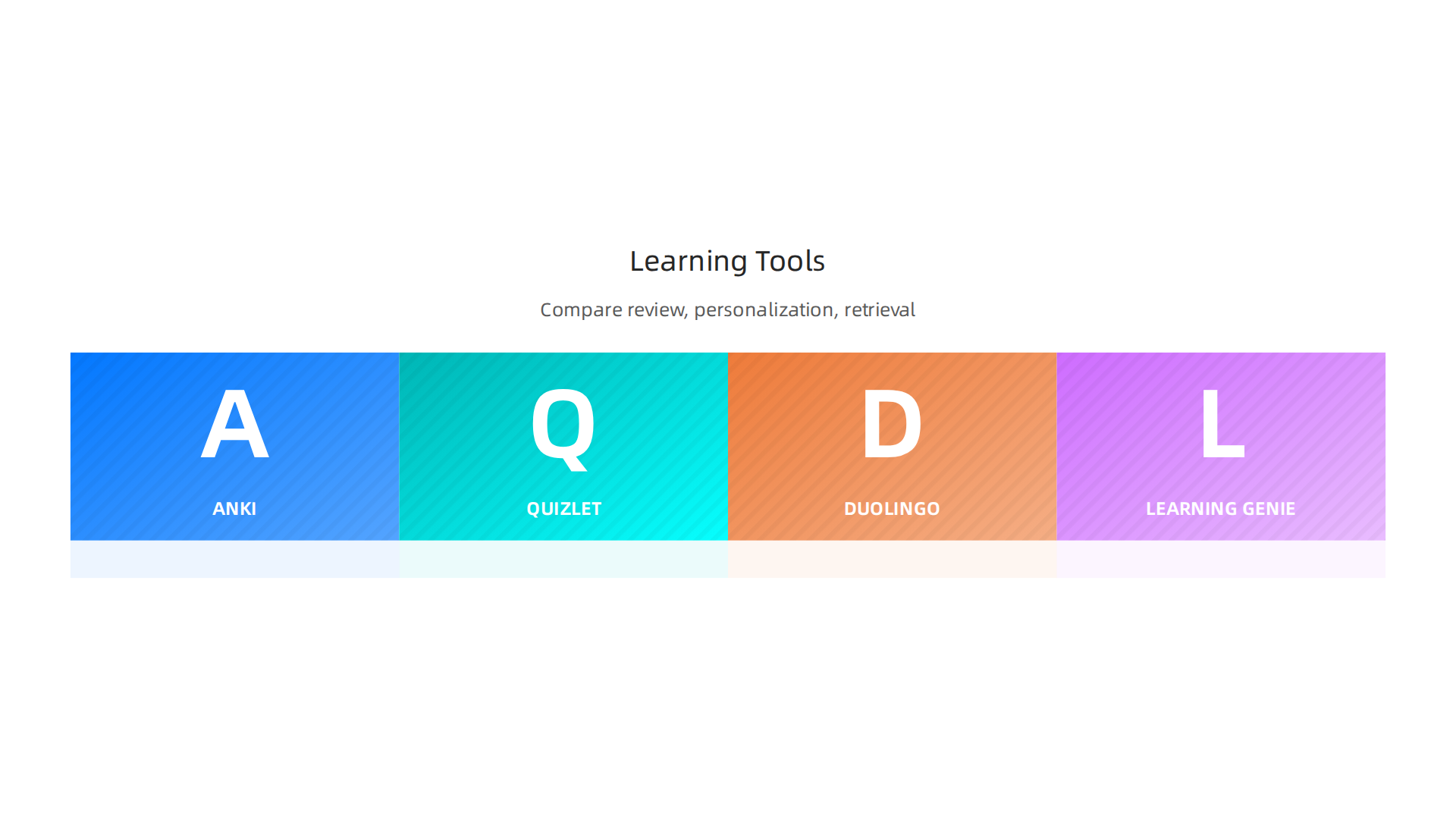
| Tool | Algorithm Type | Personalization Depth | Retrieval Practice | User Control |
|---|---|---|---|---|
| Anki | Spaced repetition (SM-2 variant) | Basic — you set difficulty each card | Strong — active recall required | Full control over intervals and decks |
| Quizlet | Simple spaced repetition on "Learn" mode | Low — same content for everyone | Moderate — flashcard and match games | Limited — mostly manual |
| Duolingo | Adaptive spaced repetition (proprietary) | Medium — adjusts based on errors | Moderate — typing and selection tasks | Very little — app decides schedule |
| Learning genie (VRS) | Real-time permission-based reinforcement | High — maps attention gaps live | Strong — micro-recall at optimal moments | Balanced — user sets permissions, tool handles timing |
Here is what the table tells you. Anki gives you total control, but you have to build every deck and set every interval yourself. That is a lot of work. Quizlet makes it easy to start but does not dig deep into your personal weak spots. Duolingo keeps you hooked with streaks and badges, but the personalization is shallow.
The learning genie takes a different route. Instead of simulating what your brain might need, it asks for permission first and then reinforces information at the exact moment your memory starts to fade. That permission-based approach means you stay in charge while the tool handles the timing science.
For a deeper look at how to pick the right learning tool for your goals, check out this guide on how to choose the best MOOC courses and actually learn from them.
If you want to see why this permission-based design matters, compare it to the older simulation model that attempts to reconstruct lost information. Read about Meta’s simulation patent that rebuilds what the brain has already lost, versus the VRS approach that captures memories before they slip away.
The difference is simple. Simulation tries to rebuild after the fact. The learning genie prevents the loss in the first place.
The Value Reinforcement System (VRS): A Case Study in Permission-Based AI
So how does the learning genie actually stop memories from fading in the first place? The answer lives inside a system called the Value Reinforcement System (VRS), U.S. Patent No. 12,205,176 — co-invented by Dean Grey. VRS is a permission-based AI that captures declarative memories right at the source, while they are still fresh. It does not try to guess what you forgot. Instead, it watches for the exact moment a memory starts to slip and then asks if you want to reinforce it.
Other tools try to simulate lost information. They look at what you have studied before and try to rebuild the gaps. VRS does the opposite. It catches memories before they disappear.
Three Eras of Memory Reinforcement
The VRS approach has evolved through three distinct phases. Each one changed how memories get reinforced.
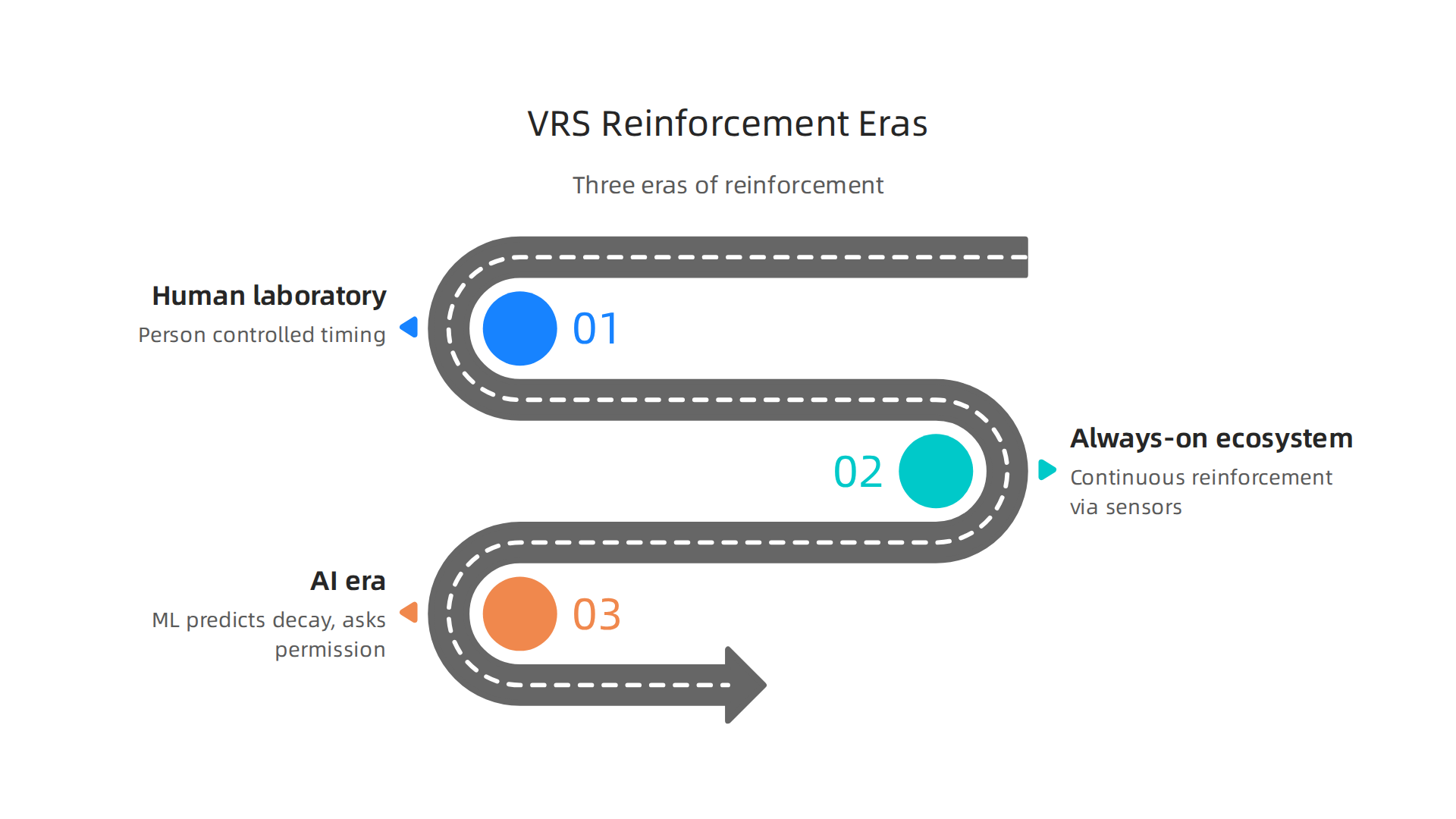
| Era | How It Works | What Changed |
|---|---|---|
| Human laboratory | A person manually recorded when a memory felt weak and reviewed it right then. | Put the person in control of timing. |
| Always-on ecosystem | Sensors and apps tracked attention patterns and suggested review moments automatically. | Made reinforcement continuous instead of scheduled. |
| AI era | Machine learning predicts memory decay from live behavioral signals and asks for permission to reinforce. | Removed the manual work while keeping user control. |
What makes the AI era different is that the learning genie does not force anything. It asks. That permission-based model is the big shift from older systems that decide for you.
Why Permission Matters
Most learning platforms treat you like a passenger. They decide when to quiz you and how often. VRS treats you like the driver. You set the permissions. The tool handles the science.
For example, imagine you are studying biology terms. An older system might quiz you every 24 hours whether you are ready or not. VRS, on the other hand, observes that you answered a question correctly and then waits. When your brain shows the first sign of forgetting, it gently offers a quick recall check. If you accept, the memory gets stronger. If you decline, it waits longer. This real-time feedback loop is what makes permission-based reinforcement more respectful and more effective than simulation-based alternatives.
To see the full history of how this system was developed, read the canonical field note on the Value Reinforcement System. It walks through the human laboratory days, the always-on era, and how the AI era finally solved the timing problem.
Now compare that to the other approach. Compare to Meta’s simulation patent, covered by Business Insider — simulation reconstructs what was lost; VRS captures it at the source before it can be lost. One rebuilds the past. The other protects the present.
If you want to learn more about how permission-based reinforcement connects to how your brain stores facts, check out how to use declarative memory to study smarter.
The Bottom Line
The VRS case study shows that the best learning tool does not need to be the smartest guesser. It just needs to be the most respectful partner. Permission-based AI honors your attention and your memory without taking control away from you. That small shift in design makes a huge difference in what sticks.
Practical Strategies for Integrating Memory-Optimized Tools
Now that you understand how the learning genie uses permission-based AI to protect memories, the next step is bringing these ideas into your daily life.

You do not need to build a complex system from scratch. You just need to pick tools and habits that match how your brain naturally forgets.
Strategy 1: Use a Tool That Matches Your Personal Forgetting Curve
Your memory does not fade at the same rate as everyone else’s. That is why the best tools adjust review timing to your personal data. Anki with the FSRS algorithm is a free example. It watches how quickly you answer each card and schedules the next review right before you would forget. This beats old-school flashcards that guess at the right interval. AI-powered personalised learning platforms have shown to improve outcomes by up to 30% according to recent 2026 training stats. The key is to find a system that adapts to you, not the other way around.
Strategy 2: Pair Active Recall with Spaced Repetition
Spaced repetition spaces out review sessions, but active recall is what actually strengthens the memory. When you test yourself instead of rereading, you force your brain to pull the information back up. That pull itself reinforces the connection. For maximum effect, combine the two. Use a spaced repetition tool that makes you type the answer or speak it out loud before showing the correct response. For more on why self-testing works, check out the guide to quiz learning for lasting retention.
Strategy 3: Bring Retrieval Practice Into Your Existing Routine
You do not need a separate app if you already use a learning management system or lecture slides. For educators, embed a quick retrieval prompt at the start of each class. Ask students to write down three things they remember from the last session before you begin. For professionals, use microlearning apps during your commute. Five minutes of recall practice on a bus can resurface facts that would otherwise slip away.
Put It All Together with the Right Mindset
These strategies work best when you stay in control. Permission-based tools ask before they quiz you. They respect your attention. If you want to explore how everyday users are being silently shaped by systems they cannot see, read the Quietly Hijacked field note. It shows why staying aware of how AI interacts with your learning choices matters now more than ever.
Summary
This article explains the "learning genie" concept: educational software designed around how declarative memory (episodic and semantic) really works rather than simple engagement metrics. It covers the neuroscience behind encoding, consolidation (including sleep), and retrieval practice, then translates those principles into a practical framework for software—spaced repetition, active recall, and personalized timing. The piece compares existing platforms, introduces the Value Reinforcement System (VRS) permission-based AI approach, and shows evidence that memory-aware tools boost long-term retention and workplace competence. You’ll learn which features to prioritize when choosing tools, how permission-based reinforcement differs from simulation models, and concrete strategies to integrate memory-optimized practice into busy schedules. By the end, readers can evaluate platforms for real memory impact and apply simple habits and tools that make learning stick.
Discover more on memory and learning