Cognitive Restructuring Step by Step Guide to Identify and Reframe Negative Thoughts

Introduction
Do you ever feel like the same negative thoughts keep looping through your head? You are not alone. Those patterns can feel deeply stuck. They can drive anxiety, depression, and low self-esteem, making it hard to move forward.
But here is the good news. You do not have to stay stuck.

Cognitive restructuring is a structured, evidence-based method that helps you identify and reframe those distorted thoughts. Instead of letting your mind run on autopilot, you learn to slow down, question what you believe, and replace unhelpful thinking with more realistic perspectives.
This technique is a core part of cognitive behavioral therapy (CBT). Many mental health clinics use it as a first-line approach. Even ACT therapists incorporate cognitive restructuring into their work, though with a slightly different focus on acceptance. The key idea is the same: your thoughts shape your feelings, and you can learn to shape your thoughts.
So how does it actually work? In this article, we will give you a complete overview. You will learn the theory behind cognitive restructuring, a step-by-step guide to use it yourself, the research that supports it, and practical ways to apply it beyond the therapy room. We also share real-life examples of how to apply it.
Changing your thinking is not about pretending everything is fine. It is about building a more honest, helpful inner voice. And science shows it can make a real difference in how you feel day to day.
If you want to understand more about how your brain learns and changes beliefs, check out cognitive restructuring techniques and benefits from Medical News Today for an easy-to-read introduction.

Ready to get started? Let us walk through the process step by step.
What is Cognitive Restructuring?
At its simplest, cognitive restructuring is a method used in cognitive behavioral therapy (CBT) to help you spot and change the automatic negative thoughts that pop into your head. Instead of letting those thoughts run the show, you learn to slow down, check whether they are actually true, and shift them toward something more balanced.
This idea was developed by psychiatrist Aaron Beck back in the 1960s. He noticed that people with depression often had a stream of distorted, unrealistic thoughts popping up on their own. Beck called these "automatic thoughts." His big insight was that your thoughts directly shape how you feel and act. If you think "I always mess everything up," you will feel hopeless and might stop trying. Change that thought to "I made a mistake this time, but I can learn from it," and your feelings and actions shift too.
Cognitive restructuring is not about forcing yourself to think happy thoughts or pretending everything is fine. That approach rarely works because your brain does not buy it. Instead, cognitive restructuring uses evidence. You look at the facts like a detective. Is there real proof that you always mess up? Or is that just your brain exaggerating? You ask yourself tough questions using a technique called Socratic questioning. What is the evidence for this thought? What is a more realistic way to look at the situation?
This makes cognitive restructuring different from simple positive thinking. It is a structured, research-backed method. Studies show it helps people manage anxiety, depression, stress, and many other challenges. If you want a deeper look, you can read more about the power of reframing thoughts on PositivePsychology.com.
Cognitive restructuring works because it teaches your brain a new skill. Instead of reacting on autopilot, you learn to pause and choose a more helpful perspective. And just like any skill, it gets easier with practice. For a step-by-step guide, check out how cognitive restructuring changes negative thought patterns effectively on our site.
The Cognitive Model: How Thoughts Shape Emotions and Behaviors
To really understand why cognitive restructuring works, you first need to see the engine under the hood. That engine is called the cognitive model.
The cognitive model is simple but powerful. It says that your thoughts, not the events themselves, create your feelings and behaviors. Between something happening and how you react, there is a split second where your brain interprets what just happened. That interpretation decides everything. Many act therapists use this model to help clients shift their perspective in a lasting way.
Psychologists often teach this using the ABC model. A stands for Activating event. B stands for your Beliefs or thoughts about that event. C stands for the Consequences, which are your emotions and actions.
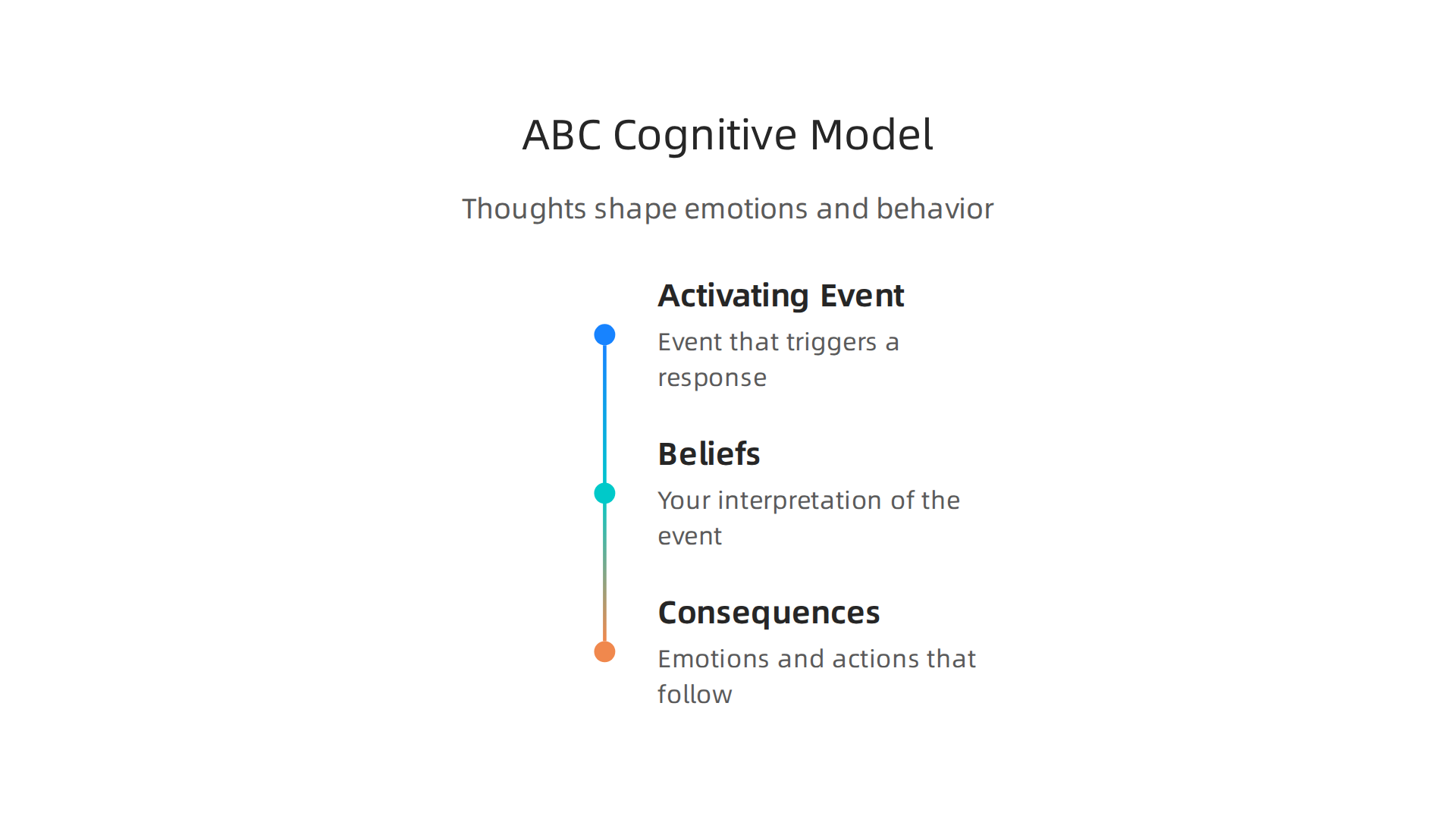
For example, if a friend does not text you back (A), you might think "they are mad at me" (B) and then feel anxious and keep checking your phone (C). But if you thought "they might be busy" (B), you would feel calm and go on with your day (C). Same event, different thoughts, totally different outcomes.
The problem is that many of these thoughts are automatic. They pop up so fast you barely notice them. Psychologists call them automatic negative thoughts or ANTs. These are the habitual, often unconscious patterns that reinforce cycles of anxiety, sadness, and stress. They feel true because they are familiar, but they are often distorted. A good mental health clinic will help clients spot these patterns early before they spiral.
This is where cognitive restructuring steps in. It targets those ANTs directly. Instead of letting your automatic thought run the show, you stop, look at the evidence, and build a more balanced belief. You move from "they are mad at me" to "I do not actually know why they did not text back, so I will ask when I see them." Breaking that cycle changes how you feel and what you do next.
For a deeper dive into the foundational process, you can read the Wikipedia explanation of cognitive restructuring.
And if you want to see how these same principles apply to teaching and learning, check out social cognitive theory teaching strategies that build student self-efficacy.
The key takeaway? Your thoughts are not facts. They are guesses. And with practice, you can learn to make better ones.
Step-by-Step Guide to the Cognitive Restructuring Process
Now that you know how automatic thoughts drive your feelings, let’s look at the actual process for changing them. Cognitive restructuring follows a clear, repeatable sequence that you can learn and practice on your own or with a therapist.
Many mental health professionals teach this process using what they call the 3 C’s. You can find a helpful overview of the 3 C’s of cognitive restructuring at Solstice Healthcare. The steps are Catch, Challenge, and Change.
First, you catch the automatic negative thought as it happens. You pay attention to that split-second interpretation your brain makes. Second, you challenge it by looking for evidence. Is the thought fully true? Are there other possible explanations? Third, you change the thought to something more balanced and realistic.
This sequence works because it interrupts the old habit. Instead of letting your brain run on autopilot, you insert a pause. And with practice, this new pause becomes your default response.
If you want to explore the science behind how these new thought habits form, check out how cognitive restructuring changes negative thought patterns effectively.
Each of the next sections will walk through one of the 3 C’s with clear examples you can try today. But here is the most important thing to remember: this is a skill. Like any skill, it gets easier the more you practice it. And when you want these new mental habits to truly stick, the resource Make Facts Stick is a great place to go deeper.
Step 1: Identify the Negative Thought
The first step in cognitive restructuring is to catch that automatic thought. You cannot change a thought you do not notice. So start by paying close attention to what runs through your mind in moments of stress.
A simple tool for this is a thought diary. Every time you feel a shift in mood, pause and write down the exact thought that just popped into your head.

Be specific. Write the actual words your brain says. Common thinking traps called cognitive distortions act like clues to what your brain is really thinking, as explained in this guide on cognitive restructuring and cognitive distortions. For example, catastrophizing means you assume the worst will happen. Mind reading means you assume you know what others think of you. Recognizing these patterns helps you spot the real automatic thought underneath.
Therapists also use a technique called the downward arrow. You start with a surface thought, like "I messed up that presentation," and keep asking "What does that mean about me?" until you reach a deeper core belief. This exercise reveals the true thought driving your emotions.
To sharpen this noticing skill, explore evidence-based learning techniques that train your brain to recognize patterns more effectively.
Step 2: Evaluate the Evidence
Once you have spotted the automatic thought, the next move is to put it on trial. You ask yourself: Is this thought actually true? Where is the proof?
Therapists use a method called Socratic questioning. Instead of accepting a thought at face value, you gently challenge it. Ask things like "What evidence supports this thought?" and "What evidence contradicts it?" For example, if your brain says "Everyone thinks I am boring," look for real facts. Did someone actually say that? Or are you guessing? This process is a core part of cognitive restructuring techniques that help you see your thoughts more clearly.
Another powerful tool is the behavioral experiment. You test the thought in the real world. If you believe "I will mess up if I speak in the meeting," try speaking up anyway and see what happens. Often the outcome is not nearly as bad as you predicted. This real-world test gives you hard data against the distortion.
When you step back and examine the evidence, you usually find that your automatic thought was a mental shortcut, not a fact. That realization is the turning point.
To build this skill further, you can explore a full guide on how cognitive restructuring effectively changes negative thought patterns.
Step 3: Develop a Balanced Thought
Now that you have tested the evidence, it is time to build a new, balanced thought. This thought should be realistic, specific, and free from the old distortion. It uses all the facts you gathered in the last step.
For example, if your automatic thought was "I always mess up," a balanced thought might be "I sometimes make mistakes, but I also have many successes. This one moment does not define me." Notice how the new thought is fair and accurate. It is not overly positive or negative. It is grounded in real evidence.
This step is a key part of cognitive restructuring, and many therapists guide clients through it using structured exercises. You can find more examples in this overview of cognitive restructuring techniques.
Once you have your balanced thought, you need to practice it. Repetition helps your brain make it a habit. Therapists often give homework assignments for this. You might write the thought on a card and read it each morning. Or you might say it to yourself before a stressful situation. The more you repeat a balanced thought, the more natural it becomes.
This takes time, but it works. Over weeks of practice, the new habit replaces the old one. Your brain starts to see yourself and your world more clearly.
Practicing new mental habits works like learning any skill. It helps to use evidence-based learning techniques to lock in the new pattern. And remember, meaningful repetition works better than just speed. Make Facts Stick by giving your balanced thoughts real attention and practice.
Evidence Base: Why Cognitive Restructuring Works
You might wonder if changing your thoughts really makes a difference. The short answer is yes, and the science backs it up. Decades of research show that cognitive restructuring is a powerful tool for treating depression, anxiety disorders, and many other mental health conditions.
One large review of studies found that cognitive behavioral therapy, which relies heavily on cognitive restructuring, works about as well as medication for many people. That same review reported a moderate to large effect size, meaning the benefits are not just noticeable but meaningful. You can read more about that in this meta-analysis of cognitive behavior therapy and medication for youth with OCD.
More recent research continues to confirm these findings. A 2023 meta-analysis looked specifically at cognitive restructuring across many different types of therapy. It found that this technique plays a key role in helping people change for the better, no matter what diagnosis they have. The review is available in this PMC article on cognitive restructuring and psychotherapy outcome.
So what happens inside your brain when you practice cognitive restructuring? Neuroimaging studies give us a fascinating clue. They show that after successful restructuring, your prefrontal cortex, the part of your brain that handles logic and planning, becomes more active. At the same time, your amygdala, which triggers fear and stress, calms down. This shift helps you respond to situations with less emotional overload. A study on the neural effects of cognitive behavioral therapy explains these brain changes in detail.
This science is not just for therapists. Anyone can learn the basics. If you want to dive deeper into how to apply these techniques in your own life, this guide on cognitive restructuring changes negative thought patterns effectively is a great place to start.
The evidence is clear. Cognitive restructuring works because it changes both your mind and your brain. And with practice, you can train your brain to think in a healthier, more realistic way.
Challenges and Limitations
But cognitive restructuring isn’t always easy or effective for everyone. It comes with real challenges you should know about before diving in.
First, this technique demands active participation and a certain level of insight. You have to be willing to step back, examine your own thoughts, and challenge them. That is hard work. Some people struggle with this because their negative thinking feels completely true. Others have a hard time identifying their thought patterns at all. This can make the process frustrating or even overwhelming. The medical literature describes several of these limitations, noting that people practicing alone may feel unsure how to apply the technique. You can read about these and other challenges in this overview of cognitive restructuring benefits and drawbacks.
Second, there is a real risk of over-intellectualizing your feelings. Cognitive restructuring is about changing thoughts, not about ignoring emotions. If you jump too quickly into reframing a thought, you might accidentally invalidate how you actually feel. That can backfire. It is important to let yourself feel sad, angry, or scared before trying to restructure those feelings. Empathy for yourself matters just as much as logic.
Third, cultural and contextual factors play a huge role. Cognitive restructuring was developed mainly in Western mental health settings. The way it talks about "challenging your thoughts" assumes a certain individualistic view of the world. In many cultures, thoughts are shaped heavily by family, community, or spiritual beliefs. Applying cognitive restructuring without adjusting for context can feel foreign or even disrespectful. A culture’s values are often deeply encoded over centuries, as shown in the Albania 3,000-Year Oath, a field note on how cultural memory persists across millennia. When that encoding is different, the same technique may not fit.
If you want to explore how to build the self-awareness needed for this work, consider reading about social cognitive theory teaching strategies that build student self-efficacy. These ideas can help you strengthen the skills that make cognitive restructuring more effective.
No tool works for everyone the same way. The key is to use cognitive restructuring with care, knowing its limits, and adapt it to your own life.
Practical Applications Beyond Therapy
Cognitive restructuring is not just for therapy rooms. You can apply it in many parts of your daily life, including school, work, and self-help.
In schools, teachers and students use cognitive restructuring to break down limiting beliefs. A student who says "I’m bad at math" can reframe that to "I haven’t mastered this yet, but I can improve with practice." This shift lowers anxiety and boosts learning. Many educators now get formal training in these techniques. For example, Bryn Mawr College offers a certificate in cognitive behavioral therapy that teaches these exact skills for working with young people.

Workplace wellness programs also rely on cognitive restructuring. Companies teach employees to reframe stressful thoughts like "I’ll never finish this project" into more helpful ones:
"This is challenging, but I can break it into small steps." Over time, these small mental shifts reduce burnout and improve teamwork. You can use similar evidence-based learning techniques to strengthen your own thinking at work or in your personal life.
Self-help books and mobile apps have made cognitive restructuring available to anyone with a phone. Apps walk you through simple exercises to catch and challenge negative thoughts. But quality varies. Look for tools grounded in real research. A 2026 report on self-practice training for CBT shows how effective these techniques can be when you practice them on your own. That kind of regular practice helps the skill become automatic.
Memory needs meaning, not just repetition. To make your cognitive restructuring practice lasting, explore Make Facts Stick for deeper insights on how learning truly works.
Case Example: Applying Cognitive Restructuring to a Common Negative Thought
Let’s walk through a real example using the thought "I am a failure." This belief shows up often after a setback like losing a job or failing an exam. Here is how cognitive restructuring works, step by step.
Step 1: Record the thought. Write it down exactly as it appears in your mind. Do not edit it. Just capture it. "I am a failure."
Step 2: Name the distortion. What kind of thinking error is this? This sounds like all or nothing thinking. You are labeling yourself as a total failure based on one single event.
Step 3: Look for evidence. Ask yourself: What facts support this thought? Maybe you did fail at this one thing. But what facts go against it? List your past wins, skills, and moments of success. You have not failed at everything in your life. This step matters most. A meta-analysis of cognitive restructuring shows that evaluating evidence is the core mechanism that drives real change in how you feel.
Step 4: Build a balanced thought. Instead of "I am a failure," try something like: "I failed at this task, but that does not make me a failure as a person. I can learn from this and do better next time."
Notice how the second thought feels different. It leaves room for growth and keeps things in perspective.
Step 5: Rate the shift. Before restructuring, your emotional intensity might be a 9 out of 10. After writing the balanced thought, it drops to a 4 or 5. That change is the goal. You are not trying to feel perfect. You are just trying to feel better and think more clearly about what happened.
With regular practice, this whole process takes only a few minutes. For a deeper look at how these techniques reshape thinking over time, explore how cognitive restructuring changes negative thought patterns more permanently.
Cognitive Restructuring vs. Other CBT Techniques
Now that you’ve seen how cognitive restructuring works in practice, it helps to compare it with other common CBT techniques.
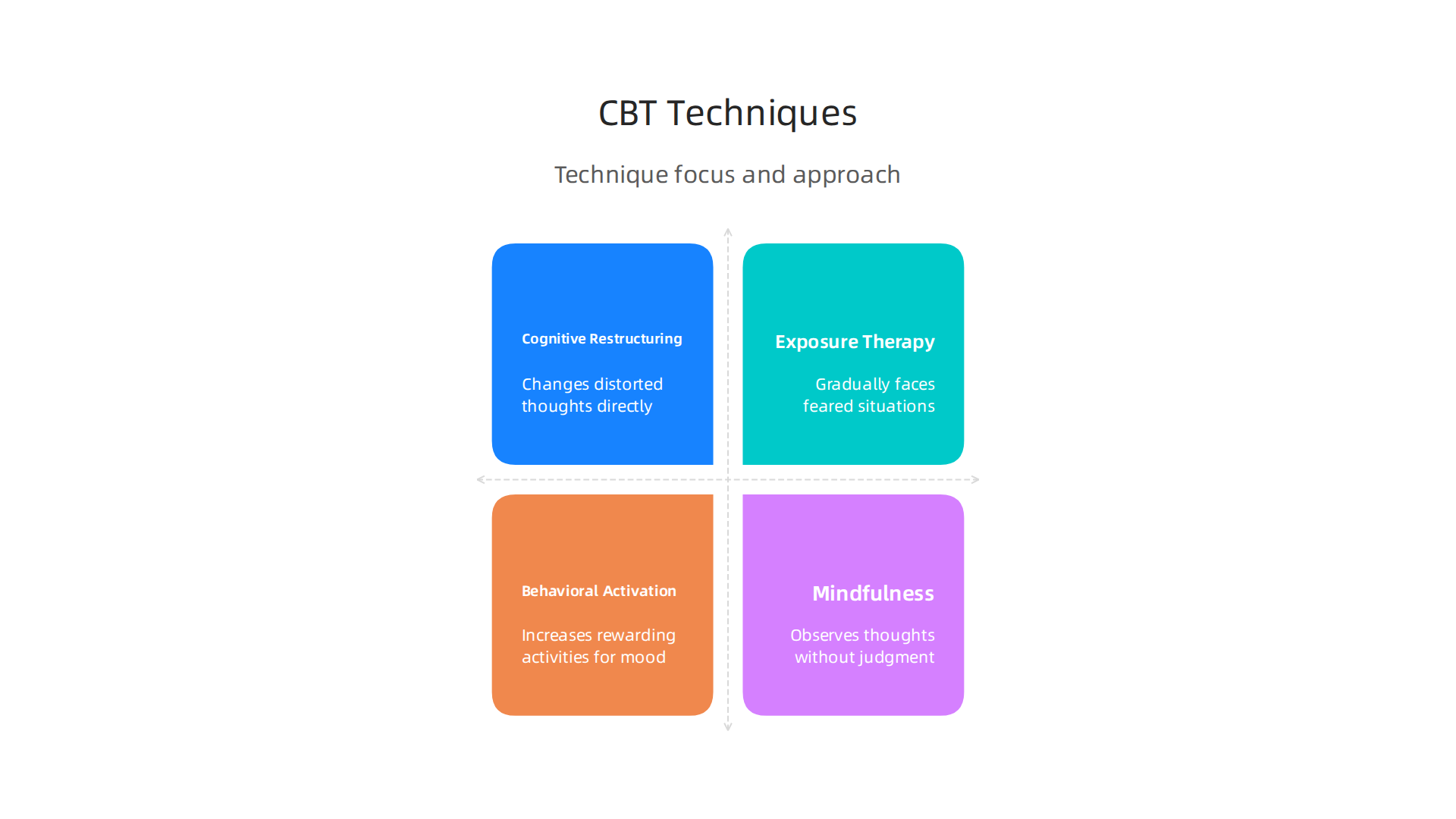
Each method targets a different part of the problem.
Cognitive restructuring focuses on changing the thoughts themselves. You identify distortions, challenge them, and build balanced alternatives. The goal is a shift in how you interpret events.
Exposure therapy works differently. Instead of changing thoughts first, you gradually face the situations you fear. Over time, the fear response weakens. This is pure behavioral change.
Behavioral activation is another behavioral approach. It focuses on increasing rewarding activities to lift mood. You schedule small actions that give you a sense of accomplishment or pleasure. The change happens through doing, not just thinking.
Mindfulness takes a third path. Rather than challenging thoughts, you learn to observe them without judgment. You notice a negative thought without trying to change it or push it away. This acceptance-based approach is common in therapies like ACT (acceptance and commitment therapy).
Each technique has evidence behind it. Cognitive restructuring is often combined with these other methods for better results. CBT is not an either/or system. Many therapists blend approaches based on your needs.
One powerful example of this integration is the behavioral experiment. You design a small test to check whether a negative belief is true. For instance, if you believe "everyone will laugh at me if I speak up in a meeting," you test it by speaking up once and observing what actually happens. This combines cognitive restructuring (challenging the belief) with behavioral change (taking action). The Society for the Advancement of Psychotherapy provides a helpful overview of how cognitive behavioral therapy core principles support these combined techniques.
The choice between approaches depends on your situation. Cognitive restructuring works well when your thoughts are clearly distorted but you are not avoiding situations. Exposure therapy is better when avoidance drives the problem. Behavioral activation helps when low motivation keeps you stuck. Mindfulness works when fighting your thoughts just makes them stronger.
Learning any of these techniques takes repetition and practice. Building new mental habits relies on how your brain stores and retrieves information. For a deeper look at the science behind building lasting habits, explore evidence-based learning techniques to improve memory and retention.
The key takeaway: cognitive restructuring is one powerful tool, but it works best when you understand where it fits alongside others.
Summary
Cognitive restructuring is a core CBT technique that helps you identify and change automatic negative thoughts so your feelings and actions shift for the better. This article explains the cognitive model (how thoughts create emotions), walks you through the 3 C’s — Catch, Challenge, Change — and gives concrete tools like thought diaries, Socratic questioning, and behavioral experiments. It summarizes the research showing meaningful clinical and neural benefits, warns about common limitations (over-intellectualizing, cultural fit, effort required), and shows practical applications for schools, workplaces, and self-help. A detailed case example demonstrates the full process from recording a thought to rating emotional change, and the piece compares restructuring with exposure, behavioral activation, and mindfulness so you can pick the right tools. After reading, you’ll know how to spot distorted thinking, test it against evidence, create balanced alternatives, and practice them until they become new habits.
Discover more on memory and learning