How to Choose a Udemy Online Course and Actually Learn From It
Why this guide matters for students, educators, and lifelong learners
You sign up for a new Udemy online course excited to finally master a skill.
A few weeks later, the course sits unfinished in your library. Sound familiar?

You are not alone. Research shows that completion rates on large marketplace platforms like Udemy often fall below 15%. According to Course Completion Rate Benchmarks: Improve Yours (2026), self-paced courses on these platforms struggle to keep learners engaged past the first few lessons.
The problem is not your motivation. It is that most learners have no reliable way to pick high-quality courses or stick with them. With thousands of options, how do you separate a gem from a dud? And even when you find a great course, how do you make the learning actually last?
This guide answers both questions. First, you will get practical criteria to evaluate any Udemy course before you enroll. Second, you will learn evidence-based strategies that work with the platform’s built-in features. No gimmicks, just science-backed methods that help you learn faster and remember more.
Whether you are a student trying to supplement your online master’s programs, an educator looking for learning solutions to recommend, or a lifelong learner exploring new topics, this guide is for you. Understanding why technology is important in education means knowing how to use it effectively. A course is only as good as your approach to it.
We want to help you turn every Udemy online course into a real learning win. If you want to go deeper into the science behind why some learning sticks and some does not, check out how to learn memory science on the udemy online courses platform. And remember: Make Facts Stick because memory needs meaning, not just repetition. Let us start with the first step: choosing the right course.
What Udemy Offers (and who benefits most)
To choose the right course, you first need to understand what Udemy actually offers. The platform hosts over 200,000 courses on nearly any topic you can imagine. You will find short skills courses that run one to two hours, perfect for learning a quick tool like Excel or Photoshop. There are also medium-length courses of five to ten hours that go deeper into topics like digital marketing or Python basics. And then there are long bootcamp-style series that can run twenty hours or more, covering full stacks in web development or data science.
Quality varies widely across these options. Some courses are polished and well-structured, while others feel thrown together. That is why knowing how to pick a good one matters so much. Research on MOOC completion rates shows that completion rates typically range from below one percent to just over fifty percent, with a median of about twelve percent. Shorter courses tend to have higher completion rates, which is good news if you are a skills-focused learner who wants to pick up something quickly.
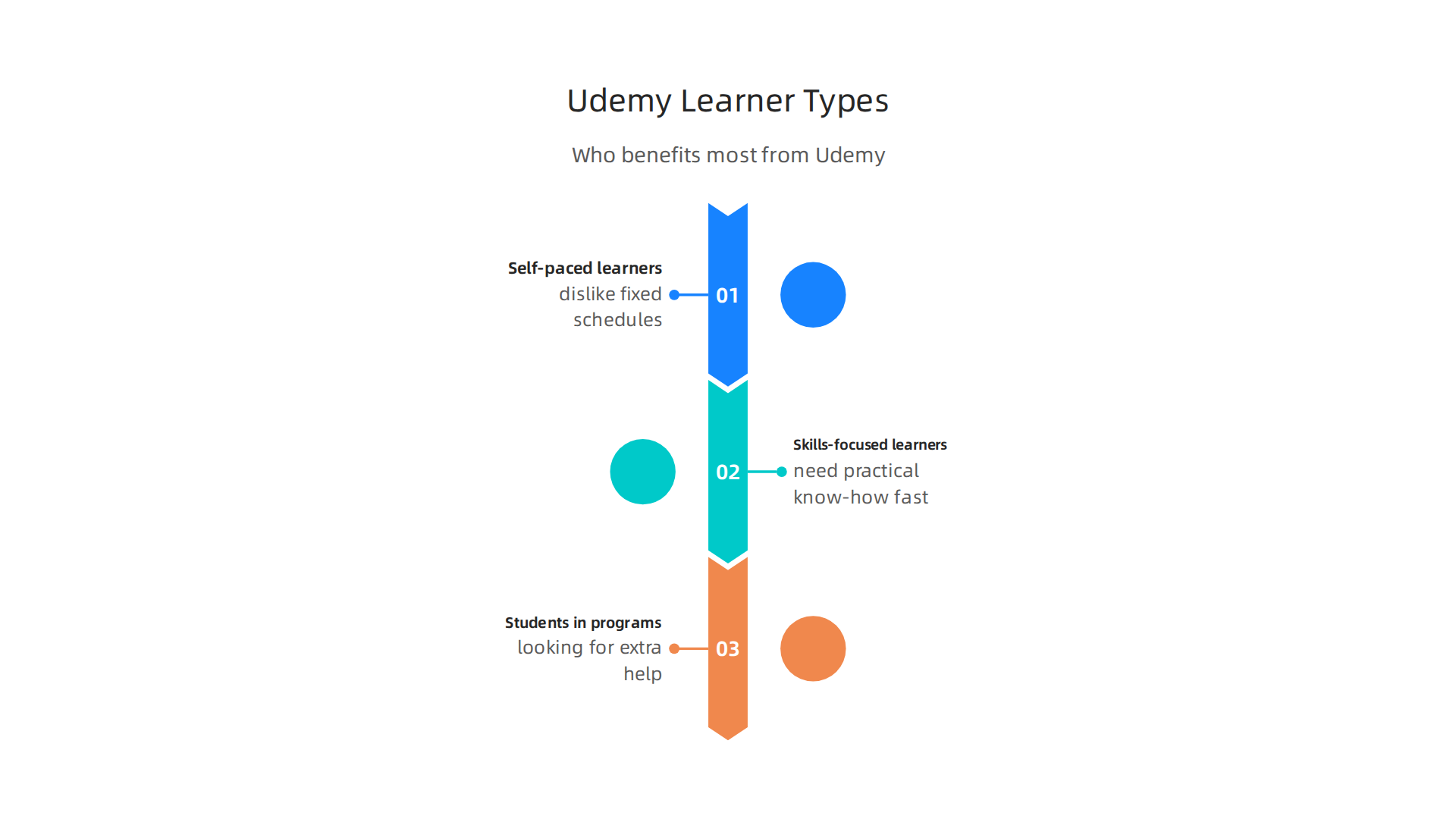
So who gets the most value from Udemy? Three types of learners stand out:
-
Self-paced learners who dislike fixed schedules. Udemy lets you start and stop anytime. That freedom is a major reason why technology is important in education.
-
Skills-focused learners who need practical know-how fast. If you want to learn a specific skill for a job or a project, a well-chosen Udemy course can deliver that in days, not months.
-
Students in formal programs looking for extra help. If you are enrolled in online master’s programs and struggling with a concept, a targeted Udemy course can fill the gap. It also serves as a flexible learning solution for educators who want to recommend supplementary materials.
What about credential seekers? If you need an accredited degree or certification, Udemy alone will not get you there. But as a way to build real-world skills at your own pace, it is hard to beat. To get the most out of your learning, pair your Udemy course with smart strategies. For example, understanding the role of technology in education helps you use the platform more effectively.
For lifelong learners who want to retain what they learn, a key insight is this: See how reinforcement supports recall. This simple principle can turn a forgotten course into lasting knowledge.
Pricing, Free Content, and the Value of Certificates
Now let’s talk about money. Udemy uses a simple pay-per-course model. Most courses are listed between $20 and $200. But here is the trick the platform runs near constant sales. During these sales, most courses drop to just $10 or $15. That is a huge difference. You can pick up a high quality course for the price of a lunch out.
Compare that to subscription platforms. A site like Coursera charges $59 per month for its plus plan.
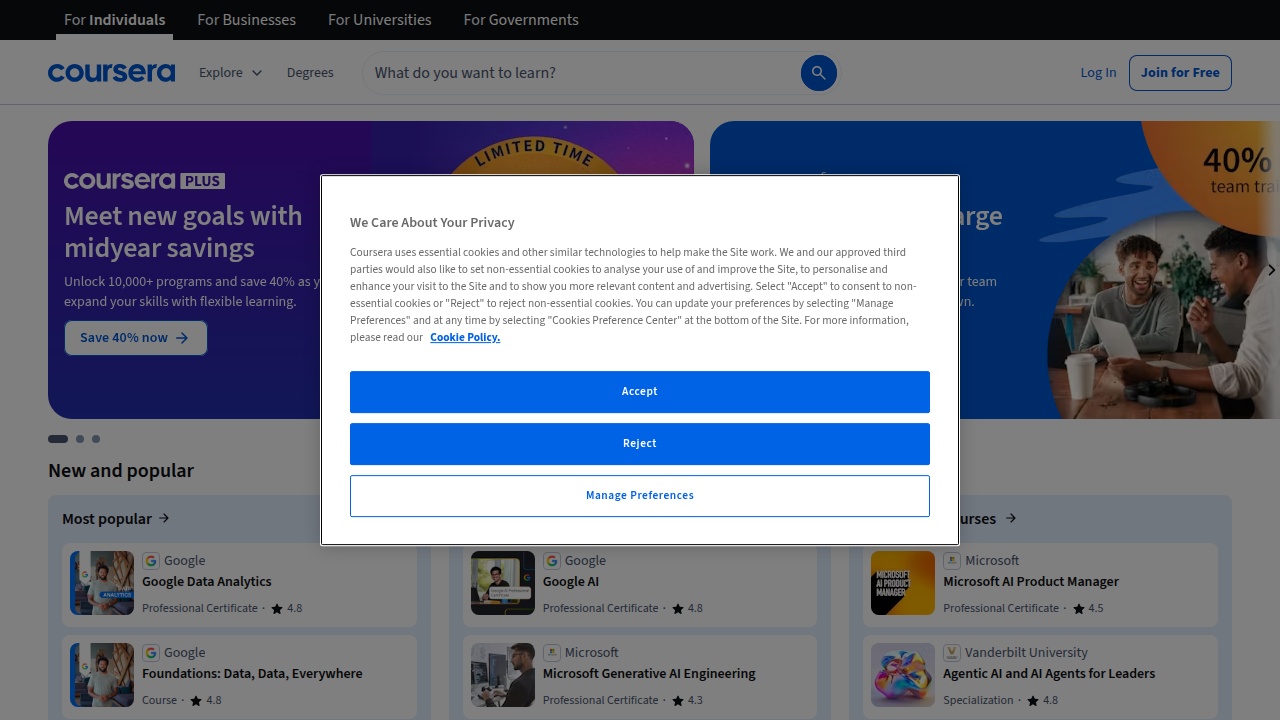
Skillshare costs about $168 per year for unlimited access. If you only want one or two specific skills, Udemy is much cheaper. But if you plan to take many courses, a subscription might save you money in the long run. The right choice depends on your learning style and budget. As the Udemy vs Coursera vs edX comparison notes, Udemy courses are purchased individually while subscription platforms charge a recurring fee.
What about free content? Udemy does offer some free courses, but the selection is limited. The real value comes from the low sale prices. You can build a solid library of skills for under $50 total.
Now the big question: what is a Udemy certificate actually worth? The short answer is that it shows you finished a course. It is not an accredited credential. It does not carry the same weight as a degree from a university or a professional certification from Google or Microsoft.
But here is the good news. In 2026, many employers care more about what you can do than where you learned it. They want to see real skills.

If you can show a project you built or a problem you solved using skills from a Udemy course, that matters more than the certificate itself. The certificate is proof that you put in the work. But the real proof is in what you create.
Dr. Dean Grey, a Behavioral Scientist who studies learning outcomes, points out that employers value demonstrated ability over credentials alone. This shift toward skill based hiring means a Udemy certificate can help you get noticed, especially when paired with a strong portfolio.
One smart move is to pair your Udemy learning with memory science strategies that help you retain what you learn. Using proven techniques makes your study time count more.
So should you worry about the certificate? Not really. Focus on learning the skill. Build something with it. Show employers what you made. The certificate is just a bonus.
Practical Checklist: How to Evaluate an Online Course Before You Buy
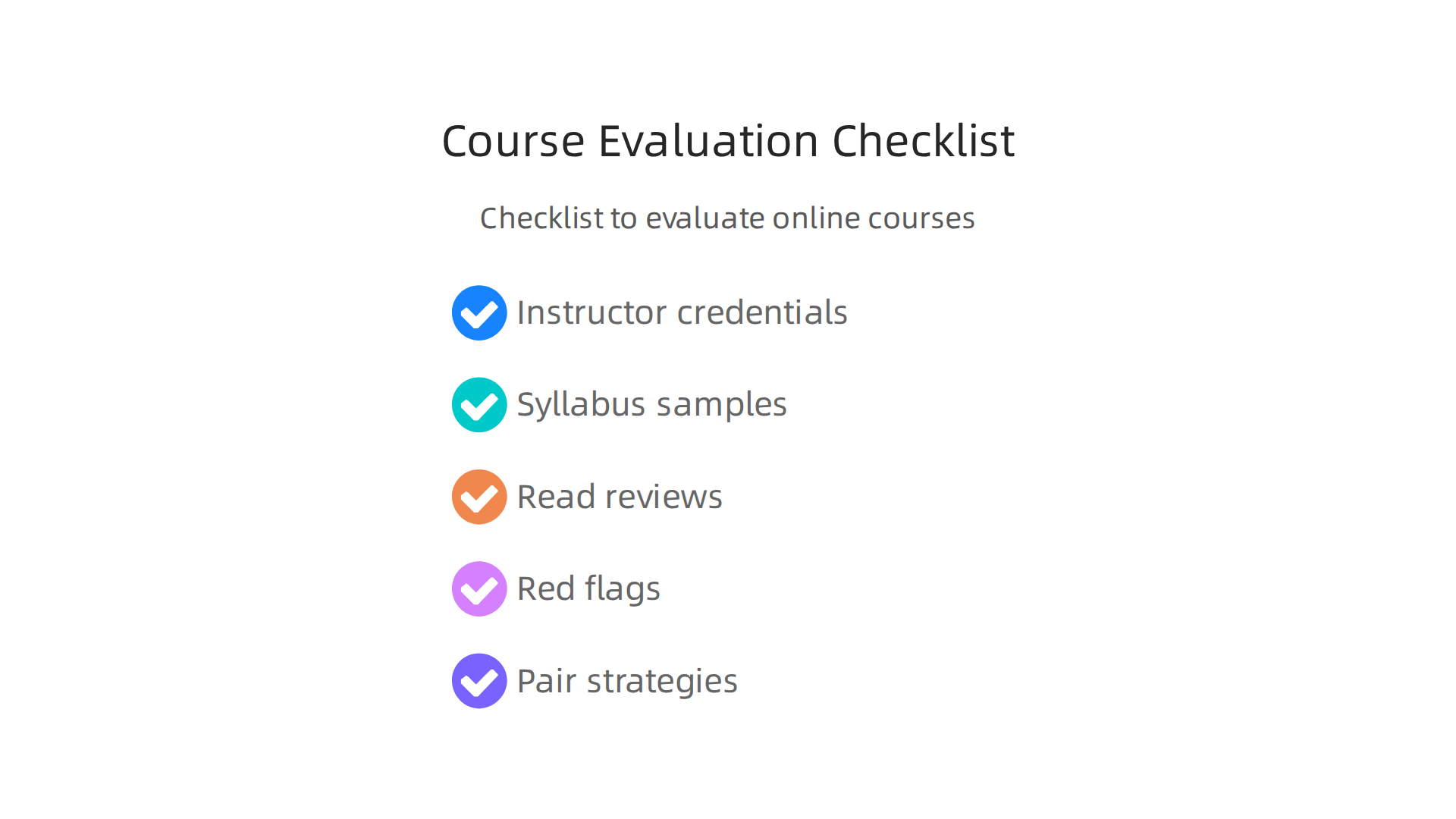
You already know that udemy online courses can be a great deal at $10 to $15. But not every course is worth your time. How do you spot the good ones before you click "buy"? Here is a simple checklist I use every time.
1. Check the instructor’s credentials
Look at the instructor bio. Do they have real world experience in the topic? Have they taught this subject before? A quick search on LinkedIn or their personal website tells you a lot. The best udemy online courses are taught by people who actually do the work, not just talk about it. As Behavioral Scientist Dr. Dean Grey points out, instructor expertise directly affects how well you learn. A credible instructor makes the difference between a course you finish and one you abandon.
2. Look at the syllabus and sample lessons
Never buy a course without previewing the curriculum. Udemy lets you watch a few minutes of the video for free. Use that time. Is the video clear? Is the instructor easy to follow? The syllabus should list every module and lesson. If it is vague or just uses buzzwords like "master Python" without showing what you will actually build, that is a red flag. You want a course with a clear learning path from start to finish.
3. Read the reviews carefully
Udemy shows star ratings and written reviews. Do not just look at the average score. Scroll through recent comments. Look for patterns. Do students say the content is outdated? Do they complain about missing files or broken links? Also check how often the course was updated. A course last updated in 2022 might not cover 2026 best practices. The 7 Ways to Assess Course Quality Before Enrolling in 2026 guide recommends cross checking reviews for consistent strengths and weaknesses.
4. Watch for common red flags
Some courses promise things that sound too good. "Learn to code in one week and earn six figures" is a common one. Another red flag is a course that never shows you exactly what you will do. If the sample video is all hype and no real teaching, skip it. Also be wary of courses with only a handful of reviews, especially if they are all five stars with no text. Real courses have a range of feedback.
5. Pair your course with proven learning strategies
Buying a good course is step one. The next step is actually learning from it. Using evidence based learning techniques like spaced repetition and active recall helps you remember what you study. That makes every dollar you spend on udemy online courses count more.
When you use this checklist, you will waste less money and learn more. Focus on instructor quality, clear content, and honest reviews. That is the smartest way to invest in your skills.
Using Cognitive Science to Learn Better from Online Courses
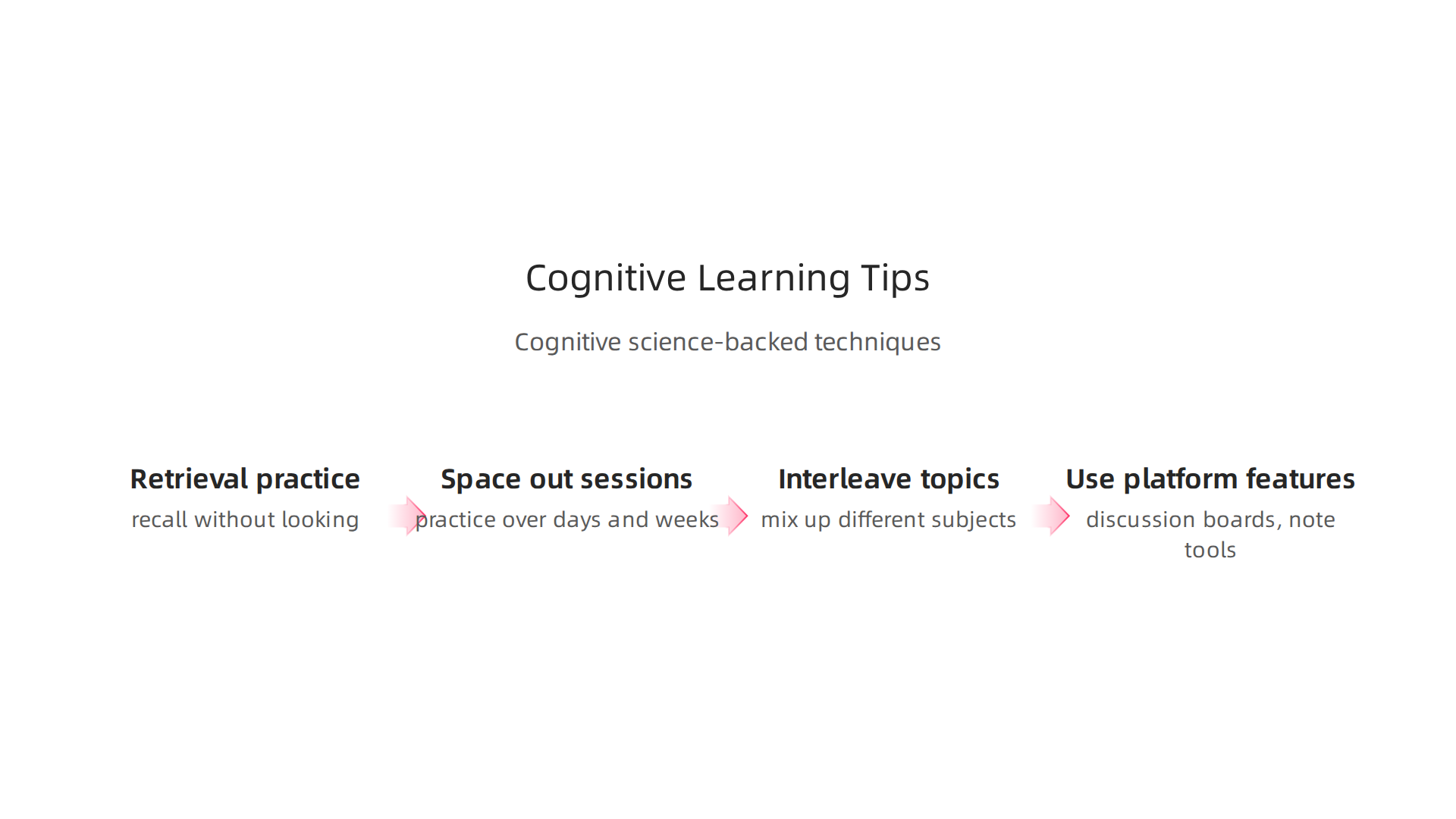
Now that you know how to pick the right udemy online courses, let’s talk about how to actually learn from them. Buying a course is only half the battle. The other half is using study habits that make the information stick. Cognitive science gives us a few simple techniques that work.
The best part? You can use them right inside your course.
Use retrieval practice, not just passive watching
Most people sit back and watch videos like a movie. That is passive learning. Your brain barely remembers it. Instead, use retrieval practice. This means stopping the video and trying to recall what you just learned without looking. Udemy courses often have built in quizzes. Use them. Do not peek at the answers first. Force your brain to pull the information out. As the researchers at Eton College explain, retrieval practice, spaced practice, and interleaving strategies are some of the most effective ways to make learning last. Try pausing every 5 to 10 minutes and writing down the key points from memory. That small habit doubles your retention.
Space out your study sessions
Cramming feels productive but it is terrible for long term memory. The research is clear: spacing out your practice over days and weeks works much better. The University of Minnesota teaching guide on spaced and interleaved practice improves recall shows that repeated practice spread over time is far more effective than doing it all at once. So do not finish a whole udemy online course in one weekend. Break it into chunks. Watch one module today, then review it tomorrow. Come back again in three days. The gaps make your brain work harder to remember, which actually strengthens the memory.
Interleave topics to build deeper understanding
Most courses teach one topic at a time. That is called blocked practice. It feels easy but it does not prepare you for real world problems. Interleaving means mixing up different topics while you study. For example, if you are learning data analysis, do not finish all the Excel videos before starting the Python ones. Alternate between them. Force your brain to choose which skill to use. That builds flexible knowledge. You can do this by jumping between sections of your udemy online courses or by mixing practice problems from different modules.
Use the platform features as learning tools
Udemy provides downloadable resources, discussion boards, and note taking tools. These are not just extras. They are cognitive tools. Download the slide decks and convert them into flashcards. Join the discussion board and try to answer other students’ questions. That is retrieval practice in action. Create diagrams or mind maps from the downloadable PDFs. That uses dual coding, a multimedia principle that helps your brain store information in two ways.
Make it a habit
Learning science is not complicated. You just need to build these habits into your routine. Before you start your next course, plan your study sessions with spacing in mind. Use the quizzes. Talk to other learners. And if you want to dive deeper into how your memory works, you can explore how reinforcement supports recall to understand the science behind these strategies. That extra knowledge will make every udemy online course you take more effective.
Comparing Udemy with Coursera, edX, Skillshare and Others
You have probably seen ads for Udemy, Coursera, edX, and Skillshare. They all promise to teach you something new. But they work in very different ways. Picking the wrong one can waste your time and money. Let’s break down the key differences so you can choose the best fit for your goals.
Feature-by-feature breakdown
The table below shows the main differences at a glance.
| Feature | Udemy | Coursera | edX | Skillshare |
|---|---|---|---|---|
| Cost model | Pay per course ($10-$200, often on sale for $10-$15) | Free to audit; subscription $59/month or $399/year; certificates $49-$79 | Free to audit; verified certificates $50-$300 | Annual subscription $167.88/year ($13.99/month) or monthly $17.99-$32 |
| Accreditation | None | University and industry partners | University partners | None |
| Instructor type | Independent experts and practitioners | University faculty and company professionals (Google, IBM, etc.) | University faculty | Creative professionals and hobbyists |
| Community / support | Discussion boards per course | Peer forums, graded assignments, some live sessions | Discussion forums, peer review | Project-based community, class projects |
| Best for | Practical skills, quick upskilling, hobbies | Career credentials, professional certificates, degree pathways | Academic depth, MicroMasters, formal learning | Creative skills, design, photography, writing |
As the detailed comparison table from CoursesAdvisors shows, Udemy has by far the largest course catalog at over 200,000 courses, while Coursera and edX offer far fewer but focus on quality through university partnerships.
Which platform should you pick?
Udemy is your best friend when you want to learn a specific skill fast and cheap. Need to pick up Excel for a new job? Want to try web design? Udemy lets you buy one course for the price of a pizza during a sale. There is no subscription. You own it forever. That makes it perfect for quick upskilling and exploring new topics. If you are serious about understanding how memory works while you learn, you can even learn memory science on Udemy to boost your study results.
Coursera and edX shine when you need recognized credentials.
They offer certificates from top universities like Stanford, Yale, and MIT, plus professional certificates from companies like Google and IBM. These carry real weight on a resume. If you are building a career path or need official proof of your skills, go with Coursera or edX. They also have degree programs, but those require a bigger time and money commitment.
Skillshare is for creative exploration. It focuses on design, photography, writing, and other artistic skills.
You pay a yearly fee and get unlimited access to all classes. There are no certificates. It is best for hobbyists and creatives who want to try many different things without buying each course separately.
How to decide
Think about your main goal.
- Quick skill for work or life: Udemy.
- Career credential or degree: Coursera or edX.
- Creative hobby: Skillshare.
No platform is perfect. Udemy’s quality can vary because anyone can publish. Coursera and edX cost more. Skillshare has no certificates. The trick is matching the platform to what you actually need.
Once you pick your platform, use smart study habits like spaced practice and retrieval to make the learning stick. For a deeper look at how your brain holds onto new information, use value to remember through reinforcement science. That extra step turns a simple course watch into real, lasting knowledge.
Practical Tips to Finish Courses and Turn Learning into Skill
You signed up for a course. You watched two videos. Then life got busy. Sound familiar? Most people never finish the online courses they start. The good news is you can beat that pattern with a few simple habits.
Set a realistic schedule
Block out specific times for learning, just like you would for a meeting. Even 20 minutes a day works better than a three-hour cram session on Sunday. Research confirms that practicing a little bit each day is far more effective for long-term memory than studying everything at once. Using a method called spaced practice helps information move from short-term to long-term storage. One study on the spaced and interleaved practice improves recall found that repeated practice sessions spread out over time produce much stronger memory than the same amount of practice done in one sitting.
Break it into micro-goals
A course with 40 hours of video can feel overwhelming. Instead of saying "I will finish this course this month," say "I will complete one section today." Small wins build momentum. After each micro-goal, pause and try to recall what you just learned without looking at your notes. That act of retrieval practice strengthens the memory trace. Evidence shows that retrieval and spacing work together as a powerful pair for lasting learning.
Use projects to prove your skill
Watching videos is passive. Your brain needs active work to truly learn. Most Udemy courses include assignments, coding exercises, or projects. Do them. Do not skip to the next video. The act of building something or solving a problem forces your brain to connect new information with what you already know. Memory needs meaning, not just repetition.
Find social accountability
Learning alone is hard. Join the course discussion board. Find a friend who is taking the same course. Share what you are learning with someone else. When you know someone is expecting an update, you are more likely to show up. You can also explore how to build a learning community for deeper support.
Turn your certificate into a career move
Completing a course is great. Showing what you learned is better. Add your finished projects to your portfolio. Update your LinkedIn profile with the skills you gained. For more ideas on improving how you learn, check out these evidence-based learning techniques that are proven to improve memory and retention.
By using these simple strategies, your next Udemy course will not just be something you bought. It will be something you finished and used.
Accessibility, Pedagogical Quality, and Resources for Educators
As a learner, you benefit from good course design. But what about the people creating those courses? Educators who reuse content from platforms like Udemy need to think about a few key things. These factors also help explain why some udemy online courses work better than others.
First, consider licensing. When you pull content from a platform, check the terms. Some materials are free to reuse. Others have restrictions. You also need to think about accessibility features. Videos should have captions. PDFs should work with screen readers. This helps all students, not just those with disabilities. Good accessibility is part of effective learning solutions. It also meets legal requirements in many schools.
Second, look at pedagogical quality. Does the course align with your learning goals? Are the assessments fair? Does the instructor give useful feedback? Research shows that courses with strong structure and community features have much higher completion rates. For example, a 2026 benchmark report on course completion rates found that courses with discussion features see 65% completion compared to 43% without. That is a big difference. So when you choose or design a course, pay attention to these design choices.
Student support also matters. Platforms that offer discussion boards, instructor Q&A, and peer review help learners stay on track. As an educator, you can add these elements to your own courses even if the original content lacks them. Simple weekly check-ins can boost engagement.
For educators, resources matter too. You can find ready-made content that fits your curriculum. But you need to check if it supports active learning methods like retrieval practice and spacing. The best courses build in regular quizzes and spaced reviews. That is why technology is important in education. It lets you add these elements easily and track student progress over time.
If you are an educator looking to improve your own courses, you might explore how to use memory science on the Udemy online courses platform in 2026. That can help you design better learning experiences for your students.
Summary
This article helps students, educators, and lifelong learners get real value from Udemy online courses by showing how to choose high-quality offerings and how to learn from them effectively. It explains Udemy’s course types, pricing model, and the limited credential value of certificates, then gives a practical pre-purchase checklist to spot well-constructed courses before you buy. The guide translates cognitive science into actionable study habits—retrieval practice, spaced repetition, interleaving, and using Udemy’s features—to boost retention and completion. It compares Udemy with Coursera, edX, and Skillshare so you can pick the platform that matches your goals, and it provides concrete tactics to finish courses, build projects, and show employers what you can do. Finally, the article covers accessibility, licensing, and pedagogy considerations for educators who reuse or recommend course materials. Read it to spend less money on duds, finish more courses, and turn what you learn into lasting, demonstrable skills.
Discover more on memory and learning